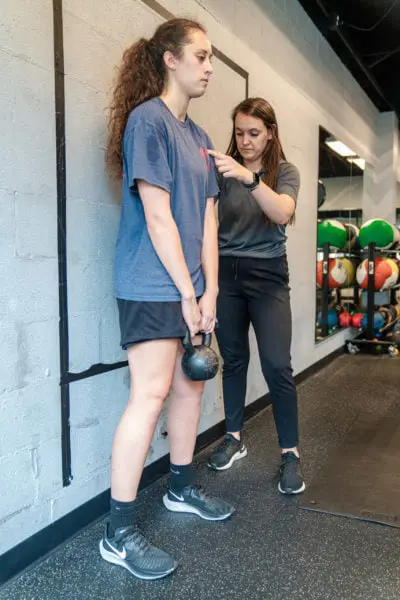
3 Easy Exercises for Happy Knees

I can’t stand doing warmups. There I said it. Even though I’m a sports physical therapist both in Bethesda and McLean (yup, we opened our new location in McLean, Virginia!), and I know better, I just want to get into my workout without spending 15 minutes doing boring drills.

If you are anything like me, you want to spend the least amount of time warming up without increasing your risk of injury.

One way to reduce the amount of time that you need to warmup your knees are with home exercises that prepare your knees to handle more stress. Our athletic physical therapy patients (both youth athletes and active adults) see us in Bethesda and McLean for help with knee pain that limits them in the gym and/or out on the field. We commonly recommend that people perform drills that build the capacity of what the knees can handle. This means that the knees will be capable of handling more stress and be ready to go as soon as you walk into the gym.

Check out the videos below where I breakdown 3 drills that you can do at home for happy, healthy, and strong knees!

These are just a few examples of drills that help you with knee pain. If you are serious about finally solving the knee pain that is forcing you to modify your favorite workouts, don’t hesitate and contact us today to schedule an appointment in McLean or Bethesda. The root cause of your knee pain is unique and it is unlikely that the cookie cutter program you found online will do the job. We will show you exactly where your knee pain is coming from and provide a customized performance physical therapy plan to address it!


For Weekend Warriors Wanting to Avoid Knee Surgery

I probably don’t need to tell you this, but the best surgery is the one that is avoided. Disclaimer, as a sports physical therapist, I am a bit biased!

After knee surgery, your knee is not the same. Tissue may have been removed or artificial parts/pieces may have been put in. Regardless of the procedure, the skin was cut open, scar tissue formed, and time is needed time to heal.

This impacts the function of your knee and your ability to run and exercise as you had previously.

Now, I am not saying that surgery should never happen. What I’m saying is that it should be a last resort.

In my 12+ years working as a sports physical therapist, I have learned that people commonly have knee surgeries when there are things they can do to delay or avoid them altogether.

In many situations, the knee cannot handle the stress required of it for sports or your active lifestyle. As physical therapists, we  commonly prescribe exercises that train the knee to handle all of that stress. In other instances, the knees are dealing with too much stress because another area isn’t doing its job. A thorough sports physical therapy assessment will determine what these areas are so that a comprehensive plan can be prescribed to fix it.

Whatever the reason is, a sports physical therapy assessment may be the secret sauce to finally solving your knee pain and avoiding the surgery you have been worried about! To schedule that, contact us today!

What’s the deal with my ankle popping?

When your knuckles pop, your ankle cracks, or your hip makes that strange noise, do you ever wonder, “Is that bad?” Should you see a sports physical therapist or doctor about it?

Well, there’s no need to worry—it’s probably not a big deal if you’re not experiencing any pain when it happens.

I have this quirky habit every morning as soon as I get out of bed. I keep my right heel on the floor and move my knee over my toes until I feel and hear a pop in the back of my heel. It freaks out my wife, Deb, every time.

The cracking or popping in a joint is similar to the sound of pressure being released from a soda bottle. Over time, pressure builds up within a joint, and for some people, it feels good to release it. That’s the noise you’re feeling and hearing.

However, if you experience pain when the pop occurs or if the area feels unstable, it’s important to reach out to us. We can help determine the root cause of these issues and whether any treatment is necessary.

We’ll assess if your pain is related to arthritis, overuse, or another movement-related issue that we can address through physical therapy, with exercises you can do at home.

Here are a few questions to ask yourself. If you answer “yes” to any of these, it might be time to seek help:

1) Is the popping I feel painful?
2) Has there been a recent injury to this area?
3) Does this area feel unstable?
4) Do I have weakness in this area?

You might not even need to visit the office—a phone call could be enough. Check out our homepage here and click on the “free phone consultation” tab!

Create Your BS Meter

I’m lying on the couch as I got sucked into Instagram and all of their sports physical therapy videos. While scrolling, one exercise video grabbed my attention. This wasn’t because it was good information. It was because it wasn’t and had thousands of likes.
 
There is so much information out there and anyone with a social media account can have a platform. You have access to the best and the worst information. It is overwhelming!
 
You need a BS detector so that you aren’t doing bicep curls while standing on a ball, blowing up a balloon (not far off what I saw the other day).
 
So how do you determine when you should ignore a social media post?
 
Speaking in absolutes. Most times, the best answer that a professional can give you is “it depends.” Rarely is there a correct answer for every situation. For example, stretching or mobility is often promoted as a “fix” for a given injury. Yet, many people have more important problems to solve. For more information, check out our post, Is Mobility Overrated? It is impossible to know of every possible factor that could be contributing to pain or injury. Even the best among us cannot be 100% certain, especially on social media.
 
It is too complicated. An expert can take a complex topic and break it down so that it makes sense to you. Complicated medical jargon is a red flag that the presenter does not understand what they are posting.
 
Promoting personal success stories as evidence. Personal success stories are subjective and ignore the facts and research. Many influencers post personal success stories as evidence for their approach. This ignores all the other factors that may have contributed to the results being promoted (genetics, differences in lifestyle, priority differences, etc.). Quality research requires thousands of trials before it is valid. A case study of 1 or 2 people only applies to those 1 or 2 people!
 
P.S. If someone is promoting a “quick fix”….run!

Stop Standing Straight

“Stand up straight!”

If your parents were anything like mine, you heard that growing up and when I started my career as a physical therapist, I assumed that I would be telling my patients to do the same.

However, that has not been the case.

As a sports physical therapist here in Bethesda, I find this cue to be detrimental to how the body functions. In fact, correcting the need to stand up straight has been one of the most helpful suggestions during physical therapy sessions and throughout the injury rehabilitation process.

Standing up straight causes you to pull your shoulder blades down and back, which limits the amount of movement available to your shoulder blades. The shoulder blades are meant to elevate and abduct (move apart) as the arm is moving away from the body. Just try to keep your shoulder blades down and back as your reach for something!

The cue to stand up straight also commonly causes people to arch their back and tip their pelvis forward. This position places increased strain on the lower back and pelvis, while limiting the amount of motion that is available at the hips.

Correcting this posture is of particular importance for athletes. Every sport has an amount of movement that is necessary to perform it. Golf requires a large amount of rotation at the hips, serving a tennis ball requires a great deal of shoulder flexion, and sprinting requires lot of hip extension.

“Standing up straight” while performing these activities will limit the movements necessary to perform these activities and can often lead to injuries.

This is not to say that this cue is a bad thing. However, it is important to understand when this cue is helpful and when it is not.

Cues like “standing up straight” may work for drills such as deadlifts, rows, and farmers carries, however it is useful to forget this cue for other activities and when attempting to correct your posture!

What Stretch Should You Be Doing?

Ten years ago, flexibility and stretching were all the rage, as well as a large component of the standard course of treatment in sports physical therapy. Many people had stretching in their daily routines, either as an athlete being told to stretch before and after practice from a coach, in a yoga studio by an instructor, or by a physical therapist in order to decrease pain. Now, the phrase “mobility” has been posted everywhere. “How to increase hip mobility to help improve your deadlift”, “Stretching Routines for Runners” and “is your ankle mobility plateauing your squat depth?” headlines can be seen from instagram and tiktok to google ads. But what is the difference between the two? Are they the same thing? What happened to the importance of stretching?

For starters, stretching or flexibility is the ability for a person to get into a position passively keeping one joint in mind. So if you want to bend down, are your hamstrings flexible and stretched out enough for you to touch your toes? To improve your flexibility, you stretch or lengthen your muscles to be able to achieve a goal.

On the other hand, mobility is the amount of active movement you have to reach a goal. For example with the “is your ankle mobility plateauing your squat depth” headline, can your ankle move enough and allow you to achieve a lower squat at your knees and your hips? To improve mobility, you typically need to target the joint itself, rather than the muscle tightness limiting a movement in stretching, in order to create more space for the bones to move on each other.

So how do you know if you cannot touch your toes due to muscle limitations, like in flexibility restrictions, or due to mobility issues? Like most questions in the physical therapy world, the answer is it depends. Physical therapists have a series of tests that can determine if the joint is unable to achieve a desired position due to muscle stiffness, joint tightness or an inability to control the motion that the body already has.

Below is an assessment and exercise that we use for many of our patients experiencing back pain. This helps us to determine the movement capabilities of the spine, including where it may be moving too much and/or not enough.

Once you figure out where your limitations are coming from, it is time to determine if you need to improve them. While these are hard questions to answer in a blog post, this is something that a physical therapist can help you distinguish by using various tests.

If this sounds like something you are interested in learning more about, contact us to receive a customized exercise program to improve either your flexibility or mobility (or both!).

×