CHP Spotlight Interview with Sports Medicine Physician, Dr. Richard Edgar

Why do so many field sport athletes and runners suffer lower body soft tissue injuries, like hamstring strains? 

As with all sports, injuries are part of the game and it is impossible to avoid them altogether. But being aware of risk factors can reduce the risk and is an essential component of the physical therapy process. There has been research studying the influence of strength imbalances of opposing muscles. One of the most common comparisons is with the hamstrings and quadriceps, called the hamstring to quadriceps strength ratio.

Research in physical therapy and sports medicine journals suggest that the hamstrings should be at least 60% as strong as the quads, especially among athletes.

Don’t miss my latest interview with Dr. Richard Edgar where we discussed topics like this and so much more! Dr. Edgar is a Primary Care Sports Medicine physician at the Anderson Orthopaedic Clinic. He specializes in non-operative treatment of musculoskeletal injuries and has an extensive sports background himself. 

The mission of the CHP Spotlight Interview Series is to share information with you from the greatest experts in the fields of sports medicine, sports physical therapy, personal training, and performance. Now, more than ever, there is a seemingly infinite amount of information available and finding the most credible information is a challenge. The good news is that we are here to help you find the best information related to physical therapy, personal training, and sports medicine from experts surrounding us in Bethesda, Chevy Chase, DC, McLean and Northern Virginia.

If you or someone you love has had a sports related injury, don’t miss this interview!

To learn more about Dr. Edgar, click here and check out our interview below!

Dry Needling Is Now in McLean

What’s up with this weird needling stuff that sports physical therapists are doing nowadays?

More and more people have been asking me about it as they have seen or heard about it being performed in performance physical therapy settings in McLean and Bethesda.

One person told me that their neighbor calls it “magic” and has cured all his aches and pains. Another person said they hear it only hurts without providing any relief.

So what is it?

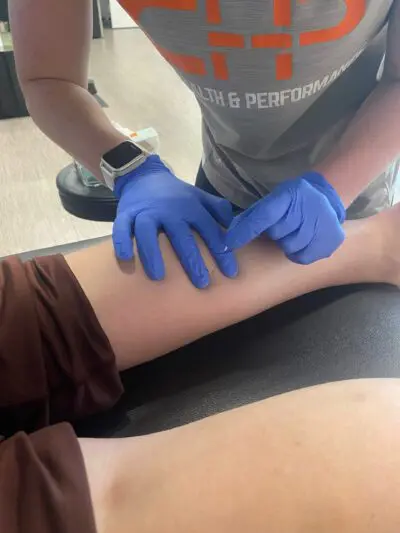
First, let’s define what dry needling is. Dry needling is a technique performed by healthcare providers like physical therapists. They insert small needles, similar to acupuncture needles, into muscles, tendons, and other soft tissues. The needle creates a small lesion (mini-injury) to the tissue, triggering the body to start a healing process.

Dry needling is a tool and like all tools in physical therapy, it has a time and place. It is not appropriate for everyone but may be helpful when used by a knowledgeable (and hopefully, not too biased) physical therapist.

If there is a great deal of inflammation currently present in one area of the body, dry needling likely is not appropriate. But if you’ve had pain for several months or years, it could help.

At the end of the day, dry needling is just one part of the overall treatment plan and will not fix an injury by itself.

At CHP, we now are offering Dry Needling as part of our physical therapy treatment plans in our McLean facility. We use this tool to reduce pain and the symptoms associated with an injury while working on the root causes.

Are you interested in learning more about dry needling and how it may help you overcome chronic pain? Contact us today to learn more and schedule an appointment!

Don’t Try To Be Patrick Mahomes

I lost count of how many times the announcers on Sunday night’s football game discussed the injury that Chiefs quarterback (and best player in the world) Patrick Mahomes played with.

He suffered a high ankle sprain just 8 days earlier and as a sports physical therapist here in McLean and Bethesda, I was blown away by how well he was able to play.

A high ankle sprain occurs when the ligaments that connect the tibia and fibula (the two bones in the lower leg) are stretched or torn. It is a more severe injury than a standard, or low ankle sprain, and takes longer to heal. Symptoms include pain, swelling, and difficulty bearing weight on the injured leg.

High ankle sprains typically take 6-8 weeks to heal and even longer to return to sport. It also involves a great deal of physical therapy and rehabilitation. At our McLean and Bethesda clinics, we typically work with athletes for 2-3 months after suffering a high ankle sprain.

I am not saying that Mahomes shouldn’t have played. As with all medical decisions, it is a risk vs. reward calculation.

By playing hurt, Mahomes risked re-injuring the ankle, causing further damage and increased the chances of developing chronic ankle issues. However, the reward is that he was able to lead his team to the Superbowl.

Mahomes determined that the reward outweighed the risk.

But we aren’t Patrick Mahomes and don’t have access to the same medical treatment (physical therapists, athletic trainers, doctors, etc.). The risk of “playing hurt” does not have the same reward (I didn’t even mention the 10-year contract he signed in 2020).

If you had an injury and are tired of sitting on the sidelines, first consult with a medical professional. As physical therapists we will help you understand your injury/pain and provide guidance on how to safely return to exercise or sport.

Once you have a better understanding of your injury, it is time to focus on your return.

The most challenging thing is learning where to start. What workout should I begin with? How much practice can I participate in?

Start small and build from there. Be conservative and make your first workout or practice easy. You can always build from there.

Every training session or practice should increase in volume and intensity in a progressive, step by step fashion. This pushes your body to adapt to more stress over time without pushing things too far, resulting in injury.

Don’t try to be Patrick Mahomes by modeling what you see on TV.

I spent the early stages of my career working with professional athletes.

Professional athletes are different. They recover faster, heal faster, and use pain killers that I do not recommend using to stay on the field.

We only see what is shown to us on TV. Ever seen a football player in their 50s?!

CHP Spotlight Interview with Orthopedic Surgeon, Dr. Ronald Paik

I recently had the pleasure of interviewing Dr. Ronald Paik from the Nirschl Orthopaedic Center on the latest edition of the CHP Spotlight Interview Series. The mission of the CHP Spotlight Interview Series is to share information with you from the greatest experts in the fields of sports medicine, sports physical therapy, personal training, and performance. Now, more than ever, there is a seemingly infinite amount of information available and finding the most credible information is a challenge. The good news is that we are here to help you find the best information related to physical therapy, personal training, and sports medicine from experts surrounding us in Bethesda, Chevy Chase, DC, McLean and Northern Virginia.

If you or someone you love has had a shoulder, elbow or knee injury, don’t miss this interview! Dr. Paik explains what you can do if you have experienced a shoulder, elbow or knee injury and what risk factors you can address right now to reduce your risk of injury. He goes on to share when surgery may be appropriate and when conservative options like physical therapy are a better choice. If you are a baseball player, field sport athlete, or weekend warrior, this is for you.

Dr. Paik is an orthopedic surgeon and sports medicine physician specializing in treating complex disorders of the shoulder, elbow, and knee. His goal is to pursue non-operative treatments, like physical therapy when possible, but he is experienced in advanced arthroscopic procedures, surgical repair and reconstruction, and total joint replacements.

To learn more about Dr. Paik, click here and check out our interview below!

Nails on a chalkboard to me

“It Will Hurt Your Knees if They Go Past Your Toes”—Debunking the Myth

Recently, while working out at the gym, I overheard two young men discussing their barbell squats. One of them mentioned that he had just finished physical therapy, and I hope the following advice didn’t come from his therapist…

After completing a set, one of the lifters (let’s call him Lifter 1) was chatting with his friend (Lifter 2). Lifter 2 advised him not to let his knees go past his toes during squats, claiming it would be bad for them.

This belief is widespread in fitness circles, the personal training industry, and was even common in physical therapy. However, it’s simply not true.

Your knees naturally go over your toes when you walk or run. In fact, proper squat technique requires your knees to move well past your toes.

Attempting to prevent this by pushing your hips back and arching your lower back only shifts more stress onto your lower back, increasing the risk of back pain.

But you might wonder: does allowing your knees to move past your toes increase stress on them?

The answer is no! In fact, research shows that training your knees to comfortably move past your toes helps build healthier knees and reduces the strain on your back.

Check out the squat tutorial below to retrain your squat technique and get your knees accustomed to moving over your toes as they naturally should!

Remember, there’s no such thing as a “bad” or “good” exercise. The suitability of an exercise depends on various factors, including your fitness goals, injury history (consult your physical therapist), unique body traits, and movement capabilities. Keep this in mind whenever you hear generalized or “one size fits all” advice about exercise.

Runners, Stop Making This Mistake in Your Training

According to the research, the chances of having a knee injury increase significantly after running for 1000 hours.

Most serious runners pass the 1000-hour mark within 1 year and end up in performance physical therapy clinics like CHP!

Does this mean that “bad knees” are inevitable once you choose to run? No, but it does mean that you must learn how to take care of them.

Running consists of thousands of strides repeated over and over. As a result, any problems with your running technique will add up, potentially contributing to injury.

Even if you are not a serious runner, you are likely approaching the 1000-hour running mark.

Does this mean that you are a ticking time bomb, ready to explode? Probably not if you are strength training and working on improving your running technique.

Strength Training

Implementing strength training into a consistent exercise routine has been shown to make you a more efficient runner. This means that you use less energy to run a given amount of time and as a result, are less fatigued. Less fatigue=less risk of injury.  For this reason, becoming a more efficient runner is an essential part of the sports physical therapy process.

Research also shows that regular strength training improves a runner’s speed and VO2 max. VO2 max is a measure of the amount of oxygen that you can use during exercise. When you can use more oxygen as you run, you will run farther, faster!

Just remember, every runner is unique. Even if you have a running partner with the same routine, you both have unique characteristics and needs to address in a strength training program. Your strength training program must be unique to you. Cookie cutter programs don’t cut it!

Running Technique

Think of the last time that you went out for a run. Were you thinking about every stride you took? Were you aware of your foot strike? I highly doubt it!

Running is an automatic pattern that does not require conscious thought to perform. Most people listen to music or podcasts. We couldn’t do that if we needed to focus on how to run.

Unfortunately, this also means that you may be repeating the same bad pattern over and over without realizing your mistake, until it is too late. One of the most common mistakes occurs with a runners foot strike position. Runners often contact the ground in front of the body which puts more stress on the body.

Foot strike position is dependent on your body dimensions (such as limb length).

We can’t change your anatomy, but we can change the position, aka the posture, of our bodies. This is often the first step of the physical therapy process for a runner!

A “stacked” posture will change your foot strike so that it occurs directly underneath the body. This results in a more efficient stride and less stress to the body. To learn about the stack, check out a previous article that I wrote on Learn to Stack Like a Snowman.

Attempt the drill below to feel what it is like to have a stacked posture while running.

  • Grab a partner and ask him/her/they to stand behind you (you are also standing)
  • Have your partner press down on your shoulders with a moderate amount of force and do not let them squish you
  • As you resist them you should feel your abs engage and feel as if you are standing tall
  • Next, attempt to shift your weight onto 1 leg and pick up your opposite foot while resisting the force of your partner
  • Try the other leg

For a video on this drill, click here.

After performing this drill, you should have a better sense of your optimal running posture. Try to replicate this feeling the next time you go on a run!

×