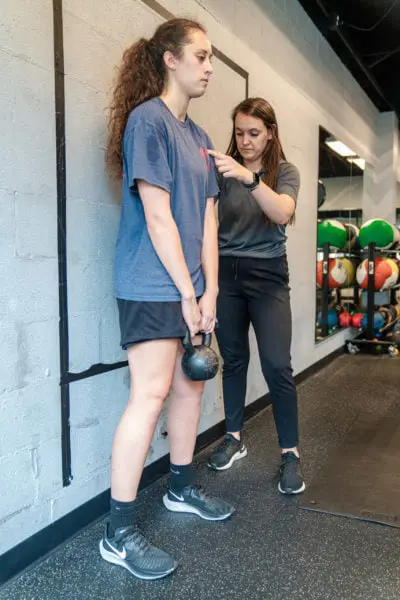
Stop Standing Straight

“Stand up straight!”

If your parents were anything like mine, you heard that growing up and when I started my career as a physical therapist, I assumed that I would be telling my patients to do the same.

However, that has not been the case.

As a sports physical therapist here in Bethesda, I find this cue to be detrimental to how the body functions. In fact, correcting the need to stand up straight has been one of the most helpful suggestions during physical therapy sessions and throughout the injury rehabilitation process.

Standing up straight causes you to pull your shoulder blades down and back, which limits the amount of movement available to your shoulder blades. The shoulder blades are meant to elevate and abduct (move apart) as the arm is moving away from the body. Just try to keep your shoulder blades down and back as your reach for something!

The cue to stand up straight also commonly causes people to arch their back and tip their pelvis forward. This position places increased strain on the lower back and pelvis, while limiting the amount of motion that is available at the hips.

Correcting this posture is of particular importance for athletes. Every sport has an amount of movement that is necessary to perform it. Golf requires a large amount of rotation at the hips, serving a tennis ball requires a great deal of shoulder flexion, and sprinting requires lot of hip extension.

“Standing up straight” while performing these activities will limit the movements necessary to perform these activities and can often lead to injuries.

This is not to say that this cue is a bad thing. However, it is important to understand when this cue is helpful and when it is not.

Cues like “standing up straight” may work for drills such as deadlifts, rows, and farmers carries, however it is useful to forget this cue for other activities and when attempting to correct your posture!

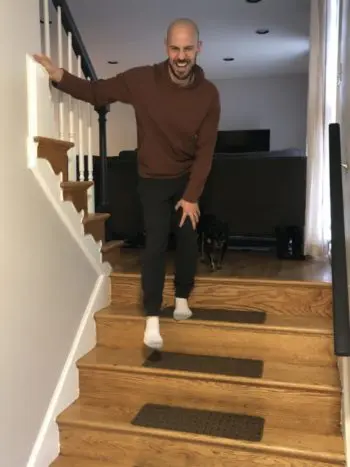
Athletes Need Strong Breaks Before They Can Hit The Gas

Athletes must have great breaks before they are able to hit the gas. When they don’t, that is when they find themselves in a sports physical therapy setting.

If you are an athlete that wants to jump higher, run faster, and be more explosive, you must first know how to slow down. In fact, this is one of the first things that we work on with athletes during physical therapy and performance training.

Athletes that struggle to absorb the impact of their bodies during explosive movements have a far greater risk of lower body injury. This can be seen when landing from a jump or cutting to change direction as the foot contacts the ground.

A recent example occurred in the most recent Super Bowl. In the 2nd half Odell Beckham Jr. tore his left ACL when he landed on his left leg as he slowed down to make a catch. While doing so his upper body was turned to the right creating a twisting motion at his knee as he attempted to slow down. He was unable to control the rapid breaking and twisting forces occurring at his knee, resulting in a large amount of stress to the ACL and the subsequent rupture of the ligament.

While none of us are athletes like Odell, we must all be capable of controlling the breaking forces that we experience when exercising, running, or playing recreational sports. The more aggressive and competitive the sport, the more force you must be capable of controlling.

This is especially true for youth athletes.

They play very competitive sports and are growing at the same time. Their soft tissues are adjusting to the changes occurring in their bodies and they have yet to develop all their athletic capabilities. These are just a few of the contributing reasons why lower body injuries like ACL tears are so prevalent in youth sports.

Below are 2 of the first drills that I teach to athletes when they are in physical therapy recovering from or seeking to prevent lower body sport-related injuries during personal training or performance training sessions.

Once you master these seemingly simple drills, you can step things up in a variety of fun ways!

Give these 2 drills a shot and let us know if you have any questions.

Don’t Trust Your Pain

We have all experienced physical pain (in fact, my own history of low back pain is what interested me in sports physical therapy).

Maybe you injured your back lifting weights. Perhaps you hurt you shoulder playing catch with your kids. You may have irritated your knee when training for a marathon.

You decide to see your doctor, physical therapist, or medical provider of choice. They then prescribe the recommended treatment or “plan of care.”

Throughout the course of treatment, you determine if you are getting better by monitoring your pain. Is it decreasing? Is it staying the same or getting worse? If your pain is improving, the treatment is working. If not, it is failing. Pretty straight forward.

That is the way that standard physical therapy views treatment but is short sighted.

Modifying your daily activities or exercise routines will help pain quickly improve in the short term but the root causes of the pain remain. This is when many people stop going to physical therapy or performing their home exercise routine.

This pain-free period of time provides the body with an opportunity to address the root causes of pain. This is essential if you wish to prevent it from returning in the future while returning to full activity.

Pain is a prediction made by the brain. When pain continuously occurs during a movement or activity, the body learns to expect it. This expectation must lessen for pain to ultimately disappear during aggravating activities. If you really want to nerd out on pain science, check out this article by my friend and fellow physical therapist, Zac Cupples.

Imagine that you have lower back pain every time that you attempt to lift something off the floor such as deadlifting a barbell in the gym or emptying dishes out of the dishwasher.

The brain has an expectation that this bent over position will hurt. Therefore, similar positions must be experienced without pain. Does this mean that you should start deadlifting on day 1 of treatment. Absolutely not. The best solution is to start with something less threatening and build from there. Below is an example of a great activity that physical therapy patients with low back pain start with.

The brain will then determine that these positions are not threatening, ultimately reducing risk of pain in the future while facilitating a full return to active life.

If you are an active adult ready to solve chronic pain for good, contact us to receive a customized home exercise program today!

Runners: don’t miss this part of your training!

Looking to Boost Your Running Performance Without Increasing Volume?

If you’re searching for ways to enhance your running performance without endlessly increasing your mileage, you’re not alone—many of our physical therapy clients in Bethesda have the same goal!

It’s a common misconception that the only path to becoming a better runner is by running farther and faster. While this might ultimately be the aim, strength training is a crucial element in improving overall fitness and race performance.

Incorporating strength training into your regular exercise routine has been proven to enhance running economy (efficiency!) and prevent injuries. These two factors are vital for long-term running success and are consistently emphasized in physical therapy.

More specifically, strength training reduces the risk of injury and boosts muscular endurance. Research shows that regular strength training improves a runner’s speed and VO2 max—the maximum amount of oxygen your body can utilize during exercise.

However, to reap these benefits, it’s important that a runner’s strength training program is properly designed and tailored to their individual goals and characteristics.

Fortunately, most runners share similar objectives: to run faster, run farther, and avoid injury. Strength training programs for runners should therefore focus on exercises that enhance running-specific qualities.

But with so many exercise options available, where do you begin? Starting on your own can be overwhelming.

That’s why we’re offering a FREE workshop designed to teach you the strength training program that will elevate your performance to the next level.

All ages and skill levels are welcome!

Is Sports Specialization Dangerous for Youth Athletes?

There comes a point in every youth athlete’s life when it’s time to choose “your sport”. Whether they’re a recreational team player, or a state champion, life gets pretty busy juggling multiple sports and activities. But when is that time, and are there dangers to specializing too early or too late? Can we become a good athlete, but prevent injuries (thus avoiding physical therapy!) and burnout at the same time?

There are a few guidelines we can follow in order to help draw a line when too much is too much. Guidelines are in place in order to prevent acute and overuse injuries in children and adolescents. While younger athletes can often “bounce back” fast, more serious injuries can ruin a season before it even starts. Here’s a few things to consider when signing your athlete up for sports:

1. Avoid over-specialization by signing up for multiple sports in a year. Just like with any activity, repeating the same stressors over and over can make you more susceptible to injury. Stay active and stay involved by choosing multiple sports.
2. “Hours per age” rule. Your child should not train more hours of one sport per week than their numerical age. (Example: a 14 year old swimmer should swim less than 14 hours per week)
3. Limit practice to 1.5 hours per day, and competition to 3 hours per week.
4. Have 1-2 rest days from sport practice/competition per week.
5. Young athletes should have up 3 months off per year, in 1 month increments of a break from organized sport.
6. Focus on form and technique before intensity.

Appropriately managing activity volume, and knowing when to take an injury seriously is hard work. Communicating with your primary care provider, pediatrician, coaches, athletic trainer, or physical therapist when something doesn’t feel right can be a useful tool to ensuring season-long success.

But most importantly, sport should be fun!

Reference:

https://www.acsm.org/docs/default-source/files-for-resource-library/6-ways-to-reduce-overuse-and-burnout-injuries-in-young-athletes.pdf?sfvrsn=acc88c52_2


Runners: How To Vary Your Training to Optimize Your Results!

Implementing variety into training is something that is commonly underutilized and overlooked among recreational runners. This is often the topic of conversation after we perform our running analysis or within a sports physical therapy session.

Varying speed, intensity, and distance can be a useful tool in run training, whether you’re training for a big race or just getting back into it.

Running at different speeds or intensities allows you to vary which muscles and tissues you are repeatedly straining. When you sprint, your technique is going to look very different than when you are going for a long, slow jog.

Including both in your training helps you to disperse the stress of the workout over more tissues, and can help prevent overuse injuries! Some examples of what this variety might look like: 

  1. High Intensity Interval Training (HIIT) runs: “sprint” training! Work to rest intervals should be greater (1:4, 1:5). For example. sprinting for 10 seconds and walking/jogging for 50 seconds. Repeat for 10-15 minutes. Great for a track or grassy field! 
  2. Interval training: longer bouts of faster running, not as intense as a full sprint. Work to rest ratios are going to look more even (2:3, 1:1 or 2:1 ratios). For example, fast running for 1-2 minutes, jogging for 2-3 minutes, repeat for 10-15 minutes. 
  3. Tempo training: usually done as a “long run”. Pick a pace, and try to stick to it throughout the duration of your run. Distances should be specific to what your goals are!
  4. Using Rate of Perceived Exertion (RPE) Scale: If you don’t know what pace time is right for you, start with RPE! You can use a scale of 0-10, with 0 being completely at rest and 10 being a sprint as fast as you can possibly go. Fast bouts of HIIT training should be performed at an RPE of 8-10, whereas interval training should be closer to RPEs of 5-8. An example of an RPE scale can be found here 

In addition to preventing injuries, adding sprints and interval training can help increase muscle mass, cardiovascular endurance, and improve your ability to cover more distance in a shorter amount of time. If you’re finding that you’re constantly dealing with the same injury, consistent soreness in one muscle group, or you just want to shake up your training, a performance physical therapist can help find the right running program for you! 


×