Set yourself up for success from your first race

Training for your first running race can be a challenge—where do you begin? What program should you follow? How long should your training last? And what exactly does “training” entail? These are common questions that we, as sports physical therapists and strength and conditioning professionals, frequently encounter.

Training involves conditioning your body to handle the demands you plan to place on it. This usually means gradually increasing the volume or intensity of your physical exercise over time, so you can perform at your best, prevent injuries, and avoid needing a visit to a sports physical therapy clinic like ours!

With countless resources and advice available online, the process can feel overwhelming. Whether you’re preparing for a 5K, marathon, triathlon, or Ironman, here are a few tips to help simplify your training journey:

1. Set Your Goals: Are you simply aiming to finish the race, or do you have a specific time goal? Defining your goals will help you determine the pace and intensity of your training sessions.

2. Assess Your Starting Point: Have you already done any conditioning for this activity, such as recreational running, biking, or swimming? If you’re starting from scratch, you’ll need to begin training earlier than someone who has been consistently active.

3. Incorporate Cross-Training: Include alternative forms of cardio (like swimming, biking, or HIIT training) and strength training in your routine. Different types of exercise target different muscle groups, which is crucial for injury prevention.

4. Taper Before Race Day: Give your body time to recover 1-2 weeks before the race—this isn’t the time to push your highest volume of training.

5. Follow a Structured Program: Depending on your race date, you can find various running programs online that suit your timeframe. Nike.com offers excellent running training plans that you can download!

If you have any questions about the tips above, the sports physical therapists and performance training specialists at Cohen Health and Performance are here to help. While these points provide a solid foundation for starting your running routine, we can offer additional guidance on calculating the right mileage to reduce injury risk, strengthening your muscles to complement your training schedule, and supporting you throughout your race preparation.

What a Foot and Ankle Surgeon Recommends For Youth Athletes

I recently had the pleasure of interviewing Dr. Thomas Sanders for the latest edition of the CHP Spotlight Interview Series. The mission of the CHP Spotlight Interview Series is to share information with you from the greatest experts in the fields of sports medicine, physical therapy, fitness and performance. Now, more than ever, there is a seemingly infinite amount of information available and finding the most credible information is a challenge. The good news is that we are here to help you find the best information related to physical therapy, training, and sports medicine from experts surrounding us in Bethesda, DC, McLean and Northern Virginia.

If you or your child has suffered a foot/ankle ankle, don’t miss this interview! Dr. Sanders explains what you should do if you have experienced a foot/ankle injury and what risk factors your child can address right now to lower their risk of injury. He goes on to share when surgery may be appropriate and when conservative options like physical therapy are a better choice. He even shares his experiences as an athlete, playing rugby, and how that lead him to specialize in helping injured athletes!

Dr. Thomas Sanders, MD, is an orthopedic foot and ankle specialist at the Centers for Advanced Orthopedics in Northern Virginia and Chief of Foot and Ankle surgery for the INOVA Health system. Dr. Sanders specializes in the treatment of ankle arthritis, lower extremity trauma, and fractures of the ankle and foot. He also helps patients in the Washington, DC, area with post-traumatic reconstruction, midfoot and forefoot arthritis, flatfoot reconstruction, and bunions/hammertoes.

To learn more about Dr. Sanders, click here and check out our interview below!


2 Drills to Improve Your Running Times

If you are a dedicated runner you likely have suffered an injury and maybe even gone to physical therapy. Whether you realized it or not, this injury limited your ability to train effectively.

Here in Bethesda (and soon to be, McLean!), physical therapy involves helping runners overcome injuries that otherwise would limit their ability to train, ultimately causing disappointing results.

There is not a one size fits all solution to helping runners. However, we often discover that runners are limited by the mobility of their hamstrings.

During a run, the hamstrings need the ability to lengthen as the thigh is in front of the body. This should be achieved without drastically changing the position of the pelvis. Many runners struggle to maintain control of their pelvis as the hamstring lengthens. This increases the stress placed onto a variety of soft tissues through the lower body and alters foot strike position.

Hamstrings, like many other muscles, must be strong when in lengthened positions. Otherwise the body will not allow you to keep any of the short-term flexibility improvements that you have made with stretching.

Below are 2 drills that you can incorporate into your strength training routine to improve hamstring strength and flexibility that the body will hold on to!

Kickstand RDL
Single Leg Eccentric Glute Bridge

A thoughtful and more scientific approach to training that is specifically designed for runners is likely all you need to drastically improve your running performance. It may not even require you to train any harder, just smarter!

Why I Don’t Train Barefoot

Barefoot training and the use of minimalist footwear has become a widely discussed topic in sports physical therapy and the running community. Many folks in the fields of sports medicine, injury rehabilitation, and performance training are all-in on the idea of training in bare feet.

Training barefoot provides great benefits.

The absence of shoes gives the body a direct connection to the ground for quicker and more accurate feedback which helps to improve balance.

Barefoot training also strengthens the feet themselves. When the feet do not have assistance from footwear for support, they must do the entirety of that job for themselves. Muscles, tendons, and ligaments in the feet work to support the arch, the heel, and the forefoot which strengthens them over time. For this reason we often prescribe barefoot training for our physical therapy patients.

However barefoot training is not appropriate for all people.

Most of us walk on hard surfaces like concrete and unlike grass or dirt, concrete is not a forgiving surface. We are unable to manipulate concrete and we have less shock absorption as we step onto harder surfaces.

In addition to an external environment that may not be conducive for barefoot training, many people have unique foot structures or previous injuries that make barefoot training unrealistic. In these situations, a shoe may help their foot function better.

An appropriate shoe allows for the foot to find the ground optimally and properly transition through the different phases of the gait cycle. This allows the body to properly alternate from one leg to the other.

A proper shoe must provide optimal heel control, allow for the arch of the foot to contact the shoe properly (and at the correct time in the gait cycle) and bend only where the toes bend.

The correct shoe can have an incredibly powerful effect on a variety of different ailments and can make a huge difference in the effectiveness of someone’s rehabilitation and training program.

Are you eager to find out if barefoot training is right for you? Contact us today to learn more!

Try this to improve your hip and trunk mobility

Who doesn’t want to loosen up their hips and trunk while building strong hamstrings and glutes?!

It is common to encounter youth athletes and active adults in athletic physical therapy and injury rehabilitation settings who have tight posterior hips and stiff rib cages. This limits the amount of rotation that they available through the trunk and reduces mobility in a variety of different directions within the hips.

As a result, more stress is placed onto the lower back, knees, and other areas of the body. Overuse injuries often follow that send people to physical therapy, including general lower back pain, lumbar disc injuries, knee arthritis, meniscus injuries, etc.

The good news is that the root causes of these kinds of injuries can be addressed and often do not require a boring home exercise program.

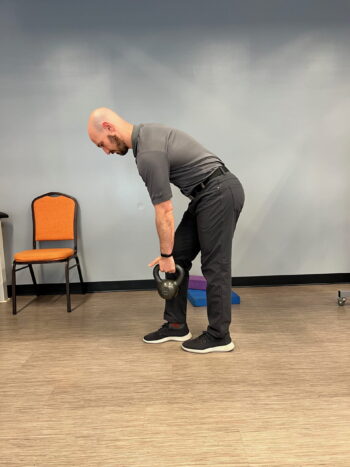
The Single Leg RDL (Romanian Deadlift) is a fantastic drill that you can implement into your workout routine to improve your hip/trunk mobility and strengthen your glutes/hamstrings.

This drill is particularly powerful for rotational athletes like golfers, tennis players, lacrosse players, and hockey players.

We typically start our patients and training clients with the kickstand version of the Single Leg RDL before progressing to the more advanced versions below.

Kickstand RDL (front leg emphasis)

Kickstand RDL with Foot on Wall

The key with these activities is to ensure that you feel the back of your hip, glute, and hamstring working (on the working leg), while also feeling your abs working. You should not be feeling your lower back at any point during the drill.

Are you interested in learning more ways that you can adjust your exercise program to correct old injuries, improve your performance and/or stay pain free? If so, simply contact us!

Speed Up Your Recovery From Back Pain

As anyone who has thrown their back out and needed physical therapy will tell you, bending over feels rough for several days after.

Putting on socks and even sitting down is uncomfortable as the body attempts to prevent the lower back from moving, especially into flexion.

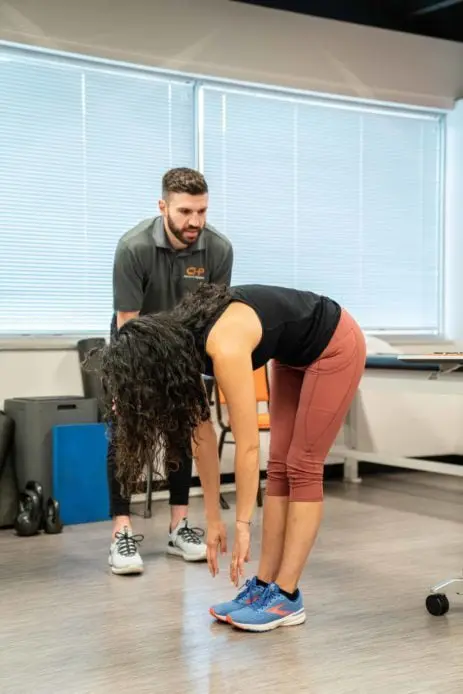
Flexion of the spine is commonly the most aggravating movement for anyone experiencing an acute episode of back pain. In physical therapy we test this by asking our patients to touch their toes. Once the acute episode subsides, the next step is training and learning to tolerate slow, controlled movements of the spine.

When tolerated well, the reverse crunch is great drill to teach this quality and can be used effectively as a warmup in the gym.

Oftentimes this is where the injury rehabilitation process stops. At this point the body can tolerate all normal daily activities however it has not learned to manage rapid movements of the spine, such as those that occur in sport or in the gym.

The Med Ball slam is a great drill to train the spine to tolerate movements that involve rapid spinal flexion. This drill should be pain free before attempting any heavy Olympic lifts like a clean or a snatch.

Also, remember to avoid using a ball that bounces as we don’t want any broken noses from this drill!

×