Make the most of your visit: 3 questions to ask your physical therapist

Whether you’re attending in-person or virtual physical therapy, your success largely depends on how engaged and involved you are in the process. A physical therapist’s role is to identify issues, develop a personalized treatment plan, and guide you toward recovery. However, as the patient, your active participation is just as crucial. Asking the right questions during your sessions can empower you to take control of your health and recovery journey.

Here are three essential questions to ask your physical therapist to ensure you get the most out of your sessions in McLean or Bethesda.

1. Why Did This Happen, and How Can We Prevent It from Happening Again?

One of the key goals of physical therapy is not just to treat the symptoms but to address the root cause of your pain or injury. Whether it’s a recurring injury, chronic pain, or post-surgery rehabilitation, understanding *why* the issue occurred in the first place is crucial to preventing it from becoming a long-term or recurring problem.

By asking your physical therapist about the underlying cause, you’ll gain insights into the factors that contributed to the issue—whether it’s poor posture, repetitive strain, muscle imbalances, or even lifestyle habits. With this knowledge, you and your PT can develop a plan to not only treat the current problem but also take proactive steps to ensure it doesn’t happen again. This might include correcting your movement patterns, strengthening weak areas, or making adjustments to your daily activities.

2. What Should I Be Doing at Home to Support My Recovery?

Physical therapy sessions are often limited to a few hours per week, but your recovery continues long after you leave the clinic. The majority of your time will be spent outside of the physical therapist’s office, which is why it’s critical to know what exercises, stretches, or adjustments you should be doing at home.

Ask your physical therapist for a clear and detailed home exercise program that complements your in-person treatment. This plan should be tailored to your specific needs and capabilities, ensuring you’re doing the right movements to support your progress. A good physical therapist will not only show you the exercises but also explain why they are important, how to perform them correctly, and how often you should do them.

On the flip side, it’s equally important to know what not to do. Certain activities or movements could slow down your recovery or even worsen your condition. By clarifying both the “dos” and “don’ts,” you’ll feel more confident in managing your rehabilitation at home.

3. How Can You Measure and Ensure I’ll Make Progress?

The ultimate goal of physical therapy is to make meaningful progress toward your recovery goals, whether that’s reducing pain, improving mobility, or returning to your favorite activities. However, many healthcare systems focus on generic benchmarks, such as returning to basic activities of daily living (ADLs) or reaching a general “baseline.”

While these objectives are important, physical therapy should go beyond just meeting minimum standards—it should be about helping you achieve your personal goals. By asking how your progress will be tracked and measured, you set the expectation that the focus is on your individual needs, not just generalized outcomes set by insurance companies.

Your physical therapist should provide a clear roadmap for your recovery, outlining the specific milestones and indicators they’ll use to track your progress. This could include improved range of motion, increased strength, reduced pain levels, or functional abilities tied to your lifestyle. Regular check-ins and reassessments will ensure that your treatment stays on track and is adjusted as needed.

Physical therapy is a partnership, and the more actively engaged you are, the better your results will be. By asking thoughtful questions and staying informed, you’ll not only deepen your understanding of your treatment plan but also enhance your ability to manage your health outside of therapy sessions.

Fact or Fiction: Do our bodies actually fall out of alignment?

We are excited to begin a series of posts discussing common myths in the realm of athletic physical therapy. Today’s myth commonly applies to back pain physical therapy as well.

Many of our patients have been told that their body may be “out of alignment”, or that their joints need to be “re-aligned.” Unfortunately, this is not the greatest advice.

Human beings are never in a static position. Even at rest, the simple act of breathing creates movement. By definition, being in alignment means that our bodies are in a straight line, or that all parts of our body are consistently in the appropriate relative positions to one another.

We cannot consistently be in alignment because we are always moving. If our body was constantly aligned, we would be unable to move anywhere.

Your body can feel as if it is out of alignment when you overuse or rely upon specific movement strategies or body positions. This can happen for a myriad of reasons and results in feelings of stiffness and discomfort that often temporarily feel better with an adjustment.

An adjustment can be helpful if the causes of stiffness or discomfort are also addressed. The root causes of stiffness or discomfort are typically addressed by focusing on movement limitations that are present.

Any relief provided by an adjustment will be temporary when the root cause of the discomfort or stiffness is left unaddressed. Check out the article below for some activities that may help!

3 Home Exercises to Help Your Back Pain

We hope that this provided some insight into a common rehab myth. Stay tuned for more to come!

Do your running shoes pass the test?

You don’t need performance physical therapists like us to tell you that footwear makes a large impact on running performance. The correct running shoe can reduce your race times and lower your injury risk.

When walking into any running store in Bethesda or Chevy Chase, you will find many different shoe brands and several different models of shoes within each brand. Among this wide array of shoes, how do we determine which is best for you?

The answer is different for each person and is dependent on a multitude of different factors. However, any running shoe must meet a few requirements to be considered and these are the first things we look for when assessing any running shoe in physical therapy for runners.

The first is that it must have a firm and snug heel cup. Your heel sits at the base of the shoe, in a place called the heel cup. The heels cup should fit snugly around your heel and should not be much wider than your heel itself. This prevents your heel from sliding around within the shoe, which would negatively impact foot mechanics.

Next, the shoe must have a toe break that folds where your toes bend.  Place your shoe on the ground and hold it there. Pull the front of your shoe upwards from underneath. The folding point of the shoe should be located where your toes bend. If your shoe prefers to fold at another location, your foot is being encouraged to bend somewhere else. This alters foot mechanics and can lead to breakdown within the structure of the foot itself.

Finally, you should be able to feel the entirety of both feet on the ground as you are standing still in your shoes. People are often unable to feel their arches, which results in more stress on the areas that are receiving better ground contact.

There are 26 bones and 30 joints within the human foot. This results in a large number of ways that our foot can compensate, and therefore, a large number of factors that we need to be mindful of when choosing the correct running shoe.

The 3 factors outlined above are a good place to start when choosing the right shoe, however there are many other factors that may also need to be considered.

Please contact us for help assessing your foot and determining the best running shoe for you!


3 Home Exercises to Help with Your Back Pain

Did you know that according to research, over 70% of Americans will experience back pain during their lives?

Surprisingly, this statistic remains high among active people. Sometimes their training even contributes to it!

One of the things you can do to help reverse this trend is to implement Pilates into your training. Dr. Ciara is a physical therapist and certified Pilates instructor. She has taught us how to incorporate Pilates into the treatment of physical therapy patients right here in Bethesda and Chevy Chase. These principles can also be used in performance training.

The good news is that Pilates doesn’t require you to go to a Pilates studio. Many Pilates exercises can be done from home and performed within your training regimen.

Begin with the 3 exercises below.

  1. Roll like a ball into Zen Teaser (C-Curve)
  2. Single Leg Stretch
  3. Curtsy Reach

The goal of these activities are to teach you how to control your body using your deep abdominals and glutes. Therefore, it is essential to focus on quality of movement, rather than the quantity performed. There are no heros with these exercises!

To learn more about Pilates, check out last weeks article below!

What Actually is Pilates?

Training with back pain may only require a simple modification

Back pain is a prevalent and debilitating condition affecting a significant portion of the global population. Studies indicate that more than 70% of individuals will experience back pain at some point. The diverse ways back pain can manifest make it a complex challenge for patients and physical therapists. However, physical therapy is an effective way to alleviate and manage this common ailment without surgery.

Practitioners often encounter many symptoms and triggers when treating patients with back pain through physical therapy. One remarkable aspect of this approach is that patients, particularly physically active ones, are keenly attuned to the movements that provoke their pain. Two common movements that often exacerbate back pain are deadlifts and squats, both of which are integral to various exercise routines.

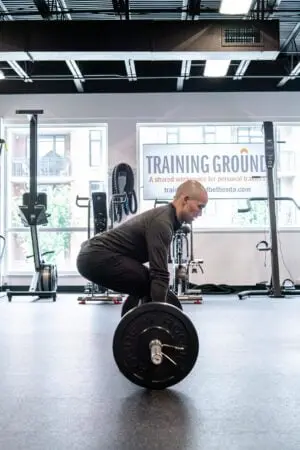
Deadlifts, which involve bending at the hips to lift objects from the ground, are notorious for triggering back pain in many individuals. This movement positions the spine horizontally relative to the ground, subjecting it to significant shearing forces. Shearing force is the mechanical stress that results from one vertebra wanting to move forward or backward relative to the one above or below it. For people with back pain, deadlifts can intensify the discomfort due to the stress placed on the spine during this movement.

Squatting is another common exercise that can exacerbate back pain, especially when performed with resistance, such as lifting weights. Unlike deadlifts, squats require a vertical orientation of the spine, leading to increased vertical compression against gravity. This added pressure can be a source of pain for many individuals suffering from back issues.

If you experience back pain, it’s essential to consider the specific movements that trigger your discomfort. Is your pain more pronounced when lifting objects from the floor or when engaging in squatting exercises with added resistance? This distinction can help guide your approach to managing and alleviating your back pain.

If deadlifting worsens your back pain, temporarily replace this exercise with squatting variations in your training program. While this isn’t a permanent solution, it can help you find relief from pain while addressing the underlying causes of your discomfort. Physical therapy can be instrumental in guiding you through these modifications and ensuring you perform the exercises correctly and safely.

Conversely, if your pain intensifies during squatting exercises with resistance, consider switching to single-leg squat variations as an alternative to traditional double-leg squats. Again, this approach is not meant to be a permanent solution but can provide temporary relief while targeting the root cause of your pain.

Consider contacting a qualified physical therapist for comprehensive support in addressing the root causes of your back pain. These professionals have the knowledge and expertise to develop personalized treatment plans tailored to your specific condition and needs. With the guidance of a physical therapist, you can work towards a long-term solution to your back pain, improving your overall quality of life and well-being.

Back pain is a common and multifaceted issue that affects many individuals. Physical therapy offers valuable solutions for managing and alleviating back pain by addressing the specific movements that trigger discomfort. Whether it’s deadlifts or squats, modifying your exercise routine with the guidance of a physical therapist can help you find relief while tackling the root causes of your pain. Don’t hesitate to seek professional assistance in your journey towards a pain-free and healthier back. Contact us for help with your back pain today!

Physical therapy for back pain often requires only 1 simple modification

Back pain remains as one of the leading causes of disability worldwide and according to research, over 70% of people will experience back pain at some point in their lives and likely require back pain physical therapy.

When back pain is measured among such a large number of people, it is impossible for each person to specify the different ways in which their back pain presents.

When treating physical therapy patients with back pain, we see this pain present in many different ways. Since we treat such active people, our patients are very aware of the different movements that elicit their symptoms.

Many times, picking objects off the floor, aka deadlifts, produce their back pain. During these movements, the body bends over by folding at the hips. This moves the spine into a position that is horizontal relative to the ground, resulting in more shearing forces within the spine. Shearing force is the force of one vertebra wanting to move forward or backward relative to the one above or below it.

For many others, squatting movements are problematic, specifically when squatting with resistance (such as when lifting weights). When squatting the spine is vertically oriented (compared to a deadlift) resulting in more vertical compression against gravity.

Do you have back pain? If so, is it worse when picking things up off the ground or when squatting with resistance?

If it is worse when picking things up off the floor, aka deadlifting, you may want to consider replacing deadlift exercises with squatting variations within your performance training program. While this should not be a permanent solution, it can help you get out of pain while addressing the root causes of the issue in physical therapy.

If your pain worsens when squatting with resistance, you may want to consider switching to more single leg squatting variations in place of double leg squats. Once again, this should not be a permanent solution (although single leg exercises are awesome!), however it can help you get out of pain while addressing the root cause of your pain.

For help addressing the root cause of your pain, contact us!

×