What actually is Pilates?

Has anyone ever suggested that you try Pilates, however you really don’t know what Pilates is? If you don’t really know what it is, how could you know if Pilates will help you?

The newest member of the CHP team, Dr. Ciara Petry, is a certified Pilates Instructor and specializes in helping, in addition to being a physical therapist. She utilizes Pilates in her physical therapy practice and within her performance training services for her clients in Bethesda and Chevy Chase.  She even uses Pilates during her virtual physical therapy sessions! We are so grateful that she was kind enough to share this information with us.

Pilates is can be described as a conscious way back into our bodies, better connecting the mind and body. Pilates focuses on body alignment, controlled movement, and breathing. Joseph H. Pilates developed this movement system with the goal of improving the ability of the deep muscles of the body to guide and control movement.

Classic Pilates does not require any fancy equipment can be easily be performed on a mat. The focus of a typical session will be on quality of movement versus quantity (number of reps, amount of weight, etc.). Spinal movements, a properly engaged core, shoulder and pelvic stability, breathing, and working with oppositional energy are all key to Pilates work.

Contrary to popular belief, Pilates is very different from Yoga and it is important to understand these differences so that you can choose the right activity for you and your goals.

Yoga was founded as a sacred tradition over 5,000+ years ago with a focus on physical, mental, emotional, and spiritual health. Yoga is a meditative practice, where Pilates is not, and follows a sequence of poses that are often held for long periods of time to increase short-term flexibility.

Pilates was founded in the 1920’s with a focus on strengthening of the core, improvement of posture, stabilization and elongation of the spine, and development of balance and overall strength. Movements are shorts with an increased focus on control, precision and long-term mobility.

For these reasons Pilates is incredibly useful for anyone suffering from back, knee, or hip pain. Furthermore, it serves as a great alternative or adjunct to weight training or running.

Next week will be discussing how you can use Pilates to help overcome injury and improve your performance in a variety of settings!
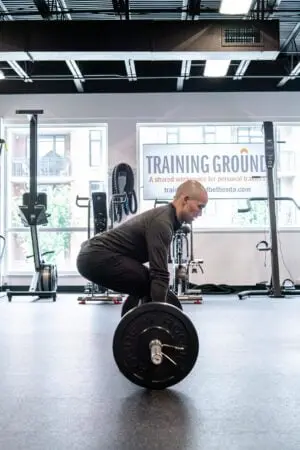
Training with back pain may only require a simple modification

Back pain is a prevalent and debilitating condition affecting a significant portion of the global population. Studies indicate that more than 70% of individuals will experience back pain at some point. The diverse ways back pain can manifest make it a complex challenge for patients and physical therapists. However, physical therapy is an effective way to alleviate and manage this common ailment without surgery.

Practitioners often encounter many symptoms and triggers when treating patients with back pain through physical therapy. One remarkable aspect of this approach is that patients, particularly physically active ones, are keenly attuned to the movements that provoke their pain. Two common movements that often exacerbate back pain are deadlifts and squats, both of which are integral to various exercise routines.

Deadlifts, which involve bending at the hips to lift objects from the ground, are notorious for triggering back pain in many individuals. This movement positions the spine horizontally relative to the ground, subjecting it to significant shearing forces. Shearing force is the mechanical stress that results from one vertebra wanting to move forward or backward relative to the one above or below it. For people with back pain, deadlifts can intensify the discomfort due to the stress placed on the spine during this movement.

Squatting is another common exercise that can exacerbate back pain, especially when performed with resistance, such as lifting weights. Unlike deadlifts, squats require a vertical orientation of the spine, leading to increased vertical compression against gravity. This added pressure can be a source of pain for many individuals suffering from back issues.

If you experience back pain, it’s essential to consider the specific movements that trigger your discomfort. Is your pain more pronounced when lifting objects from the floor or when engaging in squatting exercises with added resistance? This distinction can help guide your approach to managing and alleviating your back pain.

If deadlifting worsens your back pain, temporarily replace this exercise with squatting variations in your training program. While this isn’t a permanent solution, it can help you find relief from pain while addressing the underlying causes of your discomfort. Physical therapy can be instrumental in guiding you through these modifications and ensuring you perform the exercises correctly and safely.

Conversely, if your pain intensifies during squatting exercises with resistance, consider switching to single-leg squat variations as an alternative to traditional double-leg squats. Again, this approach is not meant to be a permanent solution but can provide temporary relief while targeting the root cause of your pain.

Consider contacting a qualified physical therapist for comprehensive support in addressing the root causes of your back pain. These professionals have the knowledge and expertise to develop personalized treatment plans tailored to your specific condition and needs. With the guidance of a physical therapist, you can work towards a long-term solution to your back pain, improving your overall quality of life and well-being.

Back pain is a common and multifaceted issue that affects many individuals. Physical therapy offers valuable solutions for managing and alleviating back pain by addressing the specific movements that trigger discomfort. Whether it’s deadlifts or squats, modifying your exercise routine with the guidance of a physical therapist can help you find relief while tackling the root causes of your pain. Don’t hesitate to seek professional assistance in your journey towards a pain-free and healthier back. Contact us for help with your back pain today!

Physical therapy for back pain often requires only 1 simple modification

Back pain remains as one of the leading causes of disability worldwide and according to research, over 70% of people will experience back pain at some point in their lives and likely require back pain physical therapy.

When back pain is measured among such a large number of people, it is impossible for each person to specify the different ways in which their back pain presents.

When treating physical therapy patients with back pain, we see this pain present in many different ways. Since we treat such active people, our patients are very aware of the different movements that elicit their symptoms.

Many times, picking objects off the floor, aka deadlifts, produce their back pain. During these movements, the body bends over by folding at the hips. This moves the spine into a position that is horizontal relative to the ground, resulting in more shearing forces within the spine. Shearing force is the force of one vertebra wanting to move forward or backward relative to the one above or below it.

For many others, squatting movements are problematic, specifically when squatting with resistance (such as when lifting weights). When squatting the spine is vertically oriented (compared to a deadlift) resulting in more vertical compression against gravity.

Do you have back pain? If so, is it worse when picking things up off the ground or when squatting with resistance?

If it is worse when picking things up off the floor, aka deadlifting, you may want to consider replacing deadlift exercises with squatting variations within your performance training program. While this should not be a permanent solution, it can help you get out of pain while addressing the root causes of the issue in physical therapy.

If your pain worsens when squatting with resistance, you may want to consider switching to more single leg squatting variations in place of double leg squats. Once again, this should not be a permanent solution (although single leg exercises are awesome!), however it can help you get out of pain while addressing the root cause of your pain.

For help addressing the root cause of your pain, contact us!

Home exercises to kickstart your training routine

When the COVID-19 pandemic began, I found myself feeling stressed and anxious. To make matters worse, old aches and pains started to resurface.

I had stopped prioritizing my fitness routine, which led to a more sedentary lifestyle than usual. The combination of stress and reduced physical activity caused my old college back injury to flare up slightly.

This experience was a powerful reminder of the importance of self-care.

Now, I make sure to prioritize my morning routine, which includes meditation, journaling, and—most importantly, for me—exercise.

While I do enjoy an intense workout, many days I simply opt for a long walk followed by 10-15 minutes of light, continuous movement using just my body weight.

My back feels great, and most importantly, I’m experiencing the physical and mental health benefits that come from regular exercise.

However, I recognize that what works for me might not work for everyone. Your self-care routine should be tailored to you. What activities help you feel and function at your best?

Even though our routines may differ, a variation of physical activity is often beneficial. I won’t dive into the science here, but if you’re interested, I’d be happy to share more!

Here are three exercises you can try at home. They’re great for anyone dealing with a cranky lower back, looking to feel better, or wanting to improve their fitness:

– Heels Elevated Goblet Squat (no weights at home? No problem! Just use a backpack filled with books or a jug of water): start with 3 sets of 8-10 reps

– Bear Position Hold: 3 sets of 5 breathing cycles

– Goblet Split Squat (use a weight or the same tool from exercise #1): start with 3 sets of 8-10 reps per side

I wasted a lot of time stretching

My passion for the field of sports medicine and strength and conditioning began when I was 15 years old.

I was a solid athlete and football was my passion. At the time my dream was to play Division I college football. Although I was successful relative to my immediate peers, I knew that I would have to work my hardest to have any chance of getting to that level.

I trained hard and searched for every advantage I could find. I read books written by famous coaches, trainers, and athletes. One of the most common pieces of advice was to constantly be stretching.

Every morning upon waking, I would perform a 15-20-minute stretching routine. I would repeat a similar routine prior to and after training, as well as before bed.

I would feel more flexible for a short period of time after performing this routine, however, did not notice any improvement in my performance.

When looking back at this now I realize that I never asked myself one simple question. What am I trying to achieve by stretching?

I was simply stretching because people told me I should!

So, what are you trying to achieve when you stretch? Will stretching be helpful for you?

As with most things, the answer is that it depends.

A muscle will become stiff when it is consistently resting in a shortened position. This may be due to posture or a person’s daily activities. For example, someone that sits for an extended period of time is likely to have stiff muscles in the front of the hips.

Stiff muscles may also occur as a result of movement compensations or a lack of movement altogether.

Simply stretching a muscle without correcting the reasons it occurred in the first place, may result in a lot of wasted time. The first step may be to simply move around throughout the day. A simple walk to the water cooler can be enough to break up extended bouts of immobility.

Also, a muscle may become stiff in an attempt to protect against an injury. For example, those with chronic lower back pain often have stiff hamstrings as the hamstrings tighten to protect the lower back.

In this case, it is important to learn to protect the lower back with exercise. One of the first steps is to learn to properly “stack” the pelvis underneath the rib cage. You will feel your abs when you are “stacked” properly. Attempt to maintain this feeling during weight lifting drills.

Below is a great exercise to learn do just that! Have fun and let us know if you have any questions!

Heels Elevated Squat

-Dr. Zachary Cohen

What most runners are missing in their training

At CHP, we often see distance runners for a variety of injuries including knee pain, plantarfascitis, and hip and lower back pain.

In addition to seeing runners as physical therapy patients, we help many runners improve their performance.

There are many things that can be done to help a runner both recover from an injury and positively improve their performance. However, one of the most overlooked pieces is a well-designed strength training program.

Many runners understand the importance of strength training, yet, may be performing strength training programs that are not designed for runners.

These programs commonly contain variations of double leg squats and deadlifts. These exercises are great in the right context, however, provide little carryover to what is required to be an effective runner.

When running, there is never a time when both feet are touching the ground simultaneously. The arms and legs are constantly moving in opposite and alternating directions as the body transitions from one foot to the other.

Therefore, double leg movements have little carryover to running itself.

For these reasons we advise that runners perform exercises that promote single leg control and strength. These exercises include, but are not limited to: lunges, single leg squats, split squats, and single leg RDLs (Romanian deadlifts). Simply adding one of these activities into each of your strength training sessions can have a large impact. Take a look at the videos below for examples of these activities.

https://www.youtube.com/watch?v=aazACzyUR-Q

https://www.youtube.com/watch?v=KK05iugeIDE

https://www.youtube.com/watch?v=EjDtPek261c

A thoughtful and scientific approach to strength training, specifically designed for runners may be all that is needed to help you drastically improve your running performance. It may not even require you to train any harder, just smarter!

×