My Favorite Piece of Health Technology in 2020

Trackable health data has produced entire industries, the most prominent of which are wearable health tracking technology. This technology can also be used to enhance the results of athletic physical therapy and performance training.

Wearable health trackers commonly measure things such as heart rate, step count, sleep quality, and physical activity. This data is useful when it is utilized to make better health decisions and develop healthier habits.

However, it is easy to become obsessed and overwhelmed with the constant influx of data. When I got my first piece of wearable technology I became so obsessed with the data that it actually caused me stress. Always remember that this data is information meant to improve your health. The data is for you to interpret and adapt to your lifestyle!

With that being said, my favorite piece of health technology in 2020 is the Oura Ring.

The Oura Ring is a wearable health tracker that detects health information through the finger and has proven to be more accurate than most commonly used health trackers. For more information about Oura Ring, check out their website https://ouraring.com/

However, its accuracy is not the reason that Oura Ring is my favorite piece of technology in 2020.

This year Oura conducted research to determine if the data collected could be used to predict when someone is infected with COVID-19. Although more research is needed, the results are promising and the answer appears to be yes. For more information on this topic, check out the article below.

https://www.ucsf.edu/news/2020/12/419271/wearable-sensor-may-signal-youre-developing-covid-19-even-if-your-symptoms-are

Do you have any questions about health and fitness technology? If so, please respond to this email and ask away!

P.S. We have no affiliation with Oura and do not receive anything by endorsing them!

Fact or Fiction: Do our bodies actually fall out of alignment?

We are excited to begin a series of posts discussing common myths in the realm of athletic physical therapy. Today’s myth commonly applies to back pain physical therapy as well.

Many of our patients have been told that their body may be “out of alignment”, or that their joints need to be “re-aligned.” Unfortunately, this is not the greatest advice.

Human beings are never in a static position. Even at rest, the simple act of breathing creates movement. By definition, being in alignment means that our bodies are in a straight line, or that all parts of our body are consistently in the appropriate relative positions to one another.

We cannot consistently be in alignment because we are always moving. If our body was constantly aligned, we would be unable to move anywhere.

Your body can feel as if it is out of alignment when you overuse or rely upon specific movement strategies or body positions. This can happen for a myriad of reasons and results in feelings of stiffness and discomfort that often temporarily feel better with an adjustment.

An adjustment can be helpful if the causes of stiffness or discomfort are also addressed. The root causes of stiffness or discomfort are typically addressed by focusing on movement limitations that are present.

Any relief provided by an adjustment will be temporary when the root cause of the discomfort or stiffness is left unaddressed. Check out the article below for some activities that may help!

3 Home Exercises to Help Your Back Pain

We hope that this provided some insight into a common rehab myth. Stay tuned for more to come!

Virtual Physical Therapy: Conquer Pain and Stay Safe

The health and safety of our Cohen Health & Performance family is our greatest priority. While we remain open and continue to take great precautions, we also offer virtual physical therapy for those that desire to remain home during these uncertain times.

Previously, we had been offering virtual physical therapy sessions to help our patients/clients living out of state and are now utilizing it successfully with our patients right here in Bethesda and Chevy Chase. This has helped us to continue to carry out our mission of helping active people, like you, get out of pain, back to moving well, and performing the activities that you love in new and innovative ways.

How do you know if virtual physical therapy is right for you?

Are you currently experiencing any discomfort or movement limitations that you now have the time to address? Are you hoping to remain active while reducing your risk of injury from the safety of your own home?

If so, then you are a perfect fit for virtual PT!

Now we know what you may be thinking….

What is virtual physical therapy? How does this actually work? Glad you asked!

Virtual Physical Therapy

You may also be thinking that we couldn’t possibly provide that much help without physically being present.

Many of our past patients initially thought the same thing and achieved amazing results!

However, don’t take our word for it. Give us a call and make us prove it! Perhaps we can even offer you a trial session!

Could this be the missing piece of your marathon training?

In a previous blog post, we introduced mat Pilates and how it helps people that are struggling with back pain.  However, many athletes use Pilates to improve other aspects of their performance and CHP’s own, Dr. Ciara Petry, uses it as part of her physical therapy treatment sessions.

As you know, Bethesda and Chevy Chase are packed with athletic people and runners of all levels. Many of these runners are preparing for a variety of races. Running volume increases as a runner prepares for a race, which increases the need for cross training. Cross training allows runners to enhance qualities that improve running performance.  However, it is important to avoid adding more pounding to the body in the process.

At Cohen Health and Performance, we have found Pilates to be incredibly helpful in this regard. Weekly supplementation of Pilates training helps to improve performance and/or reduce the risk of running related injuries.

Pilates includes low impact and multi-planar movements that enhance core stability, mobility, and other foundational components necessary for healthy running.

In an article published in 2018, Finatto et al performed a study measuring the effect of a 12-week Pilates mat program on running performance. The participants in this study were separated into 2 groups. Both groups participated in a run training program, however one of the groups also participated in classic mat Pilates training 2x/week for 1-hour per session. The study found that the Pilates group had been more resilient to fatigue when running. It was also found that runners in the Pilates training group significantly improved their 5-km times, thus suggesting that distance runners can transfer the gains made in Pilates to running!

Integrating Pilates into a runner’s performance training just 1-2x/week can improve running efficiency and performance. How cool is that?!

Here at CHP, we help our athletes conquer injury and optimize performance. Reach out today to schedule a running analysis with one of our performance physical therapists and to Dr. Ciara Petry, a certified Mat Pilates instructor, for personalized Pilates sessions!

Article for Reference: https://journals.plos.org/plosone/article?id=10.1371/journal.pone.0194057

Why Some Warmups Aren’t Useful

As performance physical therapists in Bethesda and Chevy Chase, we work within a very knowledgeable and active community.  Our clients and patients understand the importance of warming up.

Warming up is commonly touted as essential for anyone wishing to avoid injury during exercise, performance training, or running.

We agree with this statement; however, warmup routines are often implemented in a non-productive way.

There is a time and place for everything, however this does not mean that you need to stretch, roll around on the ground, and perform “activation” drills prior to being ready for exercise.

In addition to increasing total body temperature, a warmup routine should prepare the body for the specific workout that is going to take place. For this reason, we call warming up “movement preparation.” The body is being prepared to move!

Movement preparation should include drills that train the skills necessary for the day’s workout. Many times, these drills will look similar to the exercises within that day’s work out.

If you are getting ready to run, perform activities that practice things necessary to run effectively. If you are going to lift weights, practice movements similar to the lifts you are going to perform (ie. If you are going to squat, then squat in your warmup!).

This advise applies regardless of whether you are healthy, injured, in performance physical therapy, or training for performance.

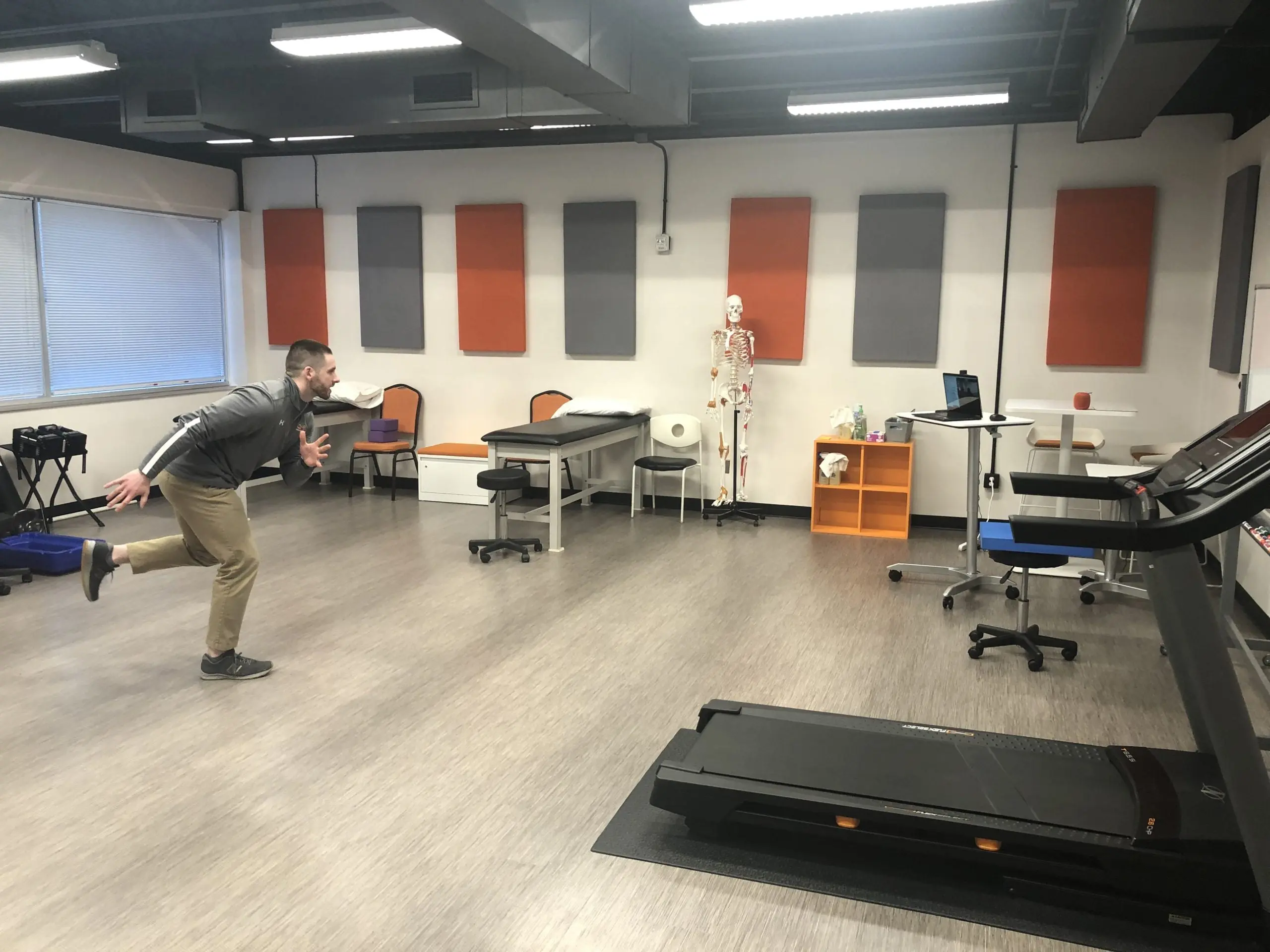
Below are 2 drills that we often use during movement preparation prior to running. Each drill practices single leg balance, the ability to shock absorb on one leg, and trunk rotation. These are all attributes necessary for running.

Single leg knee to chest
Forward lunge with cross connect

Furthermore, if you have been sitting at a desk for the majority of the day, you may need a more comprehensive warmup. On the other hand, if you have an active job requiring you to move in a variety of different ways then your warmup may not need to be as comprehensive.

Movement preparation is necessary, however it is essential to be purposeful, rather than mindlessly performing the same thing before every workout.

2 Simple Drills to Improve your Running Times

As a dedicated runner you likely have suffered an injury at some point. Perhaps it forced you to seek performance physical therapy. Whether you realized it or not, this injury limited your ability to train effectively.

At CHP, we consistently help runners in Chevy Chase and Bethesda overcome injuries that otherwise would limit their ability to train, ultimately causing disappointing results.

There is not a one size fits all solution to helping all runners; however, we often discover that runners are limited by their hamstrings.

Are you concerned that hamstring stiffness or weakness could be limiting your performance?

Your hamstring is responsible for keeping your heel close to your bottom during the heel recovery phase of the running cycle. This portion of the cycle occurs as you bring your leg back underneath your body to prepare it to strike the ground again. The closer you can keep your heel relative to your bottom, the better! This allows you to efficiently move your leg faster through space, resulting in faster times. Below is a drill we prescribe to many runners to improve this attribute.


When running the hamstrings also need the ability to lengthen as the thigh is in front of the body. This should be achieved without drastically changing the position of the pelvis. Many runners struggle to maintain control of their pelvis as the hamstring lengthens. This increases the stress placed onto a variety of soft tissues through the lower body and alters foot strike position. Below is a drill to improve these capabilities.


A thoughtful and more scientific approach to training, specifically designed for runners is likely all that you need to drastically improve your running performance. It may not even require you to train any harder, just smarter!

×