ACL Rehabilitation & Prevention · McLean & Bethesda

Your ACL Recovery Deserves More Than a Calendar.

At Cohen Health and Performance, we treat ACL injuries with the same objective rigor used in professional sports. That means technology-driven testing and physical therapy directed by PTs that specialize in the treatment of elite level athletes. We follow a clear, criteria-based path, not a generic timeline, back to the sport you love.

9–12 months
Recommended minimum recovery for cutting and pivoting sports before return
≤10%
Leg-to-leg force asymmetry target before clearing for sport-specific activity
3.0 Nm/kg
Quadriceps torque benchmark relative to body weight, the strength standard we train toward
5
Objective criteria evaluated before any return-to-sport clearance decision is made
Post-Surgery & Injury Rehab

Getting back isn't a date. It's a standard.

Most athletes are told to wait six to nine months and then they’re cleared. We don’t work that way. Recovery from an ACL tear, with or without surgery, depends on what your body can actually do, not how long it’s been. We measure everything.

Five Pillars:

Quad Activation & Early Recovery

After ACL surgery, the quad doesn't just get weak, it gets disconnected. We use techniques such as neuromuscular electrical stimulation (NMES) to restore the brain-to-muscle signal and prevent the compensatory patterns that stall progress for months.

Force-Plate Strength Testing

We measure bilateral force production and limb symmetry precisely. Not by feel, but by data. This tells us exactly where you are relative to clearance benchmarks and drives every progression decision.

Movement Quality at Game Speed

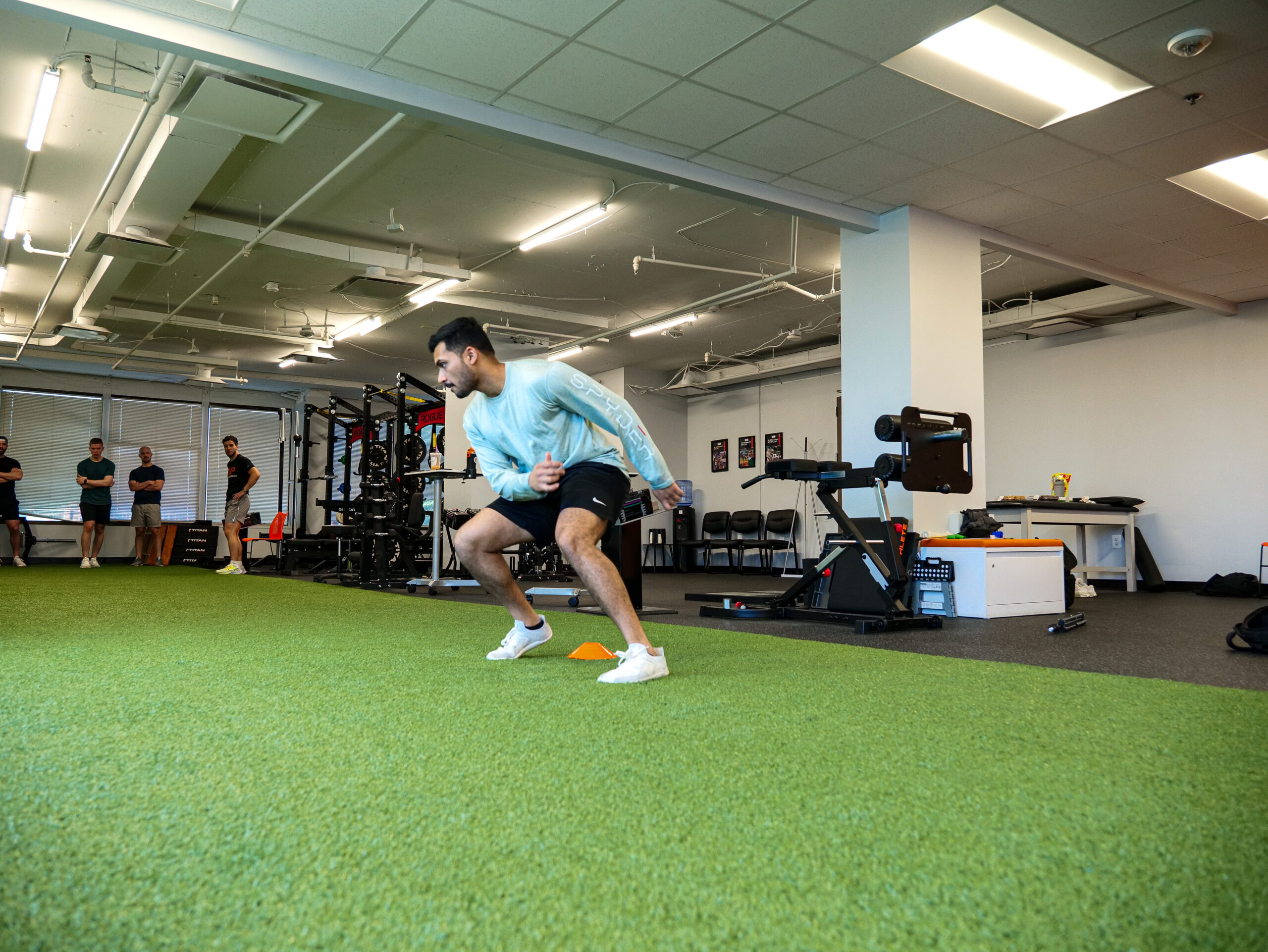
Deceleration control, trunk stability, landing mechanics under fatigue. We assess movement the way it actually breaks down on the field, then rebuild it systematically.

Full Knee Health

Pain-free range of motion, zero swelling, and no instability episodes are non-negotiable prerequisites, not checkboxes to rush through.

Psychological Readiness

Fear of re-injury predicts re-injury. We use validated assessments like the ACL-RSI (ACL Return To Sport After Injury Scale) to track confidence alongside physical metrics, because both have to be ready.

View/Download Full Guide
ACL Injury Prevention

The best ACL rehab is the one you never need.

Most ACL tears are not accidents, they're the result of addressable movement patterns, strength deficits, and biomechanical risk factors that accumulate over time. We find and fix them before they become injuries.

Four areas we address:

Movement Pattern Screening

We assess your landing mechanics, cutting technique, and deceleration control using the same clinical lens we use with post-surgical athletes. The patterns that cause ACL tears show up long before an injury occurs.

Strength & Asymmetry Testing

Leg-to-leg strength imbalances are one of the most significant modifiable risk factors for ACL injury. Force-plate testing gives us precise symmetry data, not an estimate.

Sport-Specific Training

We build strength and movement quality specific to your sport's demands. Cutting, pivoting, jumping and decelerating, so your body is prepared for what the game actually asks of it.

Turf & Surface Awareness

Research shows ACL injuries happen more frequently on artificial turf. We address footwear selection, fatigue management, and warm-up protocols to reduce surface-specific risk.

Prevention work is appropriate for athletes at any stage. Before a season, during training, or as a follow-up to a prior injury. If you want to understand your current ACL risk profile, an evaluation is the right place to start.

Technology Typically Only Reserved for the Pros

We've built our ACL program around the same clinical technology used in professional sports.

Because the athletes who walk through our doors deserve that standard of care, regardless of level.

Five points:

Force Decks

We measure the real force production capacity of each leg independently, identify asymmetries to the decimal, and track your progress against established return-to-sport benchmarks throughout your program.

NMES Neuromuscular Re-Education

Neuromuscular electrical stimulation directly addresses arthrogenic muscle inhibition, the neural disconnect that follows ACL injury. When the quad won't fire voluntarily, NMES re-teaches the pathway from the ground up.

ForceFrame Strength Assessments

Our ForceFrame from VALD measures the maximum force you can produce in specific positions against a fixed resistance, giving us precise, position-by-position strength data that reveals weaknesses traditional gym-based testing can't detect. It's one of the most accurate tools available for identifying exactly where your strength gaps are and tracking how they close over the course of your program.

Dynamo Targeted Muscle Strength Testing

Our Dynamo dynamometers allow us to test the strength of individual muscle groups quickly and accurately throughout your rehab. Rather than estimating progress by how an exercise feels, we measure it, tracking force output across sessions so every progression is backed by data, not guesswork.

GymAware Velocity-Based Training

As athletes progress into the later stages of rehab, we use GymAware technology to measure speed during strength training in real time. Velocity-based training lets us track power output rep by rep, ensuring athletes are training at the right intensity to build explosive strength and giving us an objective signal for when they're ready to advance to the next phase of their program.

Ready to get started?

Whether you're recovering from an ACL tear or looking to understand your injury risk before one happens, our team is ready to help. Reach out directly and we'll get you scheduled right away.

×