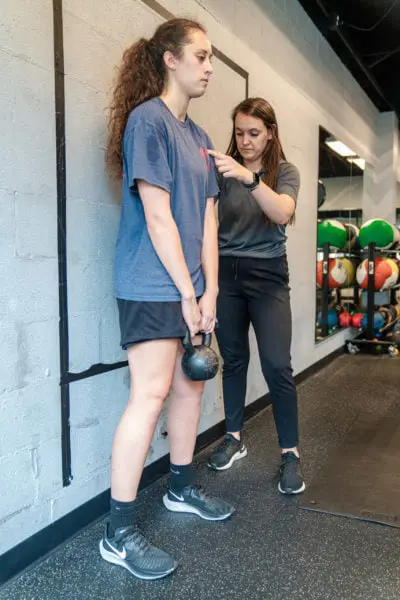
How a physical therapist trains with back pain

Back pain is one of the most common issues encountered in sports physical therapy and injury rehabilitation, especially among runners. Those with sensitive lower backs often need to carefully manage the total amount of activity they perform over time.

It’s particularly important to pay attention to exercises that involve significant axial loading, which refers to weight bearing directly down onto the spine.

Exercises with high axial loading, such as barbell squats, typically involve supporting the weight on the shoulders.

For individuals with back pain, it’s crucial to keep the volume of axial loading reasonable. However, reducing the number of exercises that can be performed may limit progress for those who want to achieve their fitness goals.

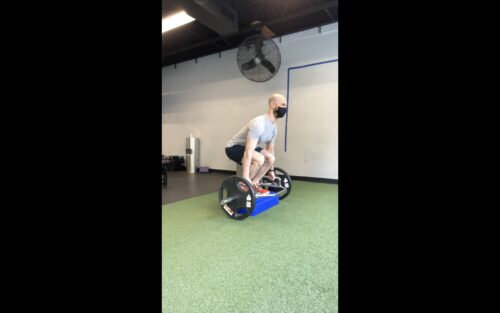
The trap bar squat is an excellent exercise that targets the legs and, when executed correctly, keeps the back feeling great.

Here’s how to do it:

1. Set up a trap bar with a box placed in the center.
2. Stand on the box and position yourself inside the trap bar.
3. Exhale to engage your core by bringing the ribs down and activating your abs.
4. Inhale as you squat down by pushing your knees forward to reach the bar—this is not a deadlift!
5. If needed, reset your abs, take the slack out of the bar, and stand tall as you exhale.
6. Repeat.

Contact us to learn more about improving your gym performance while maintaining a healthy lower back!


What Touching Your Toes Really Says

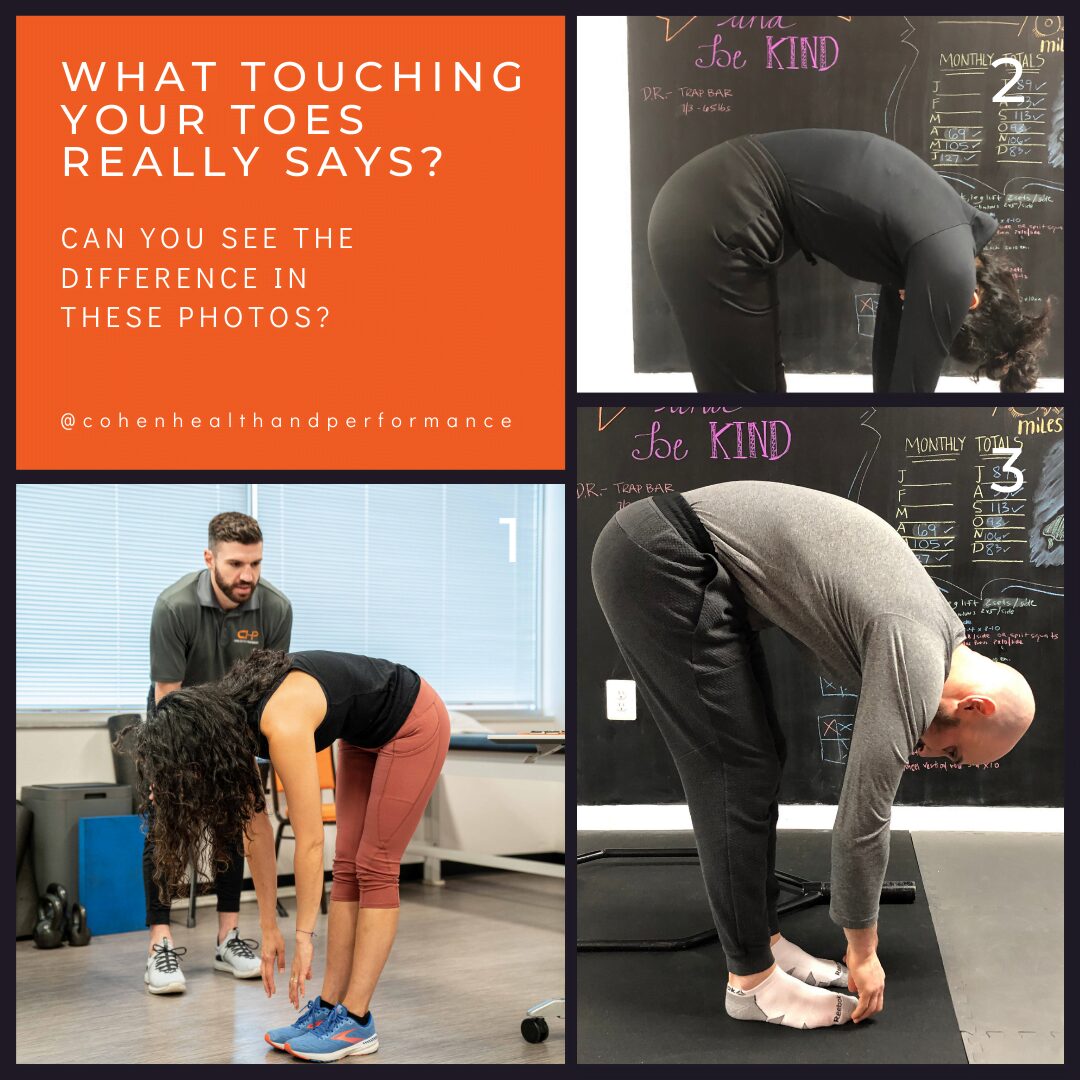
Can you see the difference in these photos? The toe touch is a simple test that is often performed in injury rehabilitation and sports physical therapy settings.

However, important parts of this test are commonly missed. Simply touching your toes doesn’t tell the whole story. If you can touch your toes, great, however there are different ways that you can get there.

Have you stretched your hamstrings to such a degree that they allow you to nearly palm the floor? 

If you are a gymnast that may be a great thing. However field sport athletes (ex. Lacrosse, football, basketball, baseball) and weight lifters need a level of hamstring stiffness for explosive movement. 

Is your lower back straight or does it flex into more of a C curve to allow you to more easily touch your toes? Is your lower back bending in certain areas but not in others?

Your lower back consists of multiple bones (vertebrae) that are stacked on top of each other. Our backs are built this way to allow for movement of one segment on the next. However many times these small movements do not occur and the lower back moves as one unit. The result is a lower back that looks straight in places despite being bent over. Over time, a lack of lower back  movement can increase the risk for injury.

The toe touch is a great test and can be made even better when directed by a professional with a trained eye.

Contact us for more information about how a customized movement assessment may help you optimize your training and avoid injury!

I felt stuck

Times have certainly changed, haven’t they? Just look at all that hair! And it seems like they couldn’t do much about the sun glare on picture day either…

“I really need to stretch more. Should I try Yoga?”

“Everyone’s talking about how Pilates strengthens your core. Maybe I should take a class?”

“I know strength training is crucial, but where do I even begin?”

If you’ve ever had thoughts like these when thinking about exercise, you’re not alone.

The world of health, fitness, sports physical therapy, and injury rehabilitation can feel massive and even a bit daunting. I remember a time when I was unsure about how to approach my own fitness journey.

After wrapping up my college football career, I no longer had coaches designing my training plans. No more structured practices, conditioning workouts, weightlifting sessions, or recovery routines that typically involved stretching, foam rolling, yoga, and light cardio.

With no clear direction, I stuck with what I knew best: lifting weights, following my old off-season routine, and adding a couple of conditioning sessions each week.

After a few weeks of this, I stopped and asked myself a simple but important question: “Why?”

Why was I training this way? What were my goals now? And what were the most effective ways to achieve them? After reflecting and writing down my thoughts, I realized that my training program no longer aligned with my new goals.

My football days were behind me, and it was time to focus on staying healthy long-term.

At the same time, I still enjoyed strength training and the feeling of being strong. Plus, I was working toward becoming a Certified Strength and Conditioning Specialist (CSCS), so I needed to practice what I preached (this was all before I entered sports physical therapy school).

I ultimately designed a new strength training program that focused on increasing strength and muscle mass while also enhancing my mobility. The goal was to feel strong and stay healthy.

This approach worked because I took a moment to slow down and ask myself a few basic questions.

When was the last time you did that? Ask yourself these questions:

– What are the outcomes I want from my training? Do I want to be stronger? Have less discomfort? Improve my mobility? Be honest with yourself.
– What are the best methods to achieve these outcomes?
– If I don’t know the answer to the above, who can help guide me?

As question three suggests, you don’t need to figure it all out on your own. There are experts available who can help you reach your goals, but only you can determine what those goals are.

Once you have that clarity, our team of sports physical therapists in Bethesda and McLean is here to help. Along with being Doctors of Physical Therapy, our Performance Physical Therapists are also Certified Strength and Conditioning Specialists. We specialize in helping injured athletes recover and get back to doing what they love.

An Alternative to X-Rays and MRIs

This week’s article is written by Dr. Michael Auriemma, a member of Regenerative Orthopedics and Sports Medicine. He is a key member of our physical therapy team here in Bethesda and Chevy Chase and has helped many athletes, active adults, and runners overcome injury in conjunction with a comprehensive physical therapy plan. Dr. Auriemma specializes in sports and musculoskeletal medicine, and has received extensive training in the use of sports ultrasound for both diagnostic and interventional procedures.

He is the perfect person to tell us about an alternative solution to X-rays and MRIs that also happens to be a lot easier, quicker, and more pleasant to use!

Enjoy!


Regenerative Orthopedics and Sports Medicine (ROSM) is a growing private practice centered in the DMV.  It is comprised of physicians who specialize in non-operative orthopedic and sports medicine. 

ROSM physicians strive to provide a higher quality of care through extended patient visits (ie. more 1 on 1 time with patients) and the use of diagnostic musculoskeletal ultrasound, a bedside tool that allows for real-time imaging of muscle injuries, tendon and ligament injuries, fascia injuries, arthritis, and nerve entrapments. 

In certain situations, ultrasound can eliminate the need for X-rays or MRIs, while other times it serves as a complimentary imaging modality. 

In addition to advanced diagnostics, ultrasound can also be utilized to guide targeted treatments to enhance recovery.  These include prolotherapy, platelet rich plasma (PRP), bone marrow aspirate concentrate (BMAC), and microfragmented adipose transfers (MFAT). 

ROSM physicians help patients choose appropriate treatments through a combination of evidence-based research and individual patient needs.

Visit our website to learn more!

-Dr. Michael Auriemma, MD

CHP Spotlight Interview: Dr. Scott Faucett

Do not miss this interview with internationally renowned orthopedic surgeon, Dr. Scott Faucett! Dr. Cohen and Dr. Faucett discussed a myriad of different topics that pertain to the worlds of physical therapy, athletics, performance, and surgical medicine. This interview is a MUST SEE if you are experiencing any hip or knee pain, or simply wish to learn more so that you can increase the longevity of these joints!

Reach out to Dr. Faucett via the information below

scottfaucettmd.com

(202) 912-8480

clinical@scottfaucettmd.com

Want to return to running after an ankle sprain?

Ankle sprains are often dismissed as minor injuries, yet they frequently lead runners and other athletes to seek physical therapy.

The seriousness of these injuries is frequently underestimated, with athletes returning to their activities too soon.

The most common type of ankle sprain that we see in physical therapy is an inversion sprain, where the foot typically remains planted as the ankle turns inward, causing the outer edge of the foot to roll onto the ground—hence the term “rolled ankle.” This motion damages the ligaments on the outside of the ankle, often leading to varying degrees of tears.

The severity of the injury and the number of ligaments affected determine the grade of the sprain, ranging from grade 1 to grade 3.

After an ankle sprain, it’s crucial to rule out a fracture. Athletes should seek an X-ray if they are unable to bear weight on the injured leg or experience severe pain around the malleolus (the prominent ankle bone on the outside).

If no fracture is found and the aforementioned symptoms are absent, the focus can shift to gradually returning to running.

During running, there is never a moment when both feet are on the ground simultaneously. This means the body is continuously bouncing from one leg to the other, placing repeated stress on the ankles as they absorb the full impact of the body.

Unfortunately, after an ankle injury, the capacity of the affected area to handle stress (the cumulative amount it can bear before re-injury) is significantly reduced. As a result, recovery from an ankle sprain often takes longer than expected, with many athletes attempting to run before their ankle has fully healed.

To ensure a safe recovery, injured tissues need to gradually reacclimate to the stress associated with running or other sports.

A careful and progressive return to running might start with non-weight-bearing movements, gradually advancing to low-impact, weight-bearing exercises such as squats, split squats, and lunges. From there, single-leg activities like balance drills and single-leg squats can be introduced, followed by plyometric exercises involving two-legged jumps, and eventually, hopping on one leg.

Finally, activities such as jump roping, short runs, and longer runs can be reintroduced into the routine.

In summary, every ankle sprain is unique, making it essential to have a trained medical professional assess the injury to rule out a fracture. This professional can then design a personalized return-to-sport program tailored to your needs.

For further assistance and information on how we can help, you know where to find us!

×