Fact or Fiction: Do our bodies actually fall out of alignment?

We are excited to begin a series of posts discussing common myths in the realm of athletic physical therapy. Today’s myth commonly applies to back pain physical therapy as well.

Many of our patients have been told that their body may be “out of alignment”, or that their joints need to be “re-aligned.” Unfortunately, this is not the greatest advice.

Human beings are never in a static position. Even at rest, the simple act of breathing creates movement. By definition, being in alignment means that our bodies are in a straight line, or that all parts of our body are consistently in the appropriate relative positions to one another.

We cannot consistently be in alignment because we are always moving. If our body was constantly aligned, we would be unable to move anywhere.

Your body can feel as if it is out of alignment when you overuse or rely upon specific movement strategies or body positions. This can happen for a myriad of reasons and results in feelings of stiffness and discomfort that often temporarily feel better with an adjustment.

An adjustment can be helpful if the causes of stiffness or discomfort are also addressed. The root causes of stiffness or discomfort are typically addressed by focusing on movement limitations that are present.

Any relief provided by an adjustment will be temporary when the root cause of the discomfort or stiffness is left unaddressed. Check out the article below for some activities that may help!

3 Home Exercises to Help Your Back Pain

We hope that this provided some insight into a common rehab myth. Stay tuned for more to come!

Could this be the missing piece of your marathon training?

In a previous blog post, we introduced mat Pilates and how it helps people that are struggling with back pain.  However, many athletes use Pilates to improve other aspects of their performance and CHP’s own, Dr. Ciara Petry, uses it as part of her physical therapy treatment sessions.

As you know, Bethesda and Chevy Chase are packed with athletic people and runners of all levels. Many of these runners are preparing for a variety of races. Running volume increases as a runner prepares for a race, which increases the need for cross training. Cross training allows runners to enhance qualities that improve running performance.  However, it is important to avoid adding more pounding to the body in the process.

At Cohen Health and Performance, we have found Pilates to be incredibly helpful in this regard. Weekly supplementation of Pilates training helps to improve performance and/or reduce the risk of running related injuries.

Pilates includes low impact and multi-planar movements that enhance core stability, mobility, and other foundational components necessary for healthy running.

In an article published in 2018, Finatto et al performed a study measuring the effect of a 12-week Pilates mat program on running performance. The participants in this study were separated into 2 groups. Both groups participated in a run training program, however one of the groups also participated in classic mat Pilates training 2x/week for 1-hour per session. The study found that the Pilates group had been more resilient to fatigue when running. It was also found that runners in the Pilates training group significantly improved their 5-km times, thus suggesting that distance runners can transfer the gains made in Pilates to running!

Integrating Pilates into a runner’s performance training just 1-2x/week can improve running efficiency and performance. How cool is that?!

Here at CHP, we help our athletes conquer injury and optimize performance. Reach out today to schedule a running analysis with one of our performance physical therapists and to Dr. Ciara Petry, a certified Mat Pilates instructor, for personalized Pilates sessions!

Article for Reference: https://journals.plos.org/plosone/article?id=10.1371/journal.pone.0194057

Why Some Warmups Aren’t Useful

As performance physical therapists in Bethesda and Chevy Chase, we work within a very knowledgeable and active community.  Our clients and patients understand the importance of warming up.

Warming up is commonly touted as essential for anyone wishing to avoid injury during exercise, performance training, or running.

We agree with this statement; however, warmup routines are often implemented in a non-productive way.

There is a time and place for everything, however this does not mean that you need to stretch, roll around on the ground, and perform “activation” drills prior to being ready for exercise.

In addition to increasing total body temperature, a warmup routine should prepare the body for the specific workout that is going to take place. For this reason, we call warming up “movement preparation.” The body is being prepared to move!

Movement preparation should include drills that train the skills necessary for the day’s workout. Many times, these drills will look similar to the exercises within that day’s work out.

If you are getting ready to run, perform activities that practice things necessary to run effectively. If you are going to lift weights, practice movements similar to the lifts you are going to perform (ie. If you are going to squat, then squat in your warmup!).

This advise applies regardless of whether you are healthy, injured, in performance physical therapy, or training for performance.

Below are 2 drills that we often use during movement preparation prior to running. Each drill practices single leg balance, the ability to shock absorb on one leg, and trunk rotation. These are all attributes necessary for running.

Single leg knee to chest
Forward lunge with cross connect

Furthermore, if you have been sitting at a desk for the majority of the day, you may need a more comprehensive warmup. On the other hand, if you have an active job requiring you to move in a variety of different ways then your warmup may not need to be as comprehensive.

Movement preparation is necessary, however it is essential to be purposeful, rather than mindlessly performing the same thing before every workout.
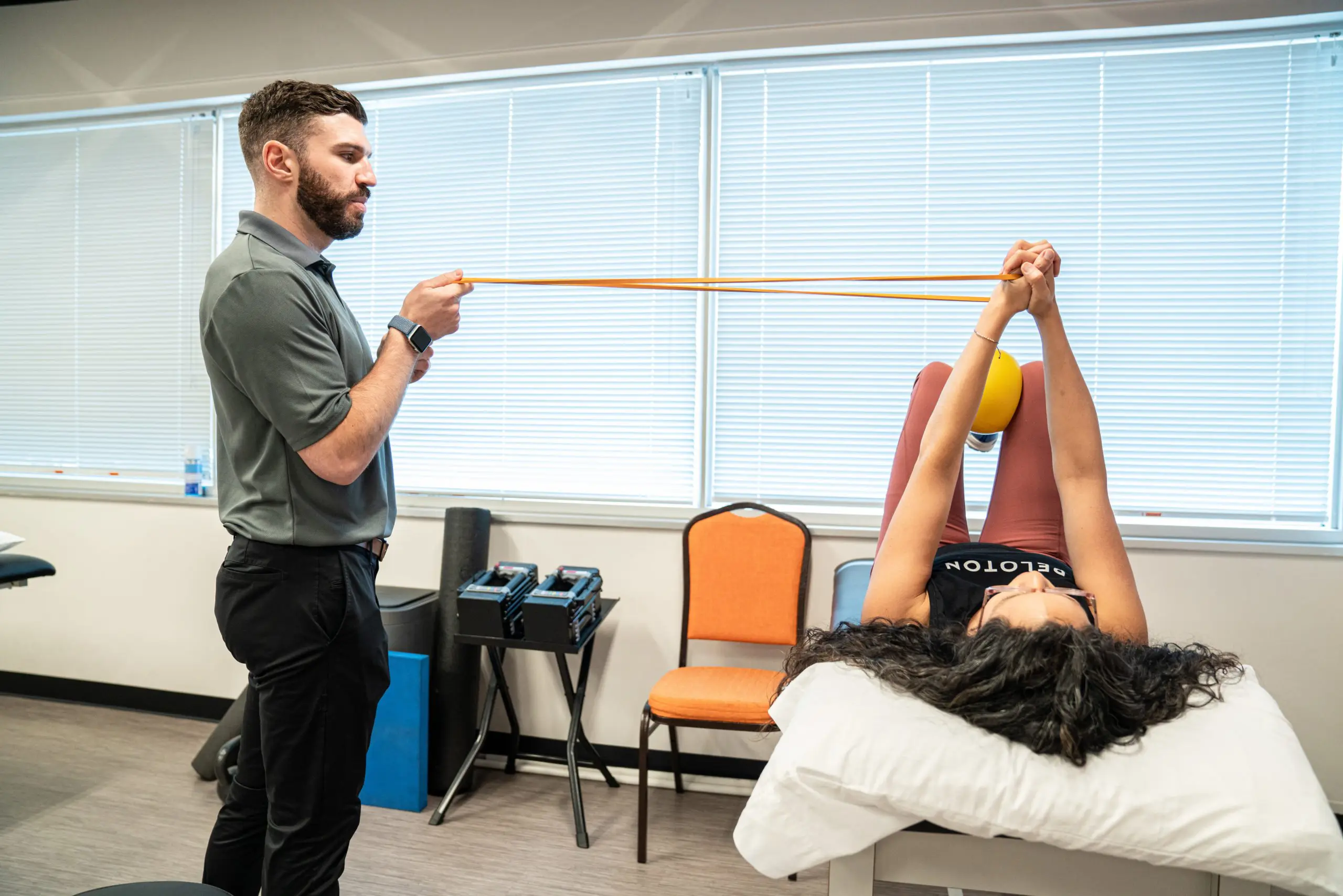
3 Home Exercises to Help with Your Back Pain

Did you know that according to research, over 70% of Americans will experience back pain during their lives?

Surprisingly, this statistic remains high among active people. Sometimes their training even contributes to it!

One of the things you can do to help reverse this trend is to implement Pilates into your training. Dr. Ciara is a physical therapist and certified Pilates instructor. She has taught us how to incorporate Pilates into the treatment of physical therapy patients right here in Bethesda and Chevy Chase. These principles can also be used in performance training.

The good news is that Pilates doesn’t require you to go to a Pilates studio. Many Pilates exercises can be done from home and performed within your training regimen.

Begin with the 3 exercises below.

  1. Roll like a ball into Zen Teaser (C-Curve)
  2. Single Leg Stretch
  3. Curtsy Reach

The goal of these activities are to teach you how to control your body using your deep abdominals and glutes. Therefore, it is essential to focus on quality of movement, rather than the quantity performed. There are no heros with these exercises!

To learn more about Pilates, check out last weeks article below!

What Actually is Pilates?

Training with back pain may only require a simple modification

Back pain is a prevalent and debilitating condition affecting a significant portion of the global population. Studies indicate that more than 70% of individuals will experience back pain at some point. The diverse ways back pain can manifest make it a complex challenge for patients and physical therapists. However, physical therapy is an effective way to alleviate and manage this common ailment without surgery.

Practitioners often encounter many symptoms and triggers when treating patients with back pain through physical therapy. One remarkable aspect of this approach is that patients, particularly physically active ones, are keenly attuned to the movements that provoke their pain. Two common movements that often exacerbate back pain are deadlifts and squats, both of which are integral to various exercise routines.

Deadlifts, which involve bending at the hips to lift objects from the ground, are notorious for triggering back pain in many individuals. This movement positions the spine horizontally relative to the ground, subjecting it to significant shearing forces. Shearing force is the mechanical stress that results from one vertebra wanting to move forward or backward relative to the one above or below it. For people with back pain, deadlifts can intensify the discomfort due to the stress placed on the spine during this movement.

Squatting is another common exercise that can exacerbate back pain, especially when performed with resistance, such as lifting weights. Unlike deadlifts, squats require a vertical orientation of the spine, leading to increased vertical compression against gravity. This added pressure can be a source of pain for many individuals suffering from back issues.

If you experience back pain, it’s essential to consider the specific movements that trigger your discomfort. Is your pain more pronounced when lifting objects from the floor or when engaging in squatting exercises with added resistance? This distinction can help guide your approach to managing and alleviating your back pain.

If deadlifting worsens your back pain, temporarily replace this exercise with squatting variations in your training program. While this isn’t a permanent solution, it can help you find relief from pain while addressing the underlying causes of your discomfort. Physical therapy can be instrumental in guiding you through these modifications and ensuring you perform the exercises correctly and safely.

Conversely, if your pain intensifies during squatting exercises with resistance, consider switching to single-leg squat variations as an alternative to traditional double-leg squats. Again, this approach is not meant to be a permanent solution but can provide temporary relief while targeting the root cause of your pain.

Consider contacting a qualified physical therapist for comprehensive support in addressing the root causes of your back pain. These professionals have the knowledge and expertise to develop personalized treatment plans tailored to your specific condition and needs. With the guidance of a physical therapist, you can work towards a long-term solution to your back pain, improving your overall quality of life and well-being.

Back pain is a common and multifaceted issue that affects many individuals. Physical therapy offers valuable solutions for managing and alleviating back pain by addressing the specific movements that trigger discomfort. Whether it’s deadlifts or squats, modifying your exercise routine with the guidance of a physical therapist can help you find relief while tackling the root causes of your pain. Don’t hesitate to seek professional assistance in your journey towards a pain-free and healthier back. Contact us for help with your back pain today!

Physical therapy for back pain often requires only 1 simple modification

Back pain remains as one of the leading causes of disability worldwide and according to research, over 70% of people will experience back pain at some point in their lives and likely require back pain physical therapy.

When back pain is measured among such a large number of people, it is impossible for each person to specify the different ways in which their back pain presents.

When treating physical therapy patients with back pain, we see this pain present in many different ways. Since we treat such active people, our patients are very aware of the different movements that elicit their symptoms.

Many times, picking objects off the floor, aka deadlifts, produce their back pain. During these movements, the body bends over by folding at the hips. This moves the spine into a position that is horizontal relative to the ground, resulting in more shearing forces within the spine. Shearing force is the force of one vertebra wanting to move forward or backward relative to the one above or below it.

For many others, squatting movements are problematic, specifically when squatting with resistance (such as when lifting weights). When squatting the spine is vertically oriented (compared to a deadlift) resulting in more vertical compression against gravity.

Do you have back pain? If so, is it worse when picking things up off the ground or when squatting with resistance?

If it is worse when picking things up off the floor, aka deadlifting, you may want to consider replacing deadlift exercises with squatting variations within your performance training program. While this should not be a permanent solution, it can help you get out of pain while addressing the root causes of the issue in physical therapy.

If your pain worsens when squatting with resistance, you may want to consider switching to more single leg squatting variations in place of double leg squats. Once again, this should not be a permanent solution (although single leg exercises are awesome!), however it can help you get out of pain while addressing the root cause of your pain.

For help addressing the root cause of your pain, contact us!

×