How a physical therapist trains with back pain

Back pain is one of the most common issues encountered in sports physical therapy and injury rehabilitation, especially among runners. Those with sensitive lower backs often need to carefully manage the total amount of activity they perform over time.

It’s particularly important to pay attention to exercises that involve significant axial loading, which refers to weight bearing directly down onto the spine.

Exercises with high axial loading, such as barbell squats, typically involve supporting the weight on the shoulders.

For individuals with back pain, it’s crucial to keep the volume of axial loading reasonable. However, reducing the number of exercises that can be performed may limit progress for those who want to achieve their fitness goals.

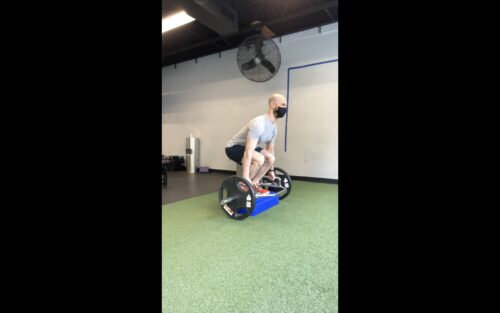
The trap bar squat is an excellent exercise that targets the legs and, when executed correctly, keeps the back feeling great.

Here’s how to do it:

1. Set up a trap bar with a box placed in the center.
2. Stand on the box and position yourself inside the trap bar.
3. Exhale to engage your core by bringing the ribs down and activating your abs.
4. Inhale as you squat down by pushing your knees forward to reach the bar—this is not a deadlift!
5. If needed, reset your abs, take the slack out of the bar, and stand tall as you exhale.
6. Repeat.

Contact us to learn more about improving your gym performance while maintaining a healthy lower back!


What Touching Your Toes Really Says

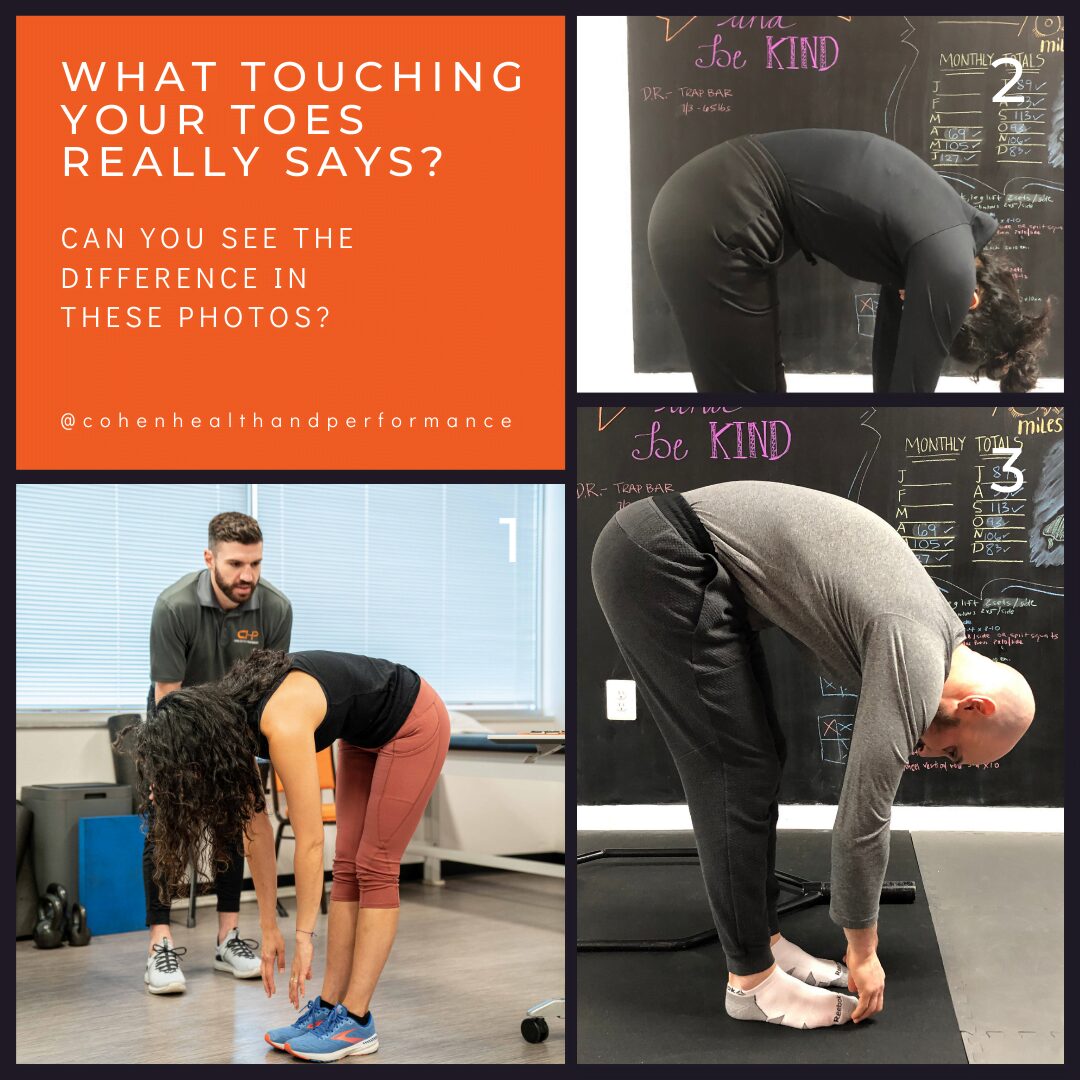
Can you see the difference in these photos? The toe touch is a simple test that is often performed in injury rehabilitation and sports physical therapy settings.

However, important parts of this test are commonly missed. Simply touching your toes doesn’t tell the whole story. If you can touch your toes, great, however there are different ways that you can get there.

Have you stretched your hamstrings to such a degree that they allow you to nearly palm the floor? 

If you are a gymnast that may be a great thing. However field sport athletes (ex. Lacrosse, football, basketball, baseball) and weight lifters need a level of hamstring stiffness for explosive movement. 

Is your lower back straight or does it flex into more of a C curve to allow you to more easily touch your toes? Is your lower back bending in certain areas but not in others?

Your lower back consists of multiple bones (vertebrae) that are stacked on top of each other. Our backs are built this way to allow for movement of one segment on the next. However many times these small movements do not occur and the lower back moves as one unit. The result is a lower back that looks straight in places despite being bent over. Over time, a lack of lower back  movement can increase the risk for injury.

The toe touch is a great test and can be made even better when directed by a professional with a trained eye.

Contact us for more information about how a customized movement assessment may help you optimize your training and avoid injury!

Why We Need to Stop Comparing Adult Movements to Children’s

It has become common in fields of physical therapy and performance training to compare adult movement to the ways that babies move. You may have spoken to a professional that uses this comparison in their approach.

The logic usually goes something like this…“Humans were born with the ability to squat fully, and our modern lifestyles robbed us of that ability, so we need to regain it.”

Sounds understandable, right?

I thought so too. I even took a couple of continuing education courses based loosely upon this concept. The class instructors showed pictures of babies at various development stages and attempted to teach movements that mimicked these phases. The idea was to help adults gain back some of the movement capabilities that they once had as children and this new freedom of movement would help to alleviate pain and resolve injury.

Adults Are Not Babies

While I think we’d all love to be able to squat to the floor, crawl around all day, and never get tired, the truth is that we are not babies anymore.

Babies have a large amount of joint laxity that allows them to get into a variety of different positions, that we don’t have as adults. Babies also have a very large head in relation to the body, which helps to provide a counterbalance for easy squatting. In fact, according to Healthline, many of a baby’s bones are composed of cartilage, a type of connective tissue that is tough but flexible. This cartilage turns to bone as we grow.

Their bodies are still growing and changing. They fall often and make mistakes (essential for learning), which flexibility and mobility help with. Because of this, the ability to squat to the floor is normal for a baby. The same cannot always be said for adults.

Adults are not babies, and we cannot use a baby’s movement as a model for how an adult should move. Not only do babies have much different bone and structural compositions, but all adults have different movement capabilities due to variations in torso lengths and body proportions (among other reasons). Using singular movement standards would overlook this critical aspect.

It is nice to think that we could be able to squat to the floor like we once did when we were a toddler. However, adults are not babies, and our bodies are not the same as they once were.

Because of this, we do not expect our physical therapy patients to squat to the floor. It is essential for all of us to set realistic movement standards that will help to live pain-free and healthy lives. For help in the arena, talk to our experienced physical therapy team in Bethesda!

Why Rest Often Makes Back Pain Worse

I’m sure you’ve heard it before…“Weight training is back for your back! Be careful.”

Although this mindset is common, after years of treating sports physical therapy patients in Bethesda and Chevy Chase, we’ve actually found the opposite to be true. According to Michael Mash, DPT, back pain from time to time is actually normal and usually resolves itself without treatment or the need for expensive medical attention.

In fact, research shows that sedentary activity, like sitting on the couch watching Netflix, can actually make back pain worse. Oftentimes, after a small “tweak” or “flare-up” from lifting weights, many athletes can self-manage by simply avoiding painful movements while focusing on exercises that still feel comfortable.

All in all, weight training is not the single source of low back pain. There are several contributing factors — including lifestyle, diet, and exercise form. The body is incredibly resilient, and with a little education and practice, you can enjoy an active lifestyle while staying healthy and pain-free!

Surprising Benefits of Walking for Mental and Physical Health

“Morning Walk” by /\ltus is licensed under CC BY-NC-ND 2.0

One important but often overlooked aspect of a healthy lifestyle and even injury rehabilitation is walking. Walking is a simple way to improve physical fitness and health while reducing the risk of various diseases.

The Benefits of Walking

Physical activity doesn’t need to be complicated. Although walking is often overlooked, science shows that putting one foot in front of the other can have some impressive mental and physical benefits.

  • It helps to maintain a healthy weight and trim body fat.
  • Increases energy levels and improves mood, memory, and sleep.
  • Reduces stress and tension in the body.
  • It eases joint pain and boosts immune system function.
  • Improves cardiovascular health and muscle endurance.
  • Reduced risk of common health problems such as heart disease, obesity, diabetes, and high blood pressure.

You may be asking yourself, “That sounds great, but how much should I be walking to reap all these benefits?”

How Many Steps Should You Get Per Day?

Walking is one of the best low-impact forms of exercise that can be done on a lunch break, while talking on the phone, or to get to your favorite coffee shop down the street.

Although the exact number of steps per day can vary based on age, health, and fitness goals, most experts recommend at least 10,000 steps per day. As a general rule of thumb, the faster, farther, and more frequently you walk, the greater the benefit you’ll experience.

By completing 10,000 steps per day, most adults can burn an extra 2,000–3,500 calories while also reaping the incredible benefits of additional cardiovascular exercise.

Not only is walking a great time to disconnect and unwind, but it will also improve your mental and physical health. 10,000 steps per day is a great goal for anyone looking to jumpstart a healthy lifestyle. However, if you want a more personalized approach, a physical therapist from our clinic in Bethesda can help!

How Stiff Ankles Lead to Back Pain

Those of you that have been to athletic physical therapy have likely learned about how a limitation in one area of the body can contribute to pain or injury elsewhere. It is common to find that runners, fitness enthusiasts, and other active people experiencing chronic lower back pain also have stiff ankles.

Exercises such as squats and lunges are a staple of many workouts and group exercise classes. These movements, in addition to many others, require a great deal of ankle dorsiflexion (the action of the knee moving over the toe). If an individual has stiff ankles and wishes to perform these activities, he or she must compensate and figure out another way to complete the exercise.

People are forced to reach their bottoms farther backwards when stiff ankles prevent their knees from advancing far enough beyond their toes. This pushes belly button forward in an effort to avoid falling backwards. As a result, the lower back arches excessively, compressing the area, and often results in discomfort.

Check out the article below from fellow Northeastern University Alumni, and former Physical Therapist for the Red Sox, Mike Reinold, to learn how you can measure if you have enough ankle dorsiflexion.

Ankle Mobility Exercises to Improve Dorsiflexion

Now that you measured your ankle dorsiflexion, what do you do about it if it?

In addition to some of Mike’s great recommendations, we suggest that you try the activities below from Dr. Cody!

If any of these activities cause pain or result in a pinching sensation in the front of the ankle, please contact us.

Have fun!

×