Athletes Need Strong Breaks Before They Can Hit The Gas

Athletes must have great breaks before they are able to hit the gas. When they don’t, that is when they find themselves in a sports physical therapy setting.

If you are an athlete that wants to jump higher, run faster, and be more explosive, you must first know how to slow down. In fact, this is one of the first things that we work on with athletes during physical therapy and performance training.

Athletes that struggle to absorb the impact of their bodies during explosive movements have a far greater risk of lower body injury. This can be seen when landing from a jump or cutting to change direction as the foot contacts the ground.

A recent example occurred in the most recent Super Bowl. In the 2nd half Odell Beckham Jr. tore his left ACL when he landed on his left leg as he slowed down to make a catch. While doing so his upper body was turned to the right creating a twisting motion at his knee as he attempted to slow down. He was unable to control the rapid breaking and twisting forces occurring at his knee, resulting in a large amount of stress to the ACL and the subsequent rupture of the ligament.

While none of us are athletes like Odell, we must all be capable of controlling the breaking forces that we experience when exercising, running, or playing recreational sports. The more aggressive and competitive the sport, the more force you must be capable of controlling.

This is especially true for youth athletes.

They play very competitive sports and are growing at the same time. Their soft tissues are adjusting to the changes occurring in their bodies and they have yet to develop all their athletic capabilities. These are just a few of the contributing reasons why lower body injuries like ACL tears are so prevalent in youth sports.

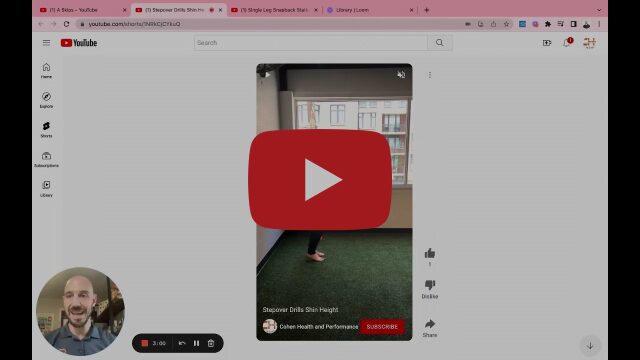
Below are 2 of the first drills that I teach to athletes when they are in physical therapy recovering from or seeking to prevent lower body sport-related injuries during personal training or performance training sessions.

Once you master these seemingly simple drills, you can step things up in a variety of fun ways!

Give these 2 drills a shot and let us know if you have any questions.

2 Drills to Improve Your Running Times

If you are a dedicated runner you likely have suffered an injury and maybe even gone to physical therapy. Whether you realized it or not, this injury limited your ability to train effectively.

Here in Bethesda (and soon to be, McLean!), physical therapy involves helping runners overcome injuries that otherwise would limit their ability to train, ultimately causing disappointing results.

There is not a one size fits all solution to helping runners. However, we often discover that runners are limited by the mobility of their hamstrings.

During a run, the hamstrings need the ability to lengthen as the thigh is in front of the body. This should be achieved without drastically changing the position of the pelvis. Many runners struggle to maintain control of their pelvis as the hamstring lengthens. This increases the stress placed onto a variety of soft tissues through the lower body and alters foot strike position.

Hamstrings, like many other muscles, must be strong when in lengthened positions. Otherwise the body will not allow you to keep any of the short-term flexibility improvements that you have made with stretching.

Below are 2 drills that you can incorporate into your strength training routine to improve hamstring strength and flexibility that the body will hold on to!

Kickstand RDL
Single Leg Eccentric Glute Bridge

A thoughtful and more scientific approach to training that is specifically designed for runners is likely all you need to drastically improve your running performance. It may not even require you to train any harder, just smarter!

What Sprinters Teach Distance Runners

Our physical therapists in Bethesda commonly teach sprinting drills to both distance runners and field sport athletes.

Although distance running and field sports are very different activities, sprinting drills help to correct running form within both groups of people and make a positive impact throughout the physical therapy process.

For runners, sprint training teaches the body to move fast. The greater the speed is that a runner is capable of running, the easier it is to run fast for extended periods of time.

For example, if someone wishes to run a marathon in 4 hours or less, this person needs to average 9:09 minutes per mile. Prior to incorporating sprint training into their routine, this person may have been capable of running 14 mph at maximum speed. After sprint training, this person is now capable of running 15 mph at maximum speed. Due to having a faster maximum speed, running a 9:09 minute mile is now less taxing on the body, therefore requiring less energy to sustain this pace.

For distance runners and field sport athletes, sprinting improves running technique by forcing an individual to pick their hips and knees up in front of their body to larger degree. This helps to change the common habit of kicking legs far behind the body, resulting in further compensations that increase the risk for hamstring injuries among many others.

Check out the video below to learn more about how we coach running technique here at Cohen Health in Performance Bethesda!


Why I Don’t Train Barefoot

Barefoot training and the use of minimalist footwear has become a widely discussed topic in sports physical therapy and the running community. Many folks in the fields of sports medicine, injury rehabilitation, and performance training are all-in on the idea of training in bare feet.

Training barefoot provides great benefits.

The absence of shoes gives the body a direct connection to the ground for quicker and more accurate feedback which helps to improve balance.

Barefoot training also strengthens the feet themselves. When the feet do not have assistance from footwear for support, they must do the entirety of that job for themselves. Muscles, tendons, and ligaments in the feet work to support the arch, the heel, and the forefoot which strengthens them over time. For this reason we often prescribe barefoot training for our physical therapy patients.

However barefoot training is not appropriate for all people.

Most of us walk on hard surfaces like concrete and unlike grass or dirt, concrete is not a forgiving surface. We are unable to manipulate concrete and we have less shock absorption as we step onto harder surfaces.

In addition to an external environment that may not be conducive for barefoot training, many people have unique foot structures or previous injuries that make barefoot training unrealistic. In these situations, a shoe may help their foot function better.

An appropriate shoe allows for the foot to find the ground optimally and properly transition through the different phases of the gait cycle. This allows the body to properly alternate from one leg to the other.

A proper shoe must provide optimal heel control, allow for the arch of the foot to contact the shoe properly (and at the correct time in the gait cycle) and bend only where the toes bend.

The correct shoe can have an incredibly powerful effect on a variety of different ailments and can make a huge difference in the effectiveness of someone’s rehabilitation and training program.

Are you eager to find out if barefoot training is right for you? Contact us today to learn more!

How land training improves swimming performance

Dryland Training: A Swimmer’s Love-Hate Relationship

Dryland training is something every swimmer has a complicated relationship with. However, building strength and power on land is just as vital for enhancing race performance as clocking laps in the pool. Shoulder pain and overuse injuries are the most common issues swimmers face, often limiting their ability to maintain high-level training. So, how can we strengthen our shoulders on land before returning to the water?

Building Shoulder Strength and Resilience

For swimmers, it’s crucial to develop sufficient strength and range of motion in the shoulders to withstand the repetitive demands of a two-hour swim practice. The rotator cuff is key to stabilizing the shoulder during overhead movements and generating power during the pull-down phase. Lift-off drills like this one focus on activating the rotator cuff muscles and building tolerance at the end range of motion. Once comfortable with this drill, incorporating overhead pressing variations and kettlebell stabilization exercises will help engage the larger muscles of the trunk and core, enhancing shoulder resilience.

Developing Full-Body Power

Swimming is a full-body workout, so it’s essential to include elements of full-body power in your dryland routine to prevent injuries during high-speed training or racing. Overhead medicine ball passes are excellent functional exercises that challenge both your overhead strength and full-body stabilization in a dynamic setting. To further simulate the pull-through motion of your stroke, progress to full medicine ball slams—no water required!

What Does It Mean To Be “Out of Alignment?”

“My body feel out of alignment.”

“My <insert healthcare professional here> said that my hips are off.”

“I think I just need to be adjusted.”

These are examples of a few of the comments that patients may express in physical therapy or other injury rehabilitations settings.

The belief that we are like a vehicle that needs to be re-aligned is often the fault of the healthcare industry, including physical therapy.

In the past, healthcare providers would tell their patients that a part of their body is out of alignment and needs to be adjusted to put it back in place. They explain that this is the reason for any discomfort that may be present.

Thankfully, this is no longer taught by most healthcare providers as this thought process has been disproven.

Our bodies are incredibly resilient.

Our joints do not simply fall out of alignment. In fact, our bodies are designed to move and if we were constantly “in line”, it would be impossible to move anywhere!

So, what is happening when an area of our body feels “off”?

As we perform a movement repetitively, compensations and movement limitations become more noticeable.

One area of the body may be moving excessively, while another area of the body may be moving too little.  For example, if your ankle mobility is limited during a squat, you will move excessively at the hips to pick up the slack, causing more stress in that area. As a result, pain, or the feeling of being out of alignment may occur in the hips/pelvis.

If you feel “off” or have been told that you are out of alignment, the solution is likely to begin with discovering what movement limitations may have led to this feeling in the first place. This information can then be used to teach you strategies to move and feel better!

Are you interested in discovering what solutions may be right for you? Contact us to find out more about our physical therapy services!

×