Is there one physical therapy intervention for running related foot injuries?

Ice baths, massage, compression socks, orthotics, rolling your feet out on tennis balls…

Have you tried one or more of these without much help?

This is Dr. Kelly, and as a passionate runner, sports physical therapist in McLean, and someone who doesn’t want to be interrupted by injury, I’ve learned foot pain is complex- there’s usually not “just one thing” contributing to it.

Here are a few things I’ve found to be most important in physical therapy when diagnosing foot injuries:

  1. Foot Type, Biomechanics, and Shoe Type: Each runner has a unique foot structure and biomechanics. High arches, flat feet, overpronation, and supination can affect how your foot strikes the ground. It’s crucial to understand your foot type to choose appropriate footwear and support. Here is a link that better explains foot type. Ensure that your shoes provide adequate cushioning, arch support, and fit your foot shape properly. Regularly replacing of worn-out shoes is essential for injury prevention (recommended replacement after 400 miles of running).
  2. Running Surface: The type of surface you run on can impact foot pain. Hard surfaces like concrete can be harsh on your feet, while softer surfaces like grass or trails offer more cushioning. Varying your running terrain can help reduce the risk of repetitive strain injuries.
  3. Running Form and Mechanics: Variations in running form can strain muscles and joints differently. Understanding your form and what muscles are dominating during your run is important to building strength and endurance as well as overall mechanical balance. A MarchingSkipping, and Single leg hopping are great drills that help enforce foot strike directly under your center of mass and tendon elasticity while running.
  4. Training Intensity and Volume: Overtraining or increasing your running intensity too quickly can stress your feet. Gradual progression and adequate rest are essential for preventing overuse injuries. In general, the best guideline to follow is to increase your volume by 10% per week.

Remember that everyone’s body is unique, and what works for one person may not work for another.

If you would like to finally solve the lower body injuries that are interrupting your ability to run successfully, don’t miss this FREE workshop..
CHP’s Running Performance Lab
Saturday, October 21st at 9am
Cohen Health and Performance
1401 Chain Bridge Rd, Suite 203
McLean, VA 22101

In this workshop, you will discover the root cause of your injuries and learn exercises to solve them.

We only have 5 slots left, so don’t miss your chance to sign up here.
Runners rejoice: how dry needling can help you

It must be your lucky day because we have another guest post from the Clinic Director of our McLean location, Dr. Kelly Henry!

Do you have tight muscles or knots that won’t go away? Maybe you have even gone to physical therapy elsewhere but made minimal progress!

If you are anything like me, you have tried massage, foam rolling, stretching, and whatever else you can think of, but they keep returning.

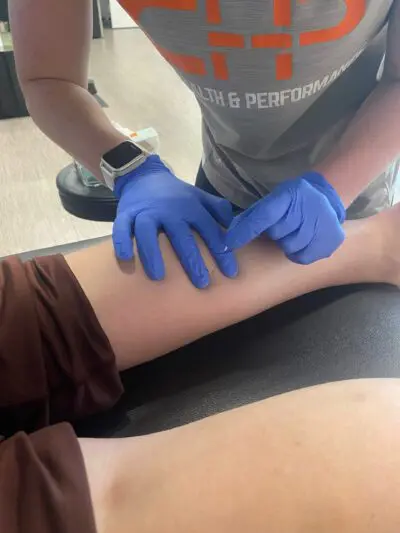
Dry needling could be the solution you are looking for. Running is a very linear and repetitive sport, which increases the risk of developing muscle tightness and symptoms related to overuse. Many runners have experienced relief of chronic quad, calf, hamstring or hip flexor tightness from dry needling.

I recently helped a runner during a physical therapy session at our McLean facility that was experiencing consistent calf pain. It was most intense in the middle of his runs and forced him to reduce his overall mileage. He did everything that he could to fix it. He spent a lot of time warming up before runs, cooling down after runs, and he stretched constantly. But nothing helped.

His first physical therapy session included dry needling for his calf muscles, range of motion drills, and a few adjustments to his running technique, and the chronic calf pain went away!

Dry needling works by targeting a muscle limiting range of motion or causing pain. Your physical therapist will identify which muscle is causing the problem, identify “trigger points” in the muscle, and create a “twitch response” with the needle. A twitch response is a quick contraction that helps the muscle relax. People often feel better just a few moments after treatment! Here are some of the things that my runners have noticed after dry needling:

  • Less tightness during and after runs
  • Improvement in muscle soreness
  • Faster recovery from nagging injuries
  • Improved range of motion and muscle activation during cross training

Dry needling is best used with other forms of physical therapy and rehabilitation, including exercise and neuromuscular conditioning.

If you are a runner that is struggling with chronic injuries or tightness or is looking to optimize your recovery, contact us for a dry needling session in our McLean facility today.

Speaking of serious runners…we have 2 slots still available for a FREE Resilient Runner Injury screen at our McLean facility. If you want to run injury-free for years to come, don’t miss this!

This screen involves the use of our exciting, new Forcedeck technology. Learn more about that here!

Contact us for more information and to sign up.

This is how I ran with an achilles injury

We have a special guest post today! Dr. Kelly Henry, the clinic director of our McLean location, is not only an outstanding sports physical therapist and strength coach but also a former collegiate swimmer at Virginia Tech. In her free time, she dominates triathlons, recently placing 2nd in her latest race. Enjoy her insights!


The Persistent Heel Pain Runners Know All Too Well

Most runners can relate to that dull, nagging pain at the back of your heel—a discomfort that’s more irritating than debilitating. It’s rarely severe enough to stop you from running or send you to physical therapy, but it lingers for a few miles each run, leaving you hoping it’ll fade away, or stretching beforehand in the hope that it won’t bother you.

I experienced this for months while training for my first triathlon. I breezed through the initial weeks, steadily increasing my mileage without any issues—until one day, I felt a twinge at the back of my heel at the start of a long run. The pain disappeared during the run, so I didn’t think much of it. But the next morning, it was back, and the morning after that, it persisted, gradually interfering with my training routine. Determined to stick to my program, I refused to cut back on my running volume or intensity, hoping the problem would resolve on its own. When it didn’t, I sought advice from a physical therapist colleague. Transitioning from a provider to a patient was humbling, but here’s what worked for me:

1) Adjusting My Running Volume

I had to admit that I needed some rest. Once I did, many of my symptoms began to decrease. Along with the strategies below, I slowly reintroduced running, increasing my mileage by no more than 10% per week.

2) Strengthening My Calves and Lower Legs

Tendon injuries often occur when a muscle isn’t prepared for the physical demands placed on it. Strengthening the calves and lower legs is crucial for enhancing load tolerance and reducing the strain on the Achilles tendon. I incorporated exercises like bent knee heel raises and various split squat variations with my heel elevated into my daily routine.


3) Addressing the Underlying Causes of My Injury

In addition to focusing on strength and running volume, I identified specific mechanical adjustments needed to optimize my running form and prevent future injuries. I improved my ankle range of motion and learned to better absorb ground impact. Drills like single leg box jumping and weighted single leg hopping were key in this process.

Are You a Serious Runner Looking to Overcome an Injury?

If you’re committed to running injury-free for years to come, our Resilient Runners Movement Screen is a must!

This screening utilizes our cutting-edge Forcedeck technology. Learn more about it here!

Contact us for more information and to sign up.

3 Tips to Help You Find the Best Shoe

Minimalist shoes, running shoes, cross-training sneakers, weightlifting shoes. As sports physical therapists, personal trainers and performance coaches in McLean and Bethesda, we are asked all sorts of footwear questions. If you are like me, and do several different things, it may seem that you need a special shoe for each activity.

In my closet you can find running, hiking, cross-training, basketball, and special weightlifting shoes. But these days I mostly use 1 pair for all of my training.

I’m more of a generalist now. I dabble in many different things but spend most of my “fitness time” exercising in the gym. Sorry ego, my days of being a specialist are behind me.

If you are training for a particular sport or are a high-level runner, you are a specialist and likely need a special shoe for your sport (and the footwear recommendations in a sports physical therapy setting will be different). But if you are a generalist like me, you need a shoe that is comfortable, designed for your foot type, and can do everything that you need.

Here are 3 things that you should look for to choose the right shoe for you.

  • It must have a firm and snug heel cup. Your heel sits at the base of the shoe, in a place called the heel cup. The heels cup should fit snugly around your heel and should not be much wider than your heel itself. This prevents your heel from sliding within the shoe, which may negatively impact foot mechanics.
  • The shoe must have a toe break that bends where you toes bend. Place your shoe on the ground and hold it there. Pull the front of your shoe up from under it. The folding point of the shoe should be located where your toes bend. If your shoe folds at another location, your shoe is not accommodating to the mechanics of your foot and can lead to breakdown within the structure of the foot itself.
  • You should be able to feel the entirety of both your feet on the ground as you are standing still in your shoes. People are often unable to feel their arches, which results in more stress on the areas that have more contact with the ground.

There are 26 bones and 30 joints within the foot. This results in many ways that our foot can compensate but these 3 tips can help solve these issues.

Would you like help finding the right brand and model shoe for you? Our performance physical therapy team would be happy to provide you with recommendations based on the brands and models that are on the market right now!

Set yourself up for success from your first race

Training for your first running race can be a challenge—where do you begin? What program should you follow? How long should your training last? And what exactly does “training” entail? These are common questions that we, as sports physical therapists and strength and conditioning professionals, frequently encounter.

Training involves conditioning your body to handle the demands you plan to place on it. This usually means gradually increasing the volume or intensity of your physical exercise over time, so you can perform at your best, prevent injuries, and avoid needing a visit to a sports physical therapy clinic like ours!

With countless resources and advice available online, the process can feel overwhelming. Whether you’re preparing for a 5K, marathon, triathlon, or Ironman, here are a few tips to help simplify your training journey:

1. Set Your Goals: Are you simply aiming to finish the race, or do you have a specific time goal? Defining your goals will help you determine the pace and intensity of your training sessions.

2. Assess Your Starting Point: Have you already done any conditioning for this activity, such as recreational running, biking, or swimming? If you’re starting from scratch, you’ll need to begin training earlier than someone who has been consistently active.

3. Incorporate Cross-Training: Include alternative forms of cardio (like swimming, biking, or HIIT training) and strength training in your routine. Different types of exercise target different muscle groups, which is crucial for injury prevention.

4. Taper Before Race Day: Give your body time to recover 1-2 weeks before the race—this isn’t the time to push your highest volume of training.

5. Follow a Structured Program: Depending on your race date, you can find various running programs online that suit your timeframe. Nike.com offers excellent running training plans that you can download!

If you have any questions about the tips above, the sports physical therapists and performance training specialists at Cohen Health and Performance are here to help. While these points provide a solid foundation for starting your running routine, we can offer additional guidance on calculating the right mileage to reduce injury risk, strengthening your muscles to complement your training schedule, and supporting you throughout your race preparation.

2 Drills to Improve Your Running Times

If you are a dedicated runner you likely have suffered an injury and maybe even gone to physical therapy. Whether you realized it or not, this injury limited your ability to train effectively.

Here in Bethesda (and soon to be, McLean!), physical therapy involves helping runners overcome injuries that otherwise would limit their ability to train, ultimately causing disappointing results.

There is not a one size fits all solution to helping runners. However, we often discover that runners are limited by the mobility of their hamstrings.

During a run, the hamstrings need the ability to lengthen as the thigh is in front of the body. This should be achieved without drastically changing the position of the pelvis. Many runners struggle to maintain control of their pelvis as the hamstring lengthens. This increases the stress placed onto a variety of soft tissues through the lower body and alters foot strike position.

Hamstrings, like many other muscles, must be strong when in lengthened positions. Otherwise the body will not allow you to keep any of the short-term flexibility improvements that you have made with stretching.

Below are 2 drills that you can incorporate into your strength training routine to improve hamstring strength and flexibility that the body will hold on to!

Kickstand RDL
Single Leg Eccentric Glute Bridge

A thoughtful and more scientific approach to training that is specifically designed for runners is likely all you need to drastically improve your running performance. It may not even require you to train any harder, just smarter!

×