Maximizing your child’s chance of earning a college scholarship

ONE person has the final decision in determining if your athlete will receive a scholarship to play college sports. The coach.

Coaches are most concerned with keeping their jobs or earning job opportunities at more prominent programs.

If your athlete can help a college coach with either, a scholarship may be coming their way!

On the other hand, coaches hate inconsistency. When talented players cannot play consistently, a coach can’t trust that they can win consistently, and inconsistent winning equals a lack of job security.

What is the number 1 reason an athlete is unable to play? You guessed it, injury.

I remember speaking to a college football coach in Texas who told me that he would rather have a good player that is consistently healthy than a great player who is always in physical therapy and injury prone. He went on to say that he likes players who overcame an injury and stayed healthy afterward. To the coach, this indicated a strong work ethic, a resilient mindset, and commitment to the physical therapy and performance training process. 

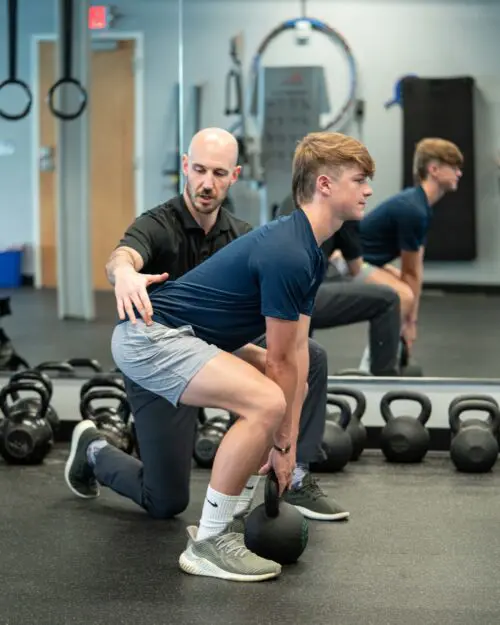
A comprehensive strength training program is best for athletes to stay healthy or overcome a lengthy injury history. Now that summer is here, this is the perfect time for your athlete to get started!

But finding the best strength training solution can be challenging. You should look for three things in your athlete’s strength training program.

  1. Qualified and Experienced Coaches: Look for coaches with a track record of working in your athletes’ sport or discipline. They should demonstrate a strong understanding of exercise science and sport-specific training.
  2. Individualized Program Design: A quality strength training program is tailored to the specific needs and goals of the athlete. Look for programs that start with an individualized assessment to identify strengths, weaknesses, and areas of improvement. The program should be designed to address your athlete’s unique characteristics.
  3. Goal Alignment: Your athlete’s strength training program should align with their goals and sport. Look for programs that incorporate exercises, training methods, or progressions relevant to your athlete’s sport. 

Are you interested in finding the best summer training program for your athlete? 

If so, contact us to participate in our rising-star training assessment.

This assessment will show you and your athlete the secret to helping them avoid injury and take their performance to the next level. 

Why most sports physical therapy for ACL injuries is incomplete

Picture this: Four months ago, you underwent surgery to repair a torn ACL (anterior cruciate ligament) in your knee, and you’ve been diligently attending sports physical therapy ever since. Initially, you were on crutches, with a swollen knee that barely moved. But after several weeks of physical therapy, you regained full range of motion and relearned how to walk normally. You’ve even started running again and are eagerly anticipating the day you can return to practice or the activities that make you feel like an athlete!

But then, your physical therapist informs you that you’re being discharged from therapy…

This scenario is common because insurance companies often don’t classify return-to-sport activities as “medically necessary.” As a result, most traditional physical therapy clinics don’t offer return-to-play programs.

I refer to this crucial stage of recovery as “the gap.” The gap represents the period between completing physical therapy and beginning performance or personal training.

Many athletes aren’t actually ready to return to their sport when they’re discharged from physical therapy because they haven’t yet bridged this gap between rehabilitation and peak performance.

At this stage, athletes may be pain-free, have full knee range of motion, and even have regained much of their strength. However, they still need to train their knee to use that strength explosively and withstand the demands of cutting, jumping, and sprinting.

Unfortunately, many athletes skip this vital phase of ACL recovery, returning to their sport before their knee is fully prepared. This significantly increases the risk of re-injuring the repaired ACL or even damaging the other knee.

Programs designed to help athletes bridge this gap typically start with tests to assess how close they are to returning to their sport. These tests often include hops, agility drills, and movements specific to the athlete’s sport.

In our Bridge The Gap ACL program, we begin with the single-leg hop test. Research suggests that the surgically repaired leg should be at least 90% as strong as the unaffected leg before engaging in sport-specific activities. Ideally, both sides should be equal before an athlete resumes full practice.

Below is an example of a single-leg hop test.


Sports physical therapists use the results of these tests to create a tailored training program that combines elements of physical therapy, strength and conditioning, and sports performance.

Research indicates that the earliest an athlete can safely return to play after ACL surgery is around nine months (even longer for younger athletes). For this reason, most bridge-the-gap programs last between 2-4 months.

Interested in learning whether our Bridge the Gap ACL Program is right for you? If you or your child is recovering from an ACL repair, contact us to find out more!

×