Maximizing your child’s chance of earning a college scholarship

ONE person has the final decision in determining if your athlete will receive a scholarship to play college sports. The coach.

Coaches are most concerned with keeping their jobs or earning job opportunities at more prominent programs.

If your athlete can help a college coach with either, a scholarship may be coming their way!

On the other hand, coaches hate inconsistency. When talented players cannot play consistently, a coach can’t trust that they can win consistently, and inconsistent winning equals a lack of job security.

What is the number 1 reason an athlete is unable to play? You guessed it, injury.

I remember speaking to a college football coach in Texas who told me that he would rather have a good player that is consistently healthy than a great player who is always in physical therapy and injury prone. He went on to say that he likes players who overcame an injury and stayed healthy afterward. To the coach, this indicated a strong work ethic, a resilient mindset, and commitment to the physical therapy and performance training process. 

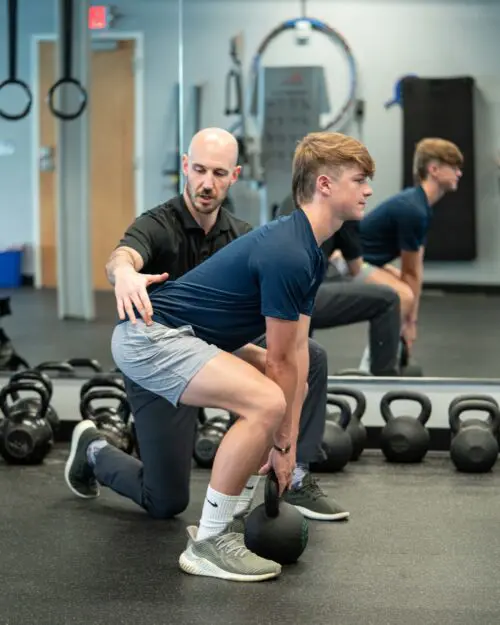
A comprehensive strength training program is best for athletes to stay healthy or overcome a lengthy injury history. Now that summer is here, this is the perfect time for your athlete to get started!

But finding the best strength training solution can be challenging. You should look for three things in your athlete’s strength training program.

  1. Qualified and Experienced Coaches: Look for coaches with a track record of working in your athletes’ sport or discipline. They should demonstrate a strong understanding of exercise science and sport-specific training.
  2. Individualized Program Design: A quality strength training program is tailored to the specific needs and goals of the athlete. Look for programs that start with an individualized assessment to identify strengths, weaknesses, and areas of improvement. The program should be designed to address your athlete’s unique characteristics.
  3. Goal Alignment: Your athlete’s strength training program should align with their goals and sport. Look for programs that incorporate exercises, training methods, or progressions relevant to your athlete’s sport. 

Are you interested in finding the best summer training program for your athlete? 

If so, contact us to participate in our rising-star training assessment.

This assessment will show you and your athlete the secret to helping them avoid injury and take their performance to the next level. 

Cryotherapy: Is It Really Worth the Hype?

A few months ago, I attended a conference with a group of physical therapists and personal trainers. Over a meal, we found ourselves discussing the day’s events. One of the highlights of the conference was a series of product pitches from various companies targeting healthcare providers like us. Among them was a cryotherapy company, and their representative happened to recognize our group.

He approached our table and confidently delivered his pitch:

“Cryotherapy can help your patients reduce pain, accelerate muscle recovery, decrease inflammation, and improve overall wellness.”

Sound familiar? If you’ve ever heard a similar claim and wondered if cryotherapy really lives up to the buzz, you’re not alone. At our physical therapy clinics in Bethesda and McLean, we receive many inquiries about the effectiveness of cryotherapy.

Let’s break it down.

What Exactly is Cryotherapy?

Cryotherapy involves exposing the body to extremely low temperatures for a brief period, usually just a few minutes. While there are several forms of cryotherapy, the most well-known is whole-body cryotherapy. This process involves standing in a chamber filled with liquid nitrogen vapor, where temperatures can drop as low as -200°F to -300°F (yes, you read that right).

The Ongoing Debate

The benefits of cryotherapy remain a topic of debate within the medical, physical therapy, and fitness communities. While some studies have shown promising results, others have found little to no benefit.

Proponents of cryotherapy suggest that it can help manage various conditions, including chronic pain, arthritis, inflammation, and even depression. The theory is that exposure to extreme cold triggers the release of endorphins—your body’s natural painkillers—while also reducing inflammation in targeted areas. In some cases, studies have indicated that cryotherapy may help alleviate pain and inflammation in people with conditions like rheumatoid arthritis. However, much more research is needed to validate these claims.

There are also suggestions that cryotherapy aids in **muscle recovery** after exercise. The idea is that cold temperatures cause blood vessels to constrict, reducing blood flow to the affected muscles. As the body warms up post-session, blood flow returns and promotes healing. While some studies support this, others have shown little to no significant effect.

So, What’s the Verdict?

Cryotherapy is still relatively new, and as with many emerging treatments, the evidence is limited and mixed. Early research shows potential, but more comprehensive studies are necessary to reach firm conclusions.

It’s also important to remember the risks. Exposing the body to such extreme cold comes with hazards, including potential skin damage and frostbite.

If you’re thinking about giving cryotherapy a try, it’s crucial to consult your physician first to ensure it’s a safe option for you.

3 Easy Exercises for Happy Knees

I can’t stand doing warmups. There I said it. Even though I’m a sports physical therapist both in Bethesda and McLean (yup, we opened our new location in McLean, Virginia!), and I know better, I just want to get into my workout without spending 15 minutes doing boring drills.

If you are anything like me, you want to spend the least amount of time warming up without increasing your risk of injury.

One way to reduce the amount of time that you need to warmup your knees are with home exercises that prepare your knees to handle more stress. Our athletic physical therapy patients (both youth athletes and active adults) see us in Bethesda and McLean for help with knee pain that limits them in the gym and/or out on the field. We commonly recommend that people perform drills that build the capacity of what the knees can handle. This means that the knees will be capable of handling more stress and be ready to go as soon as you walk into the gym.

Check out the videos below where I breakdown 3 drills that you can do at home for happy, healthy, and strong knees!

These are just a few examples of drills that help you with knee pain. If you are serious about finally solving the knee pain that is forcing you to modify your favorite workouts, don’t hesitate and contact us today to schedule an appointment in McLean or Bethesda. The root cause of your knee pain is unique and it is unlikely that the cookie cutter program you found online will do the job. We will show you exactly where your knee pain is coming from and provide a customized performance physical therapy plan to address it!

×