Why a physical therapist doesn’t recommend stretching

“My shoulder feels tight.” “My hip flexors are tight; I need to stretch them.”

These are common complaints we hear in physical therapy.

While these descriptions aren’t wrong—after all, no one can argue with how you feel—they can sometimes lead to misconceptions about how to address the problem.

The sensation of “tightness” often arises as the body’s way of protecting areas that are vulnerable to injury. When a part of the body is unstable, the nervous system responds by creating stiffness in the surrounding muscles to safeguard it. For example, the hamstrings, which attach to the pelvis, might feel tight in someone with low back pain. This tightness occurs as the muscles stiffen to provide added stability to the pelvis.

In this case, simply stretching the hamstrings won’t solve the problem. The individual needs to learn how to stabilize their back, perhaps by mastering the stack (find out how to do that here) and strengthening the trunk muscles accordingly. Once the underlying issue is addressed, the hamstrings can finally relax.

This is just one example of why a muscle might feel tight, but it’s important to understand that tightness can stem from various causes—and the solution is rarely just to stretch!

If you’re dealing with tight, uncomfortable muscles, it’s time to uncover the root cause. Contact us today to schedule an evaluation and discover how you can finally resolve those tight muscles!

What I wish about training as a high school athlete

This week we have a special guest post from Dr. Samuel Kinney. Dr. Kinney is a performance physical therapist in our McLean location. In addition to being an amazing physical therapist and strength coach, Sam was a successful collegiate soccer player. Learn more about Dr. Sam here.

“Lifting weights will stunt your growth.” “Squatting heavy is the key to training.”

The advice that I received as a high school athlete was all over the place and as a physical therapist, I now roll my eyes.

I wanted to impress my high school coaches and be the best athlete that I could be, but weight training confused me, and I didn’t know where to start.

Weight training in high school often felt like a competition among my teammates.

I placed a large emphasis placed on how much weight was on the bar. This was a result of encouragement from my team and my internal motivation to lift the most weight I could.

There wasn’t much thought put into our weight training program besides that. I eventually had a back injury while attempting to power clean more weight than I was ready for.

Fortunately, I went to physical therapy, which sparked my interest in the sports physical therapy profession. Unfortunately, I had to take time off from the gym and lost a lot of the progress that I had worked so hard for. While back injuries are impossible to prevent, had I known what I know now, I could have greatly reduced my risk of having one.

Training for your sport off the court or field is an essential part of developing strength, speed, and overall athleticism. A more scientific approach to training helps you excel at your sport and keeps you in the game by reducing your risk of injury. But knowing where to start and what to do in the weight room is one of the greatest challenges for a young athlete.

If the weight being lifted is causing you to struggle to maintain form and you are unsure that you can control the weight, it is too much. The advice that I would give to my high school self would be to forget about how much weight is on the bar and instead focus on how well I can control the weight through the full range of motion of the lift. It is more important to progressively increase the weight on the bar over time rather than in one weight training session.

If you are a high school athlete or the parent of one, Dr. Sam Kinney is currently offering free performance assessments as part of our rising-star training program.

This assessment will show you and your athlete the secret to helping them avoid injury and take their performance to the next level.

Contact us for more information and to sign up.


Need for speed: how young athletes get faster

As my old high school football coach used to say… Speed kills.

Even in physical sports like football, faster players usually have an advantage over bigger competition.

Speed training can be (and should be!) incorporated into an athlete’s workout routine and is an important part of the return to sport process in physical therapy. Whether your athlete is working to be the fastest on the field, track, or court, there are three key essentials to consider when trying to increase speed:

  1. Learn and practice the basics 

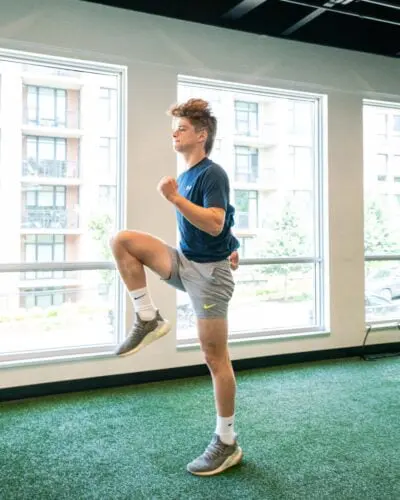
Just like any other sport, there is a technique to sprinting. You can do a few basic drills to practice sprint mechanics and emphasize proper foot strike, forward knee drive, and core activation for a fast and efficient stride. Marching, skipping, and high-knee run drills encourage this technique:


  1. Strength training! Quads, hamstrings, calves, core

Running fast requires more than moving limbs quickly to be successful. Strength is essential to running to create power, endurance and prevent injury. While athletes use virtually all their muscles to run at top speeds, some main movers for sprinting include the hip flexors, quads, hamstrings, calves, and core. Compound lifts and single leg strength exercises targeting these muscle groups are a great way to make an athlete’s stride stronger:


  1. Practice accelerations and sprinting 

Speed training can be broken down into parts, starting with the initial acceleration. There are a few drills to help decrease the time it takes you to get from the start to full speed:


An athlete can progress into repeated sprint efforts. Some common sprint workouts include:

  • Flying 10s: Build speed for 20-30 yards, sprint for 10 yards, slow down for 20-30 yards
  • 10×10: Practice accelerating for 10 yards, then slowing down as fast as you can. Repeat 10 times.

Are you an athlete or the parent of a high school athlete working to be a step faster than the competition?

Here is your solution.

We are in the midst of summer, but it’s not too late to participate in our summer rising-start training program. In this program, your athlete will receive a personal performance assessment and a custom-designed speed program that our team will coach them through.

If you dream of leaving your competition in the dust, contact us to learn more and sign up!

My shoulder pops. Is that bad?

I call these rice crispies. Snaps, crackles, and pops are typical in the shoulder and a concern for many physical therapy patients.

Rice crispies occur in the shoulder for many reasons. The shoulder joint has the most range of motion in the entire body. But with great mobility comes great responsibility!

The large amount of motion in the shoulder provides many ways to compensate. If the quality of shoulder movement is poor, it risks becoming unstable. Excellent movement quality is challenging in such a mobile joint, so the shoulder is commonly injured.

But before you worry too much about rice crispies in the shoulder, ask yourself if it is painful. If it is painless, it may only be a harmless joint noise known as crepitus, simply pressure released from the joint. Crepitus is what happens when you crack your knuckles.

But, if there is pain with the noise, consider seeing a physical therapist like our team here at CHP.

Movement compensations in the shoulder and repetitive use can irritate several tissues within the shoulder. One example is rotator cuff tendinitis, which is a common sports physical therapy injury in Bethesda and McLean.

Tendons are the cords that connect muscle to bone. The rotator cuff tendons can become worn down over time, much like the sole of a shoe that eventually wears apart. If left untreated, the result is a tearing of the rotator cuff tendon, resulting in increased pain and an inability to exercise or train fully. Limitations can progress further, affecting sleep, strength, and the ability to use the arm with daily activities.

The most important thing is to figure out why the pain or rice crispies started in the first place.

Small rotator cuff tears, arthritis, and joint damage is expected within the shoulder. But there is still a great deal that you can do (without surgery) to get out of pain and back to performing the activities that you love.

A great sports physical therapist will help you identify the root cause of your symptoms so that you can continue to exercise and enjoy your active lifestyle.

Contact us if you have questions about how we can help you with shoulder pain/popping and get you back to doing the activities you love.

This is why your back pain isn’t going anywhere

Let me tell you about a past physical therapy patient who saw me in our Bethesda and McLean facilities. We’ll call him John. John is a hard-working guy that had been struggling with back pain for years. It started with pain while weight training and eventually prevented him from standing for more than 20 minutes at one time. His inability to stand was a major problem because his job required him to be on his feet constantly. 


He had been to doctors, physical therapists, and chiropractors. He tried foam rolling, changing his desk setup, and even those strange massage gun-looking things. 


That is when he came to see me for a more “sports approach” to physical therapy.


I began our session by asking him questions about his back; I could sense that he had heard them before. But my following questions grabbed his attention.


He had not received these questions before, and I asked about his sleep habits, use of technology, and stress. These questions created our “aha moment” as we realized the following areas needed to improve if he wanted to conquer his back pain in physical therapy.  


A Poor Night’s Sleep

Sleep is the best recovery tool that we have. Research has shown that sleep quality improves outcomes in chronic pain patients, especially with back pain.


We first made sure that John had a high-quality mattress. A poor-quality bed can leave your back feeling worse due to a lack of support. Most people with back pain tolerate a firmer mattress best. Be sure to test multiple mattresses and determine the best and most comfortable ones. 


John’s final sleeping recommendation was simple—no more sleeping on his stomach. Sleeping on your stomach increases the compression on your lower back. Sleeping on your side or back can be extremely challenging when you are not used to it. But it will become much easier over time.


Addiction to Technology

John was spending way too much time looking at screens.

According to recent research, the average person spends about nine hours per day using electronic devices, which increases tension in several areas, like the lower back.


We started by setting realistic limits on John’s use of technology. We gave him a technology curfew of 9 pm (he couldn’t use his phone after 9 pm). Phones, iPads, and TVs contain blue light, suppressing melatonin production, a hormone essential for quality sleep. 


Reduce Stress

The body is resilient, but it can only handle so much physical and emotional stress. Research indicates that people struggling with anxiety and depression are more likely to experience a few orthopedic pains, including lower back pain.


After discussing this with John, he mentioned that he had enjoyed meditation but didn’t have enough time to keep it up. Because he enjoyed meditating, I suggested he try one of the many great apps with short, 5-minute meditations. 


Suppose meditation doesn’t work for you. No big deal! Search for one thing you enjoy, which reduces your stress, and implement that into your daily routine. Walking outside does that for me. Rain or shine, I ensure I get at least a couple of walks in a day.


As John worked to address these issues, we created a comprehensive physical therapy plan to help his back. Combining all these factors allowed him to recover and return to work and his active lifestyle fully. 


Back pain is a complex issue, influenced by many factors. But that is a good thing because that provides many ways that experts can help. If you have back pain that won’t go away, don’t hesitate to contact us so that we can help you find solutions. 
What I learned by going to the ER

I woke up for the final day of a conference I had traveled to in Orlando. My wife, Deb, joined me for the trip, and the first thing I heard from her was, “What happened to your elbow?!”

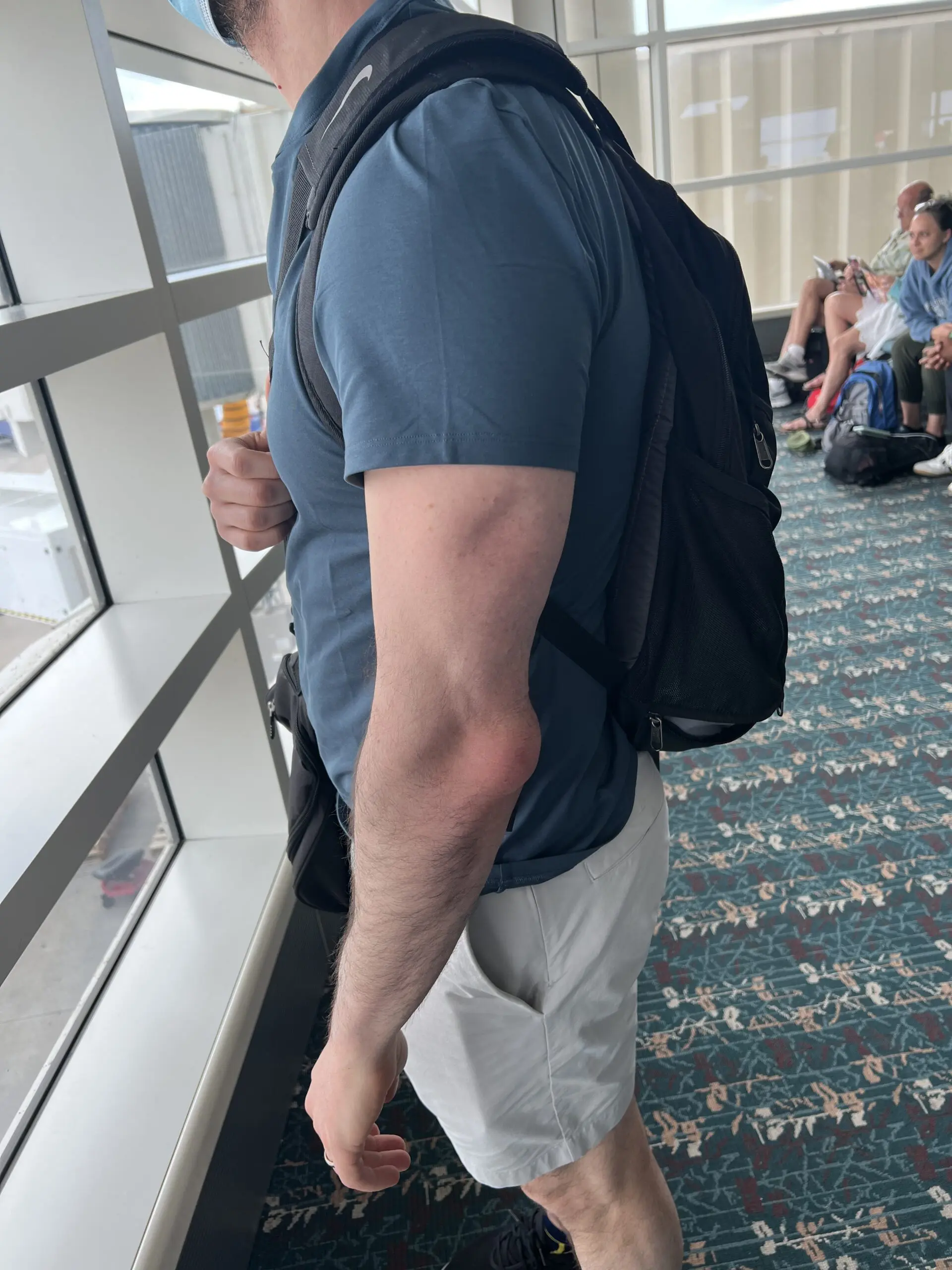
I had a golf ball-sized bump on the back of my elbow, consistent with Olecranon Bursitis. I remember one of my professors in physical therapy school calling it “Popeye elbow.” This typically occurs because of a trauma or infection, and there hadn’t been any trauma, so it must have gotten infected, which needs to be treated immediately.

We flew back home that afternoon and went right to the emergency room. After waiting a few hours, they confirmed the infection, prescribed antibiotics, drained my elbow, and recommended that I consistently maintain compression on the area.

But I wasn’t confident in the recommendations….

The PA that treated me had a lot on her plate. She was running from room to room, and I could sense she was providing general recommendations because this wasn’t her area of expertise.

So, I later texted some of my colleagues here in McLean and Bethesda within the physical therapy/medical field, and they confirmed my suspicions.

The antibiotic I was prescribed was not the best option for my type of infection, and these areas of swelling should never be wrapped in compression garments.

This is not the fault of the people of the ER. I greatly respect their expertise, the stressful environments they work in, and the fantastic work they do to help so many people. This just wasn’t their area of expertise.

In fact, they did the most critical part of their job. They kept me safe until I could see a specialist.

Elbow conditions such as mine were his area of expertise. His recommendations were specific and clear, and most importantly, he took his time so that I could ask any questions I had.

What a refreshing experience. My doctor was present, and I didn’t feel like his hand was on the doorknob the entire time as he tried to leave quickly.

It is impossible to provide excellent care when we are rushing. As physical therapists, we learn so much just by being present. One of the first things I tell our doctoral students is that our patients will give us all the clues if we slow down, listen, and ask great questions.

Are your healthcare providers doing that? Can you ask all the questions that you have?

What about when you aren’t in their clinic? It’s normal to forget to ask something during an appointment. Will they answer your question promptly when you aren’t in their office?

If you need help, contact me to connect you with the right healthcare provider. I’ve made it a mission to connect with the healthcare community around the DMV because that will help us better serve you.

As healthcare consumers, we can see whomever we want. Look for an expert that provides you with the type of care that you expect to receive!

×