3 exercises I don’t do anymore

A few weeks ago, I was catching up with a former physical therapy colleague from our time working with professional athletes.

We laughed about how we used to work out every day at 5:30 am before the athletes got to the facility. We took turns designing the training programs that we used to torture ourselves with so early in the morning.

After our conversation, I thought that looking at our old training programs would be interesting. I noticed three popular exercises that I don’t do anymore both personally and professionally with my patients as a sports physical therapist in Bethesda and McLean.

  1. Planks: Other exercises do a better job of strengthening the core and working the abs. Planks are typically performed with straight legs, which helps support the body with the legs, not the abs. It is also an easy exercise to cheat by allowing the belly to sag slightly toward the ground. As this occurs, the body is supported by the hip flexor musculature and the lower back instead of the abs. Try performing a bear variation instead!
  2. Barbell Back Squats: This exercise can be done effectively but requires many qualities to perform correctly. Minor limitations in shoulder range of motion, thoracic spine extension, hip mobility, and ankle flexibility result in much strain to the lower back and other areas. I’ve found that I can strengthen my lower body very effectively with exercises that have a lower risk. GobletZercher, or SafetySquats are usually better options unless you are a powerlifter or a collegiate athlete.
  3. Upright Rows: The upright row fails the risk vs. reward equation. You can create the benefits of this exercise with other, lower-risk exercises. The upright row forces the shoulder into combined flexion and internal rotation as it lifts a weight. Doing so is stressful to the shoulder and isn’t worth the risk. Dumbbell pressing variations like this are a better option.

What is the goal of this exercise? That is the question I ask myself as I design training and physical therapy programs for my patients/clients. Typically, the goal is to increase strength, build muscle, or prevent injury. If a different exercise is more effective at reaching those goals or can deliver the same result with less risk, that is the better option.


Maybe I Do Hate Stretching…

Zac, why do you hate stretching?

I received this question during a physical therapy session recently, which admittedly made me chuckle. I don’t hate stretching, but we overrate its importance (physical therapists included).

Like most people, when you think of stretching, you think of static stretching. This type of stretching involves holding a stretch for an extended period.

Come to gyms like the one I train at, and you will see most people doing this form of stretching before they exercise.

Research has shown that static stretching performed before physical activity may negatively affect performance and does nothing to reduce injury risk. It temporarily decreases muscle strength and power and reduces muscle stiffness, essential for joint control and protection.

But stretching feels good. I agree, so I recommend that you perform your favorite stretches when you are done with your workout.

So, what should I do to warm up before exercise?

Dynamic stretching and drills specific to the activity you are about to perform.

This type of warmup involves moving your body through its full range of motion, mimicking the movements of the activity you are about to perform. This helps increase heart rate and body temperature and improves coordination, balance, and neuromuscular control.

Below are 2 drills I often use on my upper body days, followed by 2 more that I commonly use on lower body days with both physical therapy and personal training clients.

Upper Body

  1. Kettlebell Windmill
  2. Sidelying Arm Bar

Lower Body

  1. Sissy Squat
  2. Heels Elevated Clean

Interested in receiving a custom-designed warmup routine from our Doctors of Physical Therapy to help you reduce your injury risk while preparing you to perform at your best? Contact us to learn more!

My jaw pops, is that bad?

Have you noticed joints making more noise as you have gotten older? One of the strangest ones is the random popping I get in my jaw.

Does that ever happen to you? If so, and if it is painful, you may want to investigate it (our physical therapy team in McLean and Bethesda treats this!). 

Open and close your mouth while feeling in front of your ears. Search until you feel the joint moving, called your temporomandibular joint (TMJ). This joint allows you to open and close your mouth and move your jaw from side to side.

The TMJ has a small shock-absorbing cartilage disc between the jawbone and your skull. If this disc moves out of alignment or there is arthritis in the joint, clicking, popping, and pain can occur.

The alignment of the TMJ is a product of everything below it. When I see physical therapy patients experiencing TMJ pain, I first check the position of the head, neck, and rib cage and look at posture. Check out this article to learn more about how to get your head, rib cage, and pelvis in the proper position.

This sometimes corrects TMJ pain, but we can’t stop here. Here are some factors that may also need to be addressed.

  1. Malocclusion: Malocclusion is when the teeth do not fit together correctly, resulting in jaw misalignment. This is when your dentist needs to work with your physical therapist as part of the healthcare team!
  2. Stress: Teeth clenching is associated with stress. Caring for your mental health is essential to helping TMJ issues. Many dentists also suggest nightguards for those of us that clench when sleeping.
  3. Chewing gum: stay away!
  4. Posture, especially while working: What posture is best? Does that even exist? Check out an article I wrote on that here.

Popping, clicking, and jaw pain is most likely a result of several different factors. TMJ issues usually require a healthcare team such as a physician, physical therapist, and dentist. Popping and clicking without pain likely isn’t much to worry about. Still, please see a healthcare provider if pain is associated with it.

At CHP, our physical therapists we evaluate patients with TMJ discomfort. If you or anyone you know would like help solving these challenging problems, contact us today!

Dry Needling Is Now in McLean

What’s up with this weird needling stuff that sports physical therapists are doing nowadays?

More and more people have been asking me about it as they have seen or heard about it being performed in performance physical therapy settings in McLean and Bethesda.

One person told me that their neighbor calls it “magic” and has cured all his aches and pains. Another person said they hear it only hurts without providing any relief.

So what is it?

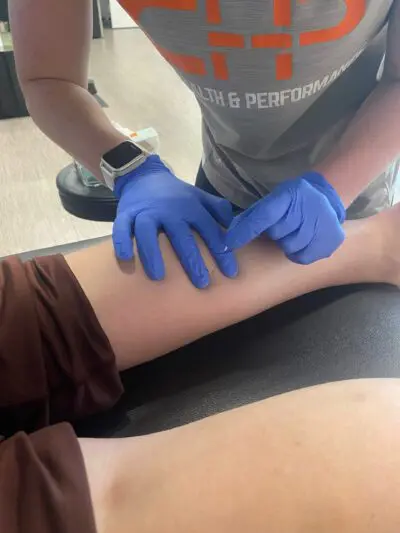
First, let’s define what dry needling is. Dry needling is a technique performed by healthcare providers like physical therapists. They insert small needles, similar to acupuncture needles, into muscles, tendons, and other soft tissues. The needle creates a small lesion (mini-injury) to the tissue, triggering the body to start a healing process.

Dry needling is a tool and like all tools in physical therapy, it has a time and place. It is not appropriate for everyone but may be helpful when used by a knowledgeable (and hopefully, not too biased) physical therapist.

If there is a great deal of inflammation currently present in one area of the body, dry needling likely is not appropriate. But if you’ve had pain for several months or years, it could help.

At the end of the day, dry needling is just one part of the overall treatment plan and will not fix an injury by itself.

At CHP, we now are offering Dry Needling as part of our physical therapy treatment plans in our McLean facility. We use this tool to reduce pain and the symptoms associated with an injury while working on the root causes.

Are you interested in learning more about dry needling and how it may help you overcome chronic pain? Contact us today to learn more and schedule an appointment!

Don’t Try To Be Patrick Mahomes

I lost count of how many times the announcers on Sunday night’s football game discussed the injury that Chiefs quarterback (and best player in the world) Patrick Mahomes played with.

He suffered a high ankle sprain just 8 days earlier and as a sports physical therapist here in McLean and Bethesda, I was blown away by how well he was able to play.

A high ankle sprain occurs when the ligaments that connect the tibia and fibula (the two bones in the lower leg) are stretched or torn. It is a more severe injury than a standard, or low ankle sprain, and takes longer to heal. Symptoms include pain, swelling, and difficulty bearing weight on the injured leg.

High ankle sprains typically take 6-8 weeks to heal and even longer to return to sport. It also involves a great deal of physical therapy and rehabilitation. At our McLean and Bethesda clinics, we typically work with athletes for 2-3 months after suffering a high ankle sprain.

I am not saying that Mahomes shouldn’t have played. As with all medical decisions, it is a risk vs. reward calculation.

By playing hurt, Mahomes risked re-injuring the ankle, causing further damage and increased the chances of developing chronic ankle issues. However, the reward is that he was able to lead his team to the Superbowl.

Mahomes determined that the reward outweighed the risk.

But we aren’t Patrick Mahomes and don’t have access to the same medical treatment (physical therapists, athletic trainers, doctors, etc.). The risk of “playing hurt” does not have the same reward (I didn’t even mention the 10-year contract he signed in 2020).

If you had an injury and are tired of sitting on the sidelines, first consult with a medical professional. As physical therapists we will help you understand your injury/pain and provide guidance on how to safely return to exercise or sport.

Once you have a better understanding of your injury, it is time to focus on your return.

The most challenging thing is learning where to start. What workout should I begin with? How much practice can I participate in?

Start small and build from there. Be conservative and make your first workout or practice easy. You can always build from there.

Every training session or practice should increase in volume and intensity in a progressive, step by step fashion. This pushes your body to adapt to more stress over time without pushing things too far, resulting in injury.

Don’t try to be Patrick Mahomes by modeling what you see on TV.

I spent the early stages of my career working with professional athletes.

Professional athletes are different. They recover faster, heal faster, and use pain killers that I do not recommend using to stay on the field.

We only see what is shown to us on TV. Ever seen a football player in their 50s?!

×