
The Best Sitting Posture

This is the best sitting posture.

Many physical therapy articles and rehab blogs discuss the importance of sitting posture and how perfect sitting posture is essential to avoid neck and back pain. Here are a few examples of what I found in several articles online.

  1. Sit with your feet flat on the floor. This position helps to distribute your weight evenly and reduces pressure on your lower back.
  2. Support your lower back. If your chair doesn’t provide enough support for your lower back, consider using a lumbar roll or cushion. This can help maintain the natural curve of your spine and prevent low back pain.
  3. Sit up straight. Sitting up straight helps to maintain good posture and reduce strain on your back. Avoid slouching or leaning forward.

While these may be helpful recommendations as part of the physical therapy process, they miss the most important thing.

There is no perfect sitting posture, and the “best” posture is the one that is constantly changing.

When standing, we naturally sway and shift our weight forward and back or from one foot to another. Unfortunately, this goes away as we sit and concentrate on something…like this blog I’m writing!

The longer we concentrate on something, muscular tension increases. This keeps us still and helps us focus better on what is in front of us. Unfortunately, too much muscular tension leads to discomfort.

Does this mean you must get up every 10-15 minutes and move around? In a perfect world, sure, but there may be better solutions if you try to get stuff done.

As I am writing this article, I am fidgeting. My sitting posture is changing, and I am shifting my weight from one side to the other. I sometimes cross one leg under the other and raise or lower my chair.

But one more part of sitting posture may be most impactful.


Give your eyes a break.


Research shows a connection between high levels of focus on a screen and discomfort in the upper body.

Optometrists recommend the 20/20/20 rule to help with this. The 20/20/20 rule states that for every 20 minutes of focus-intensive work, you should take a 20-second break and look 20 feet away.

This helps to reduce your focus on a single point and, as a result, reduces tension in your upper body.

Our bodies typically don’t respond well when we ask them to be still for long periods. A more active approach to sitting helps us avoid the discomfort that may come with it.

If you are interested in learning other strategies that can be used to sit comfortably throughout your day, contact us!
Dry Needling Is Now in McLean

What’s up with this weird needling stuff that sports physical therapists are doing nowadays?

More and more people have been asking me about it as they have seen or heard about it being performed in performance physical therapy settings in McLean and Bethesda.

One person told me that their neighbor calls it “magic” and has cured all his aches and pains. Another person said they hear it only hurts without providing any relief.

So what is it?

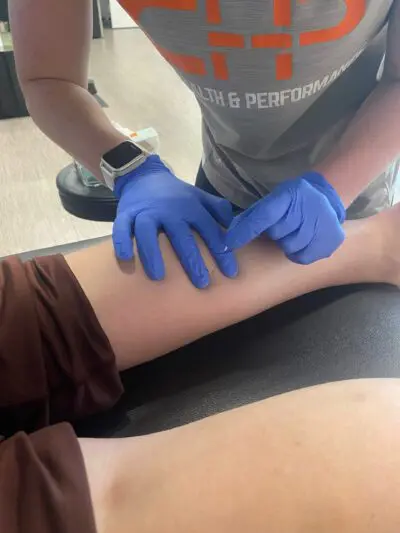
First, let’s define what dry needling is. Dry needling is a technique performed by healthcare providers like physical therapists. They insert small needles, similar to acupuncture needles, into muscles, tendons, and other soft tissues. The needle creates a small lesion (mini-injury) to the tissue, triggering the body to start a healing process.

Dry needling is a tool and like all tools in physical therapy, it has a time and place. It is not appropriate for everyone but may be helpful when used by a knowledgeable (and hopefully, not too biased) physical therapist.

If there is a great deal of inflammation currently present in one area of the body, dry needling likely is not appropriate. But if you’ve had pain for several months or years, it could help.

At the end of the day, dry needling is just one part of the overall treatment plan and will not fix an injury by itself.

At CHP, we now are offering Dry Needling as part of our physical therapy treatment plans in our McLean facility. We use this tool to reduce pain and the symptoms associated with an injury while working on the root causes.

Are you interested in learning more about dry needling and how it may help you overcome chronic pain? Contact us today to learn more and schedule an appointment!

Nails on a chalkboard to me

“It Will Hurt Your Knees if They Go Past Your Toes”—Debunking the Myth

Recently, while working out at the gym, I overheard two young men discussing their barbell squats. One of them mentioned that he had just finished physical therapy, and I hope the following advice didn’t come from his therapist…

After completing a set, one of the lifters (let’s call him Lifter 1) was chatting with his friend (Lifter 2). Lifter 2 advised him not to let his knees go past his toes during squats, claiming it would be bad for them.

This belief is widespread in fitness circles, the personal training industry, and was even common in physical therapy. However, it’s simply not true.

Your knees naturally go over your toes when you walk or run. In fact, proper squat technique requires your knees to move well past your toes.

Attempting to prevent this by pushing your hips back and arching your lower back only shifts more stress onto your lower back, increasing the risk of back pain.

But you might wonder: does allowing your knees to move past your toes increase stress on them?

The answer is no! In fact, research shows that training your knees to comfortably move past your toes helps build healthier knees and reduces the strain on your back.

Check out the squat tutorial below to retrain your squat technique and get your knees accustomed to moving over your toes as they naturally should!

Remember, there’s no such thing as a “bad” or “good” exercise. The suitability of an exercise depends on various factors, including your fitness goals, injury history (consult your physical therapist), unique body traits, and movement capabilities. Keep this in mind whenever you hear generalized or “one size fits all” advice about exercise.

Runners, Stop Making This Mistake in Your Training

According to the research, the chances of having a knee injury increase significantly after running for 1000 hours.

Most serious runners pass the 1000-hour mark within 1 year and end up in performance physical therapy clinics like CHP!

Does this mean that “bad knees” are inevitable once you choose to run? No, but it does mean that you must learn how to take care of them.

Running consists of thousands of strides repeated over and over. As a result, any problems with your running technique will add up, potentially contributing to injury.

Even if you are not a serious runner, you are likely approaching the 1000-hour running mark.

Does this mean that you are a ticking time bomb, ready to explode? Probably not if you are strength training and working on improving your running technique.

Strength Training

Implementing strength training into a consistent exercise routine has been shown to make you a more efficient runner. This means that you use less energy to run a given amount of time and as a result, are less fatigued. Less fatigue=less risk of injury.  For this reason, becoming a more efficient runner is an essential part of the sports physical therapy process.

Research also shows that regular strength training improves a runner’s speed and VO2 max. VO2 max is a measure of the amount of oxygen that you can use during exercise. When you can use more oxygen as you run, you will run farther, faster!

Just remember, every runner is unique. Even if you have a running partner with the same routine, you both have unique characteristics and needs to address in a strength training program. Your strength training program must be unique to you. Cookie cutter programs don’t cut it!

Running Technique

Think of the last time that you went out for a run. Were you thinking about every stride you took? Were you aware of your foot strike? I highly doubt it!

Running is an automatic pattern that does not require conscious thought to perform. Most people listen to music or podcasts. We couldn’t do that if we needed to focus on how to run.

Unfortunately, this also means that you may be repeating the same bad pattern over and over without realizing your mistake, until it is too late. One of the most common mistakes occurs with a runners foot strike position. Runners often contact the ground in front of the body which puts more stress on the body.

Foot strike position is dependent on your body dimensions (such as limb length).

We can’t change your anatomy, but we can change the position, aka the posture, of our bodies. This is often the first step of the physical therapy process for a runner!

A “stacked” posture will change your foot strike so that it occurs directly underneath the body. This results in a more efficient stride and less stress to the body. To learn about the stack, check out a previous article that I wrote on Learn to Stack Like a Snowman.

Attempt the drill below to feel what it is like to have a stacked posture while running.

  • Grab a partner and ask him/her/they to stand behind you (you are also standing)
  • Have your partner press down on your shoulders with a moderate amount of force and do not let them squish you
  • As you resist them you should feel your abs engage and feel as if you are standing tall
  • Next, attempt to shift your weight onto 1 leg and pick up your opposite foot while resisting the force of your partner
  • Try the other leg

For a video on this drill, click here.

After performing this drill, you should have a better sense of your optimal running posture. Try to replicate this feeling the next time you go on a run!

This Made Me Roll My Eyes

The medical profession, sports physical therapy included, is good at giving out bandaids.

To illustrate this point, let me tell you a story about my best friend.  He lives in LA and takes advantage of all it has to offer. The guy can’t sit still. He hops in the ocean to go open water swimming in the morning and goes on hikes or trail runs in the evenings/weekends. 75 degrees and sunny every day must be nice…

On another beautiful, 75-degree day, he was running on a dirt trail to the top of Runyon Canyon and suddenly felt a sharp pain in the inside of his right knee. As he kept running, the pain increased. He decided to turn around, limp down the trail, and make an appointment with his Doctor. He saw his Doctor the next week and was told to take Advil and “take it easy”. This was when he called his favorite performance physical therapist…

My friend has known me since I was 10 years old and could feel me rolling my eyes.

Have you ever been told only to rest as a solution to an injury? This isn’t bad advice but it is a band-aid. It stops the bleeding without solving the reason the bleeding is occurring in the first place!

Pain occurs when the amount of stress placed upon the body exceeds the body’s tolerance of it.

So what is causing this stress to accumulate? It could be over-training, insufficient sleep, poor nutrition or a variety of other factors. Most likely it is a combination of many different things.

The root cause of pain must be addressed if you hope to feel better, stay better, and exercise consistently.

It is essential for your Doctor or Performance Physical Therapist to answer these questions and provide a plan to address them. If you are ready to finally solve the root causes of your pain and injury, contact us now!

What a Runny Nose and Your Pain Have in Common

Do you remember the last time that you caught a cold, the flu, or had Covid? If you are like me, you build a mountain of dirty tissues to keep your snot under control. Meanwhile, the little bug causing it runs around your body, creating chaos.

The pain you feel when exercising is a lot like your runny nose. Pain is a symptom of a larger issue and the key to finally fixing it is to correct that root cause.

Unfortunately, I find that most athletic physical therapy treatment for focuses on the symptoms, rather than the reasons the symptoms started in the first place. We wouldn’t blow our nose all day without taking medicine to kill the bug causing it, would we?!

At Cohen Health and Performance, the goal of every patient’s first performance physical therapy appointment at our Bethesda or McLean location is to discover the root cause of their symptoms. Once this has been identified, our physical therapists create a rehabilitation plan that is customized for every person that we see. Every person is different, with different reasons for an injury and different goals. If your physical therapist has a cookie cutter plan that they use for every patient with low back pain, for example, find another physical therapist!

How do you know if your physical therapy plan is a good one?

The end goals of the rehabilitation plan should be YOUR goals, not the goals of the physical therapist. The physical therapist should clearly describe how your plan is going to get you back to the activities that are most important to you, not what the insurance company wants to see.

For example, we help many runners overcome injury. Their first physical therapy appointment includes a running analysis if they are able to do so. Their rehabilitation plan then includes drills that will help them get back running ASAP. Below is an example of an exercise that we may give a runner with knee pain to prepare them for the stress of their training.


It is easy for physical therapy to become focused on outcomes that insurance companies want to see because that is what is required to get paid. This is why we advise our patients to look for a physical therapy clinic that works for their patients, not insurance companies!

×