What Is That Hip Pinch?

Have you ever experienced an annoying “pinchy” sensation in the front of your hip? Many patients are referred to physical therapy for other regions of the body (back pain being the most common) and mention this uncomfortable sensation in passing.

Typically this occurs with movements like deep squatting. This “pinch” occurs as the ball of the hip (the femoral head) glides forward excessively and presses against the soft tissues located in the front of the joint.

This forward movement is normal however it is important be mindful of where the socket of the joint (acetabulum) is positioned as well.

Often times, pinching occurs in the front of the hip due to a poorly positioned hip socket.

The good news is that we can reposition the hip socket so that your hip does not pinch as easily!

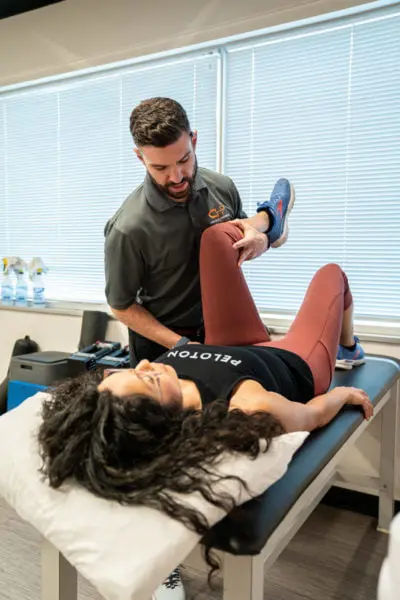
There are many great drills that help with this however the Shifted Single Leg 90/90 Hip Lift is a great one to start with (this is also a great movement to get the hips/pelvis moving before running). In this video, the left hip socket is being oriented into a position that will result in less pinching.

  1. Start by lying on your back with hips/knees bent at 90 degrees and feet on a wall
  2. Slowly pull your heels down towards the ground as you reach your knees towards the ceiling. Your tailbone will slowly lift off of the ground and you should begin feeling your hamstrings working.
  3. Without moving your feet, shift 1 hip/knee down as the other hip/knee shifts up. As you shift one hip/knee down, ensure that you are pulling towards the ground with that heel. You should feel that specific hamstring cooking at this point!
  4. Pick the opposite foot up off the wall while maintaining the hip shift
  5. Hold this position while taking a relaxed breath in through the nose, followed by a long exhale out through the mouth before pausing for 5 seconds. Perform this for 5 cycles.

As with all exercises, they should be specifically tailored to your particular needs and unique physical qualities. Schedule a FREE phone consultation with a member of our physical therapy team on our website to determine how to most effectively implement an exercise like this into your program!

I felt stuck

Times have certainly changed, haven’t they? Just look at all that hair! And it seems like they couldn’t do much about the sun glare on picture day either…

“I really need to stretch more. Should I try Yoga?”

“Everyone’s talking about how Pilates strengthens your core. Maybe I should take a class?”

“I know strength training is crucial, but where do I even begin?”

If you’ve ever had thoughts like these when thinking about exercise, you’re not alone.

The world of health, fitness, sports physical therapy, and injury rehabilitation can feel massive and even a bit daunting. I remember a time when I was unsure about how to approach my own fitness journey.

After wrapping up my college football career, I no longer had coaches designing my training plans. No more structured practices, conditioning workouts, weightlifting sessions, or recovery routines that typically involved stretching, foam rolling, yoga, and light cardio.

With no clear direction, I stuck with what I knew best: lifting weights, following my old off-season routine, and adding a couple of conditioning sessions each week.

After a few weeks of this, I stopped and asked myself a simple but important question: “Why?”

Why was I training this way? What were my goals now? And what were the most effective ways to achieve them? After reflecting and writing down my thoughts, I realized that my training program no longer aligned with my new goals.

My football days were behind me, and it was time to focus on staying healthy long-term.

At the same time, I still enjoyed strength training and the feeling of being strong. Plus, I was working toward becoming a Certified Strength and Conditioning Specialist (CSCS), so I needed to practice what I preached (this was all before I entered sports physical therapy school).

I ultimately designed a new strength training program that focused on increasing strength and muscle mass while also enhancing my mobility. The goal was to feel strong and stay healthy.

This approach worked because I took a moment to slow down and ask myself a few basic questions.

When was the last time you did that? Ask yourself these questions:

– What are the outcomes I want from my training? Do I want to be stronger? Have less discomfort? Improve my mobility? Be honest with yourself.
– What are the best methods to achieve these outcomes?
– If I don’t know the answer to the above, who can help guide me?

As question three suggests, you don’t need to figure it all out on your own. There are experts available who can help you reach your goals, but only you can determine what those goals are.

Once you have that clarity, our team of sports physical therapists in Bethesda and McLean is here to help. Along with being Doctors of Physical Therapy, our Performance Physical Therapists are also Certified Strength and Conditioning Specialists. We specialize in helping injured athletes recover and get back to doing what they love.

How to “Fix” Rounded Shoulders

As physical therapists, we often answer questions pertaining to “poor posture.” One of the most common reports from our patients in Bethesda and Chevy Chase is having “forward shoulders.”

The solution to this, which is often taught by other physical therapists, is to stretch the muscles in the front of the shoulders. The most common of these muscle groups is the pecs.

The logic goes something like this. “Your pecs are tight and pulling your shoulders forward. If you stretch them, your shoulders can move back and correct your posture.”

While this reasoning isn’t necessarily wrong, it is shortsighted. It fails to question why muscles like the pecs became tight in the first place. Simply stretching these muscles won’t correct the root cause of the issue.

The shoulder complex rests on top of the rib cage and the pecs attach to the sternum (ribs 1-7 attach to the sternum) as well as the ribs on the front of the rib cage.

As we breath in the rib cage should expand in 360 degrees and as we breath out it should do the opposite.

People with forward shoulders and stiff pecs often have difficulty expanding the front part of their rib cage during a relaxed breath in. This prevents the pecs from lengthening fully and often causes them to remain stiff, pulling the shoulders forward.

If you are looking to improve your posture and “pull your shoulders back”, the solution must include breathing exercises that emphasis relaxation and expansion of the chest/front part of the rib cage.

Here is an example from our YouTube page that illustrates this concept.

If you are looking to improve your posture or shoulder function, contact us now!

Photo Credit

“Orlando’s Poor Posture” by hewy is licensed under CC BY-NC-ND 2.0

Does Your Metabolism Actually Slow As You Age?

As we age it is common to feel that it is increasingly difficult to prevent injury or reach our fitness goals. We have spoken to many people in Bethesda that feel the help of a physical therapist is inevitable. Many challenges that are experienced are often attributed to a slowing metabolism.

However, this may not be the case.

There has been evidence that suggests that our metabolism doesn’t slow much, if at all, during adulthood. However, even if we later discover that some of these findings are misleading, a slowing metabolism is not the only reason that it takes longer to recover from injuries or fail to reach our fitness goals as we age.

Many of the challenges associated with aging stem from lifestyle changes.

In modern times humans have become more sedentary as we age. We no longer participate in organized sports, play outdoor games with our friends, and migrate to sedentary desk jobs for much of the day. This results in a large decrease in our daily energy expenditure and increases our risk of injury. Prolonged sedentary activity causes our body to become de-conditioned and less prepared for the rigors of life. As an example, this is why we suggest partaking in a running analysis prior to training for a race.

Another factor we may not realize is that as we get older, we take on a lot more responsibility.

Think back to your teenage years or time in your 20s. Did you have a lot of worries back then? A career? Family commitments? A mortgage? As these “adult things” add up, so do our commitments, resulting in less free time. Less time for exercise, less time for self-care, and less time for sleep.

Countless studies have shown us that as sleep decreases our health is negatively impacted in several ways, including an increased risk of orthopedic injury.

While it may be easy to see all of this as a negative, the good news is that many of the seemingly negative effects of aging are not as inevitable as we may have thought! Furthermore, feeling better and healthier doesn’t require you to be perfect.

As performance physical therapists, we help our patients identify the smallest possible improvement that will make the largest possible impact to overcome an injury.


Image Information

“Tiantan Park-life: The Elderly Exercising in China’s Parks – Parallel Bars” by _chrisUK is licensed under CC BY-NC-ND 2.0


3 Indications You Should Ignore a Social Media Post

Today there is more access to information then ever. This access to information is no more prevalent than in the realms of health, medicine, fitness/performance, or any other area of athletic physical therapy.  Anyone with a social media account can quickly find thousands of posts related to these topics which creates a whole new challenge.

Because everyone can promote themselves as an expert on social media, it is essential to have a discerning eye for quality information. Unfortunately, social media platforms, such as Instagram, do not promote posts based on the validity of the information presented.

Amongst such a vast array of information, how do you determine when you should ignore a social media post related to health, fitness, or performance physical therapy information?

  • The presenter speaks in absolutes. Commonly the best answer that a professional can give you is “it depends.” The reason for this is that a person’s experience is context dependent and is the result of several different factors that must be considered together. For example, stretching or improving mobility is often promoted as a “fix” for a given injury. However, this does not apply to those that have more important problems to solve or possess full range of motion in the area being discussed. For more information on this topic, check out our post on Is Mobility Overrated? Furthermore, it is impossible to know of every possible factor that could be contributing to pain, injury, limitations, or challenges. Therefore, even the best among us cannot claim to be 100% certain, especially on social media.
  • The information is unnecessarily complicated. An expert can take a complex topic and break it down so that it makes sense to you. Overly complicated terminology and unnecessary use of medical jargon are red flags that the presenter may not fully understand the material being presented.
  • Promoting personal success stories as evidence. Personal success stories are anecdotal. The definition of anecdotal is “not necessarily true or reliable, because based on personal accounts rather than facts or research.” Many medical and fitness professional post personal success stories as evidence for the validity of their method, approach, or something that they are attempting to market. This ignores all the other factors that may have contributed to these results (see #1 above). Even if the results being presented are valid, it only applies to the person being shown. Quality research commonly requires thousands of trials before being considered valid. A case study of 1 or 2 people only applies to the people being referenced and ignores your unique circumstances.

**Bonus: If a presenter promotes “quick fixes”, run!

Discerning quality from poor information is very challenging in the modern age. Everyone can promote themselves as an expert, however there are several ways to determine when it is best to ignore a presenter. These are just a few of several ways that you can do so.


Photo Credits

“Social Media” by MySign AG is licensed under CC BY 2.0

Why We Need to Stop Comparing Adult Movements to Children’s

It has become common in fields of physical therapy and performance training to compare adult movement to the ways that babies move. You may have spoken to a professional that uses this comparison in their approach.

The logic usually goes something like this…“Humans were born with the ability to squat fully, and our modern lifestyles robbed us of that ability, so we need to regain it.”

Sounds understandable, right?

I thought so too. I even took a couple of continuing education courses based loosely upon this concept. The class instructors showed pictures of babies at various development stages and attempted to teach movements that mimicked these phases. The idea was to help adults gain back some of the movement capabilities that they once had as children and this new freedom of movement would help to alleviate pain and resolve injury.

Adults Are Not Babies

While I think we’d all love to be able to squat to the floor, crawl around all day, and never get tired, the truth is that we are not babies anymore.

Babies have a large amount of joint laxity that allows them to get into a variety of different positions, that we don’t have as adults. Babies also have a very large head in relation to the body, which helps to provide a counterbalance for easy squatting. In fact, according to Healthline, many of a baby’s bones are composed of cartilage, a type of connective tissue that is tough but flexible. This cartilage turns to bone as we grow.

Their bodies are still growing and changing. They fall often and make mistakes (essential for learning), which flexibility and mobility help with. Because of this, the ability to squat to the floor is normal for a baby. The same cannot always be said for adults.

Adults are not babies, and we cannot use a baby’s movement as a model for how an adult should move. Not only do babies have much different bone and structural compositions, but all adults have different movement capabilities due to variations in torso lengths and body proportions (among other reasons). Using singular movement standards would overlook this critical aspect.

It is nice to think that we could be able to squat to the floor like we once did when we were a toddler. However, adults are not babies, and our bodies are not the same as they once were.

Because of this, we do not expect our physical therapy patients to squat to the floor. It is essential for all of us to set realistic movement standards that will help to live pain-free and healthy lives. For help in the arena, talk to our experienced physical therapy team in Bethesda!

×