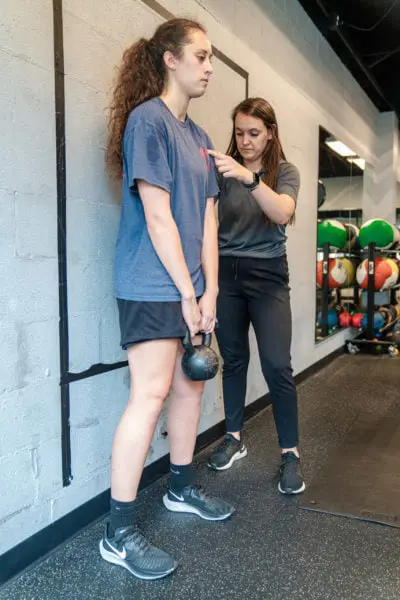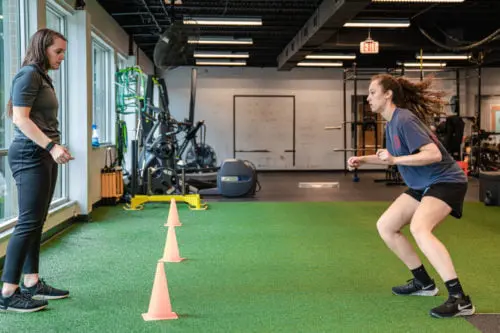
The first drills that we teach to youth athletes

It is essential to understand the demands placed onto the body when working in a sports physical therapy, injury rehabilitation, and performance training setting.

Sports and weight training require athletes to control the body when moving rapidly.

If an athlete wishes to own the “stack” (stacking of our head, rib cage and pelvis over one another) and protect their lower back they must be capable of doing so when performing high velocity movements.

When youth athletes first train, we use medicine ball drills to teach this ability.

The medicine ball chest pass is a great drill to teach this capability. During this the drill, the athlete is generating enough velocity to propel the ball into the wall and back. As this occurs, it can be easy to lose the “stack” requiring the athlete demonstrate a higher of level of body control.

After mastering the chest pass, it is time to bring the arms overhead. More trunk strength and control are required with this movement and the ability to manage intra-abdominal pressure is further challenged. Check out this exercise here.

These are just a couple of the exercises that we incorporate into the training sessions and warmups for our youth athletes.

If you interested in learning more about the summer training options for youth athletes at CHP,  please contact us!
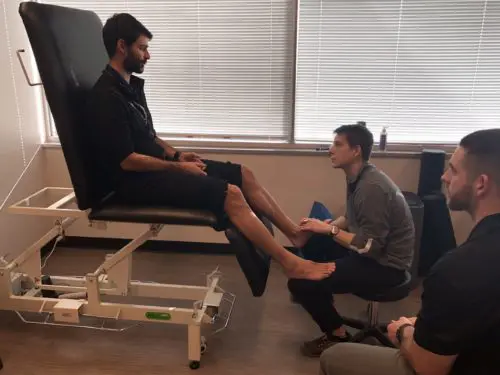
Is Your Doctor (or physical therapy clinic) Taking Care of You?

Recently, I joined my mother-in-law for a visit to a physician’s office.

The physician she saw has a solid reputation and is known as a “go-to” expert in his field.

During the visit he spent a total of 5 minutes with my mother-in-law, glossing over test results and providing very brief recommendations.

He appeared to be speaking as fast as he could so that he could finish the visit and to get to his next patient. After his rushed explanation, we attempted to ask questions, which he answered while backing out of the room.

Sadly, experiences like this are very common in the world of healthcare and I do not blame the healthcare providers because they oftentimes are not left with much of a choice.

The health insurance industry consistently reduces reimbursement to health care providers, forcing them to schedule more patients within a fixed time period. As a result, the quality of care suffers, and everything becomes less personalized.

This also occurs in physical therapy, forcing many clinicians to resort to “cookie cutter” protocols.

If you go to Physical Therapy because of lower back pain then you get put on the lower back pain protocol, shoulder pain=shoulder protocol, etc.

Many times, this works, however, it is not the best choice for those looking to live an active, pain free, and healthy life.

For this reason I typically seek out practitioners that are out of network with health insurance as it enables them to provide me with the highest quality of care possible. In this approach I am treated like an individual and I get to ask all the questions that I would like so that I can a better understanding of my health.

We are out of network providers here at Cohen Health and Performance. We strive to get the best possible results for our patients in the least number of visits, while also providing the education necessary to prevent future issues from occurring.

People can feel better, move better, and enjoy an active lifestyle.  Our mission at CHP will always be to take the best possible care of our patients and that is why we are out of network with health insurance.

Interested in learning more about how this approach can help you? Contact us here!

Why Are You Bench Pressing?

How often do you stop and think about how you want to perform an exercise and if that is conducive to your goals?  Our physical therapy patients here in Bethesda often have the goal of learning to train without pain or discomfort. Training clients, most concerned with sports performance may have goals that include becoming stronger, faster, or building muscle mass.

There is not always a “correct” way to perform every exercise.⁣ Let’s take the bench press as an example.

Depending on your goals and capabilities, you may want to play around with the angle of your arms when bench pressing.⁣

Is your goal to build big pecs? Perform the lift with the arms closer to 90 degrees and do not allow the arms to drift past the body as you can see in the video here.

Do you want to lift more weight while keeping your shoulders and lower back healthy? If so, perform this lift with the arms closer to 45 degrees to take the stress off the front of the shoulders. Check out this bench press variation here.⁣

This is just one of many exercises that can be altered to change the focus.

The key is being clear on the outcome that you have in mind!⁣

Image Source

Bench Press” by A. Blight is licensed under CC BY 2.0.

Secret to Avoiding Running Related Hamstring Injuries

Many runners and other athletes, like you, understand that strength training improves performance, reduces injury risk and decreases the likelihood that you will see us in physical therapy!

However, we have found that you may be strength training because you feel that you are supposed to but these workouts are more than simply checking a box.

It is important to think about how you are training a particular muscle group during your workout. This change in focus may be the secret to eliminating future hamstring injuries that cause many to look for a physical therapist.

Many people strengthen the hamstrings in a concentric (as the muscles shorten) fashion, however most hamstring strains occur as the muscles lengthen and work to slow down the swinging leg.

It is essential for any runner or athlete that performs a great deal of sprinting to develop a large amount of eccentric (muscle contraction that occurs as it lengthens) hamstring strength.

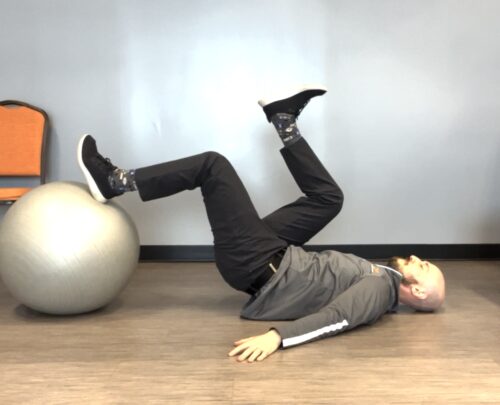
Eccentric hamstring curls are a great way to build this quality and the double leg variation on a physioball is a great place to start! Click here to see this exercise.

Once you have mastered the double leg eccentric glute bridge, it is time to step things up to the single leg progression.

How do you know if you are ready to move on? A great goal to shoot for on the double leg version is 10 FULL repetitions with a full 5 second lengthening period on each rep. The hips should not be dropping, and you should feel your abs throughout the set!

As we continue to build eccentric hamstring strength, this drill will add some additional challenges.

One leg will be flexed with the hip and knee at 90 degrees, mimicking a sprinting position. The result is one hip in a position of flexion while the other is in extension, much like sprinting or running. This will challenge your ability to control the position of the pelvis as you demonstrate hamstring strength.

Click here for the single leg progression!

Once you have mastered the single leg eccentric hamstring curl on a physioball, you can progress even further. To learn how to do that amongst other ways to optimize your strength training, click here.

Also, don’t forget to follow us on Instagram and facebook @cohenhealthandperformance!

Learn to Stack Like a Snowman

Learn to stack like a snowman….

The “stack” is one of the prerequisite positions to master in physical therapy or performance training. This position is essential for movements like squats, split squats, hip hinging and pretty much anything one might perform in the gym.

Think of the stack like a snowman. The 3 balls of a snowman represent the head (top ball), rib cage (middle ball), and pelvis (bottom ball). The goal of the stack is to center each of the 3 balls over one another.

The weight bearing surfaces of all 3 balls are larger when they are centered over one another. This means that the weight of the snowman is spread over a larger area (ie. less stress in each individual spot).

Now imagine that one ball starts to roll forward or backward. The ball above and below must roll with it to avoid falling to the ground and keep the snowman standing upright. This adjustment changes the weight bearing dynamics for each ball and more weight is now directed onto a smaller amount of space. This produces more stress onto these new weight bearing areas and may cause these areas to break down faster (think discs in our lower back).

This same dynamic happens in our body. As one of our balls (head, rib cage, or pelvis) rotates away from center, the other balls must accommodate. This places more stress onto the body as a whole and often results in discomfort.

Achieve the stack by practicing the following steps.

  1. Imagine that you are wearing pants with back pockets. Without bending your knees further, roll your back pockets underneath your body (you should feel your abs turn on)
  2. Without hunching over take a relaxed breath in, followed by a long and relaxed breath out. Feel your anterior ribs move down, back and in. Ensure that you can gently maintain this position while inhaling and exhaling
  3. Imagine that someone is standing behind you pressing hard down onto your shoulders. 

The stack can be a challenging position to master and integrate into your training routine. However it is often the secret to avoiding back pain with common activities in the gym. 

Contact us to learn other adjustments to common exercises that may become your hidden secret to overcoming pain and optimizing your performance.

Why Powerlifters Don’t Move Laterally

As most physical therapists will tell you, powerlifters typically do not demonstrate great multidirectional movement skills. Why would they?

Training for any sport is all about specificity.

The goal of a powerlifter is to squat, deadlift or bench press more weight. Their training reflects this and as a result, they become better at those lifts. Any movement qualities that do not contribute to helping perform in these lifts are likely to suffer because they are not useful to the sport.

In fact, any unnecessary movement may be detrimental to their sport because it takes energy away from what is most important.

One way to prevent unnecessary movements from occurring is to reduce the capability of doing so in the first place!

Elite level powerlifters often do not even possess the prerequisite movement capabilities to efficiently move laterally.  That wouldn’t be helpful to their performance!

The highest level of performance in any sport often requires physiological adaptations that set the body up for the greatest level of success in that specific activity. Many times, this means that unrelated movement capabilities will diminish.

While this is helpful for short term performance, when taken too far, a reduction in movement options can increase the risk for injury. A lack of movement capabilities results in a limited number of ways the body can minimize physical stress.

How do we know that the body has lost too many movement options? Overuse injuries begin to accumulate, and signs of discomfort start to present themselves.

The best solution for any athlete looking to improve their performance in particular sport is to visit a professional that can assess their capabilities and personal risk profile. Our team of Doctors of Physical Therapy at Cohen Health and Performance specializes in just that.

Contact us today to learn more!

×