2 Drills to Improve Your Running Times

If you are a dedicated runner you likely have suffered an injury and maybe even gone to physical therapy. Whether you realized it or not, this injury limited your ability to train effectively.

Here in Bethesda (and soon to be, McLean!), physical therapy involves helping runners overcome injuries that otherwise would limit their ability to train, ultimately causing disappointing results.

There is not a one size fits all solution to helping runners. However, we often discover that runners are limited by the mobility of their hamstrings.

During a run, the hamstrings need the ability to lengthen as the thigh is in front of the body. This should be achieved without drastically changing the position of the pelvis. Many runners struggle to maintain control of their pelvis as the hamstring lengthens. This increases the stress placed onto a variety of soft tissues through the lower body and alters foot strike position.

Hamstrings, like many other muscles, must be strong when in lengthened positions. Otherwise the body will not allow you to keep any of the short-term flexibility improvements that you have made with stretching.

Below are 2 drills that you can incorporate into your strength training routine to improve hamstring strength and flexibility that the body will hold on to!

Kickstand RDL
Single Leg Eccentric Glute Bridge

A thoughtful and more scientific approach to training that is specifically designed for runners is likely all you need to drastically improve your running performance. It may not even require you to train any harder, just smarter!

One Quick Test of Shoulder Health

It’s not as easy as it sounds.

Maintaining a quadruped position (hands and knees) reveals a great deal about your upper body strength and preferred movement strategies. For these reasons, we use this position as a test and exercise within our sports physical therapy setting.

Even strong and muscular patients commonly assume a quadruped position with their shoulder blades pinched close together and deep lower back arch (belly button dropped towards the ground).

This position is often utilized because it conserves energy and allows the body to be lazy. Compression from the lower and upper back is used to hold the torso up against gravity, instead of the abs and muscles involved with reaching. These strategies are common among folks experiencing back pain, shoulder pain and a variety of other issues.

The abs and muscles involved with reaching (for example, the serratus anterior) are essential components of athletic performance, running, walking and pretty much being a human being.

As these skills diminish, the risk of experiencing various injuries may increase.

The bear test is a great way to see if test your upper body strength and movement capabilities.

Think you have what it takes to pass the test? Give it a shot with this drill!

Photo Credit

Polar bear” by tharendra is licensed under CC BY-ND 2.0.

What Does It Mean To Be “Out of Alignment?”

“My body feel out of alignment.”

“My <insert healthcare professional here> said that my hips are off.”

“I think I just need to be adjusted.”

These are examples of a few of the comments that patients may express in physical therapy or other injury rehabilitations settings.

The belief that we are like a vehicle that needs to be re-aligned is often the fault of the healthcare industry, including physical therapy.

In the past, healthcare providers would tell their patients that a part of their body is out of alignment and needs to be adjusted to put it back in place. They explain that this is the reason for any discomfort that may be present.

Thankfully, this is no longer taught by most healthcare providers as this thought process has been disproven.

Our bodies are incredibly resilient.

Our joints do not simply fall out of alignment. In fact, our bodies are designed to move and if we were constantly “in line”, it would be impossible to move anywhere!

So, what is happening when an area of our body feels “off”?

As we perform a movement repetitively, compensations and movement limitations become more noticeable.

One area of the body may be moving excessively, while another area of the body may be moving too little.  For example, if your ankle mobility is limited during a squat, you will move excessively at the hips to pick up the slack, causing more stress in that area. As a result, pain, or the feeling of being out of alignment may occur in the hips/pelvis.

If you feel “off” or have been told that you are out of alignment, the solution is likely to begin with discovering what movement limitations may have led to this feeling in the first place. This information can then be used to teach you strategies to move and feel better!

Are you interested in discovering what solutions may be right for you? Contact us to find out more about our physical therapy services!

Unlocking mobility

Do your hips or lower back feel tight when you squat? Do your shoulders feel stiff when you try to raise your arms overhead, or do your ankles feel restricted during certain movements? These are common complaints seen regularly in the field of sports physical therapy.

Mobility issues like these are often frustrating, but they aren’t random. In fact, it’s your body—and more specifically, your nervous system—deliberately limiting your range of motion. That stiff muscle you feel is your body’s way of protecting itself or adapting to the physical demands placed on it.

As a physical therapist, I frequently reflect on my experiences working with elite athletes, particularly during my time with the National Basketball Association (NBA). Many of these athletes experienced ankle mobility restrictions, which were a natural adaptation to their sport. Their constant sprinting, jumping, and cutting movements—often performed with their heels rarely touching the ground—caused their bodies to adapt in a way that improved performance but at the cost of mobility.

In these athletes, the tissues around their ankles functioned like tight springs, making them more explosive without requiring excessive energy expenditure. While these adaptations allowed them to excel on the court, they also came with trade-offs, limiting ankle mobility. Over time, these performance-enhancing adaptations can lead to increased risk of injury if mobility is sacrificed too much.

When Does an Adaptation Become a Problem?

Adaptations like limited ankle mobility can be beneficial for specific movements or sports. However, when these adaptations go too far, they can put you at a higher risk for injury.

The key question is: How do we know when adaptations have gone too far?

The answer is simple: when the body can no longer perform the basic movements required by your daily life or sport. At this point, your joints have less mobility than necessary, and that’s when you begin to experience discomfort, stiffness, or injury.

For instance, a basketball player who spends most of their time on the balls of their feet may lose the ability to properly flex their ankles. This lack of mobility may not seem like an issue during the game, but it can lead to compensations elsewhere in the body, causing lower back pain, knee problems, or even an Achilles injury. Similarly, if your shoulders are stiff when lifting weights, it might not be the weights that are causing pain, but rather the shoulder’s inability to move through its full range of motion due to overuse or compensatory patterns.

How Can Physical Therapy Help?

One of the core principles of physical therapy is identifying and addressing these movement limitations before they turn into bigger problems. By targeting areas of the body that have adapted too far, physical therapy helps restore balance between mobility and stability.

At its core, mobility isn’t just about increasing flexibility or stretching. It’s about teaching your body how to move in a variety of ways. This is especially important for athletes and active individuals who have developed specific movement strategies over time. For example, if you primarily engage in forward-motion activities (like running or cycling), your body may over-adapt to these movements and lose the ability to move comfortably in other directions.

The Importance of Varying Your Movements

To counteract these adaptations, I encourage athletes and patients alike to incorporate daily exercises that challenge their bodies to move outside of their typical patterns. By regularly practicing movements that are different from their usual routines, individuals can maintain better overall mobility and reduce the risk of overuse injuries.

For example, I recently worked with a patient who had limited shoulder mobility. This patient experienced stiffness when raising their arms overhead due to years of repetitive shoulder movements. I introduced a daily shoulder mobility drill to improve their range of motion and reduce the risk of injury.

In another case, I advised a runner to incorporate lateral movement drills into her routine to counterbalance the constant forward motion of running. This allowed her to develop strength and mobility in muscles that weren’t being used as much, ultimately improving her performance and reducing her risk of injury.

Try These Mobility Drills for Better Movement

Here are a couple of examples of the mobility drills I often prescribe:

These exercises are simple but effective ways to restore mobility and ensure that your body doesn’t over-adapt to a single movement pattern.

Ready to Improve Your Mobility?

If you’re tired of feeling tight, stiff, or restricted during your favorite activities, physical therapy can help you restore balance and improve your movement. Whether it’s your hips, back, shoulders, or ankles causing trouble, understanding and addressing the root cause of your mobility limitations is the first step to feeling better and moving more freely.

Would you like to discover daily exercises and routines that can help you improve your mobility and overall performance? Contact us today to schedule an evaluation and get started on the path to better movement!

Speed Up Your Recovery From Back Pain

As anyone who has thrown their back out and needed physical therapy will tell you, bending over feels rough for several days after.

Putting on socks and even sitting down is uncomfortable as the body attempts to prevent the lower back from moving, especially into flexion.

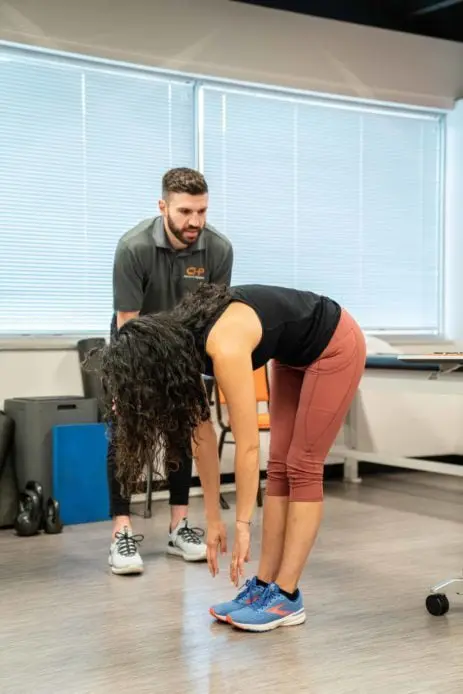
Flexion of the spine is commonly the most aggravating movement for anyone experiencing an acute episode of back pain. In physical therapy we test this by asking our patients to touch their toes. Once the acute episode subsides, the next step is training and learning to tolerate slow, controlled movements of the spine.

When tolerated well, the reverse crunch is great drill to teach this quality and can be used effectively as a warmup in the gym.

Oftentimes this is where the injury rehabilitation process stops. At this point the body can tolerate all normal daily activities however it has not learned to manage rapid movements of the spine, such as those that occur in sport or in the gym.

The Med Ball slam is a great drill to train the spine to tolerate movements that involve rapid spinal flexion. This drill should be pain free before attempting any heavy Olympic lifts like a clean or a snatch.

Also, remember to avoid using a ball that bounces as we don’t want any broken noses from this drill!

Physical Therapy Didn’t Work…

I tried physical therapy and it didn’t work.

Many of our patients in Bethesda have seen other physical therapists prior to seeing us. In their previous physical therapy experiences, they did not achieve the results that they were looking for and are coming to us for answers.

Personally, I love working with these people because they continue to believe that our profession can help them. However, negative experiences in physical therapy often cause many others to lose faith in the profession.

Perhaps you are one of these people. If so, I don’t blame you as I once was in your shoes!

When I was in High School, I experienced a quadricep injury that was impacting my ability to play football.

I went to my local physical therapy practice searching for help in overcoming this injury and play in my junior season. It was going to be my first season starting on both offense and defense causing this injury to constantly remain in the front of my mind.

My introduction to physical therapy was not what I had hoped for, and I now realize that my physical therapists were not taking great care of me (to learn more about how you can determine if this is the case, see my latest blog here).

Luckily, I was still able to play in my season and was back to 100% by the middle of the year. However, I can’t help but wonder if I would have been fully healthy to start the season if I saw a different physical therapist.

Like all other professions, the physical therapy industry has great professionals and poor ones. Furthermore, some physical therapists specialize with athletes, some with cardiac patients and others with people living in nursing homes.

As a result, my hope is that instead of saying “I tried physical therapy and it didn’t work”, you say “This physical therapist or physical therapy practice didn’t provide the results that I was looking for and I need to find someone that is a better fit for what I need.” 

×