Secret to Avoiding Running Related Hamstring Injuries

Many runners and other athletes, like you, understand that strength training improves performance, reduces injury risk and decreases the likelihood that you will see us in physical therapy!

However, we have found that you may be strength training because you feel that you are supposed to but these workouts are more than simply checking a box.

It is important to think about how you are training a particular muscle group during your workout. This change in focus may be the secret to eliminating future hamstring injuries that cause many to look for a physical therapist.

Many people strengthen the hamstrings in a concentric (as the muscles shorten) fashion, however most hamstring strains occur as the muscles lengthen and work to slow down the swinging leg.

It is essential for any runner or athlete that performs a great deal of sprinting to develop a large amount of eccentric (muscle contraction that occurs as it lengthens) hamstring strength.

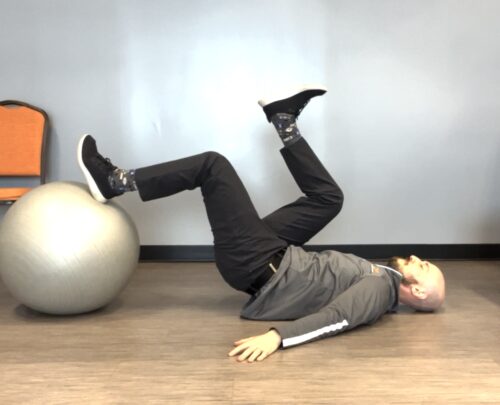
Eccentric hamstring curls are a great way to build this quality and the double leg variation on a physioball is a great place to start! Click here to see this exercise.

Once you have mastered the double leg eccentric glute bridge, it is time to step things up to the single leg progression.

How do you know if you are ready to move on? A great goal to shoot for on the double leg version is 10 FULL repetitions with a full 5 second lengthening period on each rep. The hips should not be dropping, and you should feel your abs throughout the set!

As we continue to build eccentric hamstring strength, this drill will add some additional challenges.

One leg will be flexed with the hip and knee at 90 degrees, mimicking a sprinting position. The result is one hip in a position of flexion while the other is in extension, much like sprinting or running. This will challenge your ability to control the position of the pelvis as you demonstrate hamstring strength.

Click here for the single leg progression!

Once you have mastered the single leg eccentric hamstring curl on a physioball, you can progress even further. To learn how to do that amongst other ways to optimize your strength training, click here.

Also, don’t forget to follow us on Instagram and facebook @cohenhealthandperformance!

Want to return to running after an ankle sprain?

Ankle sprains are often dismissed as minor injuries, yet they frequently lead runners and other athletes to seek physical therapy.

The seriousness of these injuries is frequently underestimated, with athletes returning to their activities too soon.

The most common type of ankle sprain that we see in physical therapy is an inversion sprain, where the foot typically remains planted as the ankle turns inward, causing the outer edge of the foot to roll onto the ground—hence the term “rolled ankle.” This motion damages the ligaments on the outside of the ankle, often leading to varying degrees of tears.

The severity of the injury and the number of ligaments affected determine the grade of the sprain, ranging from grade 1 to grade 3.

After an ankle sprain, it’s crucial to rule out a fracture. Athletes should seek an X-ray if they are unable to bear weight on the injured leg or experience severe pain around the malleolus (the prominent ankle bone on the outside).

If no fracture is found and the aforementioned symptoms are absent, the focus can shift to gradually returning to running.

During running, there is never a moment when both feet are on the ground simultaneously. This means the body is continuously bouncing from one leg to the other, placing repeated stress on the ankles as they absorb the full impact of the body.

Unfortunately, after an ankle injury, the capacity of the affected area to handle stress (the cumulative amount it can bear before re-injury) is significantly reduced. As a result, recovery from an ankle sprain often takes longer than expected, with many athletes attempting to run before their ankle has fully healed.

To ensure a safe recovery, injured tissues need to gradually reacclimate to the stress associated with running or other sports.

A careful and progressive return to running might start with non-weight-bearing movements, gradually advancing to low-impact, weight-bearing exercises such as squats, split squats, and lunges. From there, single-leg activities like balance drills and single-leg squats can be introduced, followed by plyometric exercises involving two-legged jumps, and eventually, hopping on one leg.

Finally, activities such as jump roping, short runs, and longer runs can be reintroduced into the routine.

In summary, every ankle sprain is unique, making it essential to have a trained medical professional assess the injury to rule out a fracture. This professional can then design a personalized return-to-sport program tailored to your needs.

For further assistance and information on how we can help, you know where to find us!

What Should You Be Drinking Before, During, and After a Run?

Much like other areas of performance training, proper hydration as an essential aspect of a comfortable, enjoyable run. Although it’s normal for runners to experience a small amount of dehydration, drinking enough fluids can significantly reduce the chances of any adverse effects. On top of that, proper hydration can improve your energy and endurance and even minimize recovery times.

Here are some general hydration recommendations to maximize run performance.

1. Pre-Run

Your hydration strategy should begin long before you start putting on your running gear. What you drink in the hours before a run is perhaps one of the most important aspects of hydration. Be mindful to drink plenty of fluids throughout the day before your run. Then, about 15–30 minutes before heading out the door, drink 250–500ml of fluids.

2. During The Run

The general rule of thumb is to drink 5–10 fl. oz. every 15–20 minutes while you are running. Again, this requirement can vary based on your individual needs or the temperature at the time of your run. However, this is a great general rule to set a baseline for how much water to bring along for your run.

If you don’t like carrying a water bottle or wearing a hydration belt, you can plan out a running route with access to water fountains along the way.

3. Post-Run

Post-run hydration is essential to get your fluid levels back to normal and helps prepare you for the next run. The general rule of thumb is to drink 16–24 fl. oz. of water for every pound lost during your run. 

Final Thoughts

Everyone — and every run — is different. Some days it’s hot and humid, and you’ll likely want to increase your fluid consumption. Other days you may only be running for 20 minutes, in which case you might not even need to bring water on the run. The more you experiment with different hydration techniques, the more in-tune you’ll be with your body and its unique hydration needs. 

Could this be the missing piece of your marathon training?

In a previous blog post, we introduced mat Pilates and how it helps people that are struggling with back pain.  However, many athletes use Pilates to improve other aspects of their performance and CHP’s own, Dr. Ciara Petry, uses it as part of her physical therapy treatment sessions.

As you know, Bethesda and Chevy Chase are packed with athletic people and runners of all levels. Many of these runners are preparing for a variety of races. Running volume increases as a runner prepares for a race, which increases the need for cross training. Cross training allows runners to enhance qualities that improve running performance.  However, it is important to avoid adding more pounding to the body in the process.

At Cohen Health and Performance, we have found Pilates to be incredibly helpful in this regard. Weekly supplementation of Pilates training helps to improve performance and/or reduce the risk of running related injuries.

Pilates includes low impact and multi-planar movements that enhance core stability, mobility, and other foundational components necessary for healthy running.

In an article published in 2018, Finatto et al performed a study measuring the effect of a 12-week Pilates mat program on running performance. The participants in this study were separated into 2 groups. Both groups participated in a run training program, however one of the groups also participated in classic mat Pilates training 2x/week for 1-hour per session. The study found that the Pilates group had been more resilient to fatigue when running. It was also found that runners in the Pilates training group significantly improved their 5-km times, thus suggesting that distance runners can transfer the gains made in Pilates to running!

Integrating Pilates into a runner’s performance training just 1-2x/week can improve running efficiency and performance. How cool is that?!

Here at CHP, we help our athletes conquer injury and optimize performance. Reach out today to schedule a running analysis with one of our performance physical therapists and to Dr. Ciara Petry, a certified Mat Pilates instructor, for personalized Pilates sessions!

Article for Reference: https://journals.plos.org/plosone/article?id=10.1371/journal.pone.0194057

Why Some Warmups Aren’t Useful

As performance physical therapists in Bethesda and Chevy Chase, we work within a very knowledgeable and active community.  Our clients and patients understand the importance of warming up.

Warming up is commonly touted as essential for anyone wishing to avoid injury during exercise, performance training, or running.

We agree with this statement; however, warmup routines are often implemented in a non-productive way.

There is a time and place for everything, however this does not mean that you need to stretch, roll around on the ground, and perform “activation” drills prior to being ready for exercise.

In addition to increasing total body temperature, a warmup routine should prepare the body for the specific workout that is going to take place. For this reason, we call warming up “movement preparation.” The body is being prepared to move!

Movement preparation should include drills that train the skills necessary for the day’s workout. Many times, these drills will look similar to the exercises within that day’s work out.

If you are getting ready to run, perform activities that practice things necessary to run effectively. If you are going to lift weights, practice movements similar to the lifts you are going to perform (ie. If you are going to squat, then squat in your warmup!).

This advise applies regardless of whether you are healthy, injured, in performance physical therapy, or training for performance.

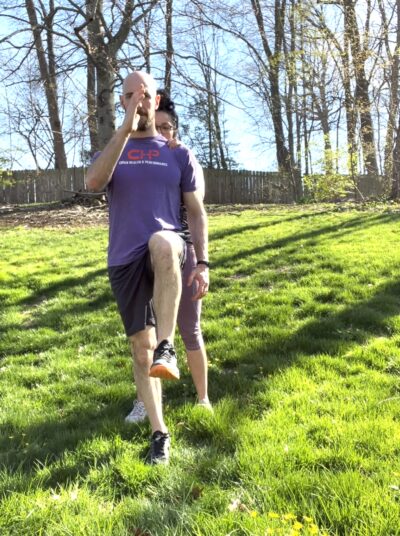
Below are 2 drills that we often use during movement preparation prior to running. Each drill practices single leg balance, the ability to shock absorb on one leg, and trunk rotation. These are all attributes necessary for running.

Single leg knee to chest
Forward lunge with cross connect

Furthermore, if you have been sitting at a desk for the majority of the day, you may need a more comprehensive warmup. On the other hand, if you have an active job requiring you to move in a variety of different ways then your warmup may not need to be as comprehensive.

Movement preparation is necessary, however it is essential to be purposeful, rather than mindlessly performing the same thing before every workout.

2 Simple Drills to Improve your Running Times

As a dedicated runner you likely have suffered an injury at some point. Perhaps it forced you to seek performance physical therapy. Whether you realized it or not, this injury limited your ability to train effectively.

At CHP, we consistently help runners in Chevy Chase and Bethesda overcome injuries that otherwise would limit their ability to train, ultimately causing disappointing results.

There is not a one size fits all solution to helping all runners; however, we often discover that runners are limited by their hamstrings.

Are you concerned that hamstring stiffness or weakness could be limiting your performance?

Your hamstring is responsible for keeping your heel close to your bottom during the heel recovery phase of the running cycle. This portion of the cycle occurs as you bring your leg back underneath your body to prepare it to strike the ground again. The closer you can keep your heel relative to your bottom, the better! This allows you to efficiently move your leg faster through space, resulting in faster times. Below is a drill we prescribe to many runners to improve this attribute.


When running the hamstrings also need the ability to lengthen as the thigh is in front of the body. This should be achieved without drastically changing the position of the pelvis. Many runners struggle to maintain control of their pelvis as the hamstring lengthens. This increases the stress placed onto a variety of soft tissues through the lower body and alters foot strike position. Below is a drill to improve these capabilities.


A thoughtful and more scientific approach to training, specifically designed for runners is likely all that you need to drastically improve your running performance. It may not even require you to train any harder, just smarter!

×