A missing piece of a runners training program

In the world of running and endurance sports, the integration of strength training into a regular fitness routine is not just beneficial; it’s essential. This article delves into the importance of strength training for runners, exploring how it enhances performance, the most effective approaches to take, and specific methods that yield the best results.

The Significance of Strength Training for Runners

Strength training goes beyond merely increasing muscle mass; for runners, it’s a critical component in improving overall performance, efficiency, and reducing injury risk. By focusing on core strength, lower body power, single-leg stability, and explosiveness, runners can significantly enhance their running mechanics. This not only leads to faster and more efficient running but also plays a vital role in injury prevention by ensuring the body can handle the repetitive impact of running.

Triple Extension: A Key Focus

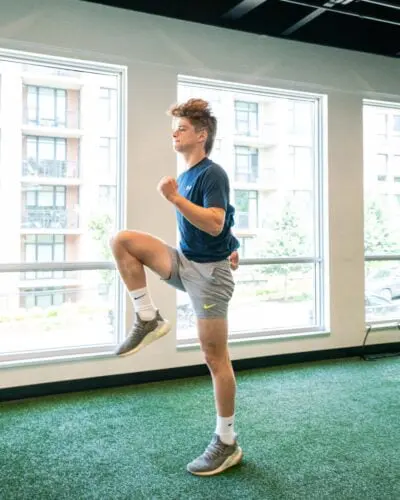
A particularly effective method within strength training for runners is the emphasis on triple extension. This concept mirrors a critical moment in running – the propulsion phase, where the back leg pushes off the ground. Triple extension involves the simultaneous extension of the ankle, knee, and hip joints. This action is fundamental to creating a powerful stride transition, thereby enhancing the force generated with each step.

Practical Applications of Triple Extension

Incorporating triple extension into your strength training regimen can be transformative. Here are some practical exercises that focus on this concept:

Wall Load and Lift


This exercise is incredibly versatile, making it suitable for warm-ups, strength sessions, or even as a drill to refine triple extension coordination. It helps in reinforcing the proper alignment and mechanics needed for an effective push-off in running.

Explosive Deadlifts

By incorporating speed and explosiveness into traditional deadlifts, this exercise bridges the gap between standard weightlifting and running mechanics. It emphasizes the power generation aspect of the triple extension, crucial for improving running speed.

Kettlebell Swings

A staple in many strength training programs, kettlebell swings can be particularly beneficial for runners when modified to mimic the running dynamics. By using lighter weights and focusing on swift extension at the hips, knees, and ankles, this exercise directly translates to improved running performance.

Why Strength Training Matters

The benefits of strength training for runners are multifaceted. It’s not just about running faster; it’s about running smarter. Strength training:

  • Improves Running Economy: By increasing muscle strength and power, runners can achieve greater efficiency, meaning they use less energy to maintain the same pace.
  • Enhances Endurance: Stronger muscles can handle the demands of long-distance running more effectively, delaying the onset of fatigue.
  • Reduces Injury Risk: A well-rounded strength training program increases muscle and joint resilience, making runners less susceptible to common running injuries.

Conclusion

Incorporating strength training into a runner’s regimen is crucial for enhancing performance, efficiency, and injury prevention. Focusing on exercises that promote triple extension can significantly improve the power and mechanics of a runner’s stride. By embracing a comprehensive strength program that includes exercises like wall loads and lifts, explosive deadlifts, and kettlebell swings, runners can unlock their full potential. Ultimately, strength training is not just a supplement to running; it’s a cornerstone of a well-rounded running program.

3 Tips to Help You Find the Best Shoe

Minimalist shoes, running shoes, cross-training sneakers, weightlifting shoes. As sports physical therapists, personal trainers and performance coaches in McLean and Bethesda, we are asked all sorts of footwear questions. If you are like me, and do several different things, it may seem that you need a special shoe for each activity.

In my closet you can find running, hiking, cross-training, basketball, and special weightlifting shoes. But these days I mostly use 1 pair for all of my training.

I’m more of a generalist now. I dabble in many different things but spend most of my “fitness time” exercising in the gym. Sorry ego, my days of being a specialist are behind me.

If you are training for a particular sport or are a high-level runner, you are a specialist and likely need a special shoe for your sport (and the footwear recommendations in a sports physical therapy setting will be different). But if you are a generalist like me, you need a shoe that is comfortable, designed for your foot type, and can do everything that you need.

Here are 3 things that you should look for to choose the right shoe for you.

  • It must have a firm and snug heel cup. Your heel sits at the base of the shoe, in a place called the heel cup. The heels cup should fit snugly around your heel and should not be much wider than your heel itself. This prevents your heel from sliding within the shoe, which may negatively impact foot mechanics.
  • The shoe must have a toe break that bends where you toes bend. Place your shoe on the ground and hold it there. Pull the front of your shoe up from under it. The folding point of the shoe should be located where your toes bend. If your shoe folds at another location, your shoe is not accommodating to the mechanics of your foot and can lead to breakdown within the structure of the foot itself.
  • You should be able to feel the entirety of both your feet on the ground as you are standing still in your shoes. People are often unable to feel their arches, which results in more stress on the areas that have more contact with the ground.

There are 26 bones and 30 joints within the foot. This results in many ways that our foot can compensate but these 3 tips can help solve these issues.

Would you like help finding the right brand and model shoe for you? Our performance physical therapy team would be happy to provide you with recommendations based on the brands and models that are on the market right now!

Runners, Stop Making This Mistake in Your Training

According to the research, the chances of having a knee injury increase significantly after running for 1000 hours.

Most serious runners pass the 1000-hour mark within 1 year and end up in performance physical therapy clinics like CHP!

Does this mean that “bad knees” are inevitable once you choose to run? No, but it does mean that you must learn how to take care of them.

Running consists of thousands of strides repeated over and over. As a result, any problems with your running technique will add up, potentially contributing to injury.

Even if you are not a serious runner, you are likely approaching the 1000-hour running mark.

Does this mean that you are a ticking time bomb, ready to explode? Probably not if you are strength training and working on improving your running technique.

Strength Training

Implementing strength training into a consistent exercise routine has been shown to make you a more efficient runner. This means that you use less energy to run a given amount of time and as a result, are less fatigued. Less fatigue=less risk of injury.  For this reason, becoming a more efficient runner is an essential part of the sports physical therapy process.

Research also shows that regular strength training improves a runner’s speed and VO2 max. VO2 max is a measure of the amount of oxygen that you can use during exercise. When you can use more oxygen as you run, you will run farther, faster!

Just remember, every runner is unique. Even if you have a running partner with the same routine, you both have unique characteristics and needs to address in a strength training program. Your strength training program must be unique to you. Cookie cutter programs don’t cut it!

Running Technique

Think of the last time that you went out for a run. Were you thinking about every stride you took? Were you aware of your foot strike? I highly doubt it!

Running is an automatic pattern that does not require conscious thought to perform. Most people listen to music or podcasts. We couldn’t do that if we needed to focus on how to run.

Unfortunately, this also means that you may be repeating the same bad pattern over and over without realizing your mistake, until it is too late. One of the most common mistakes occurs with a runners foot strike position. Runners often contact the ground in front of the body which puts more stress on the body.

Foot strike position is dependent on your body dimensions (such as limb length).

We can’t change your anatomy, but we can change the position, aka the posture, of our bodies. This is often the first step of the physical therapy process for a runner!

A “stacked” posture will change your foot strike so that it occurs directly underneath the body. This results in a more efficient stride and less stress to the body. To learn about the stack, check out a previous article that I wrote on Learn to Stack Like a Snowman.

Attempt the drill below to feel what it is like to have a stacked posture while running.

  • Grab a partner and ask him/her/they to stand behind you (you are also standing)
  • Have your partner press down on your shoulders with a moderate amount of force and do not let them squish you
  • As you resist them you should feel your abs engage and feel as if you are standing tall
  • Next, attempt to shift your weight onto 1 leg and pick up your opposite foot while resisting the force of your partner
  • Try the other leg

For a video on this drill, click here.

After performing this drill, you should have a better sense of your optimal running posture. Try to replicate this feeling the next time you go on a run!

2 Drills to Improve Your Running Times

If you are a dedicated runner you likely have suffered an injury and maybe even gone to physical therapy. Whether you realized it or not, this injury limited your ability to train effectively.

Here in Bethesda (and soon to be, McLean!), physical therapy involves helping runners overcome injuries that otherwise would limit their ability to train, ultimately causing disappointing results.

There is not a one size fits all solution to helping runners. However, we often discover that runners are limited by the mobility of their hamstrings.

During a run, the hamstrings need the ability to lengthen as the thigh is in front of the body. This should be achieved without drastically changing the position of the pelvis. Many runners struggle to maintain control of their pelvis as the hamstring lengthens. This increases the stress placed onto a variety of soft tissues through the lower body and alters foot strike position.

Hamstrings, like many other muscles, must be strong when in lengthened positions. Otherwise the body will not allow you to keep any of the short-term flexibility improvements that you have made with stretching.

Below are 2 drills that you can incorporate into your strength training routine to improve hamstring strength and flexibility that the body will hold on to!

Kickstand RDL
Single Leg Eccentric Glute Bridge

A thoughtful and more scientific approach to training that is specifically designed for runners is likely all you need to drastically improve your running performance. It may not even require you to train any harder, just smarter!

Runners: How To Vary Your Training to Optimize Your Results!

Implementing variety into training is something that is commonly underutilized and overlooked among recreational runners. This is often the topic of conversation after we perform our running analysis or within a sports physical therapy session.

Varying speed, intensity, and distance can be a useful tool in run training, whether you’re training for a big race or just getting back into it.

Running at different speeds or intensities allows you to vary which muscles and tissues you are repeatedly straining. When you sprint, your technique is going to look very different than when you are going for a long, slow jog.

Including both in your training helps you to disperse the stress of the workout over more tissues, and can help prevent overuse injuries! Some examples of what this variety might look like: 

  1. High Intensity Interval Training (HIIT) runs: “sprint” training! Work to rest intervals should be greater (1:4, 1:5). For example. sprinting for 10 seconds and walking/jogging for 50 seconds. Repeat for 10-15 minutes. Great for a track or grassy field! 
  2. Interval training: longer bouts of faster running, not as intense as a full sprint. Work to rest ratios are going to look more even (2:3, 1:1 or 2:1 ratios). For example, fast running for 1-2 minutes, jogging for 2-3 minutes, repeat for 10-15 minutes. 
  3. Tempo training: usually done as a “long run”. Pick a pace, and try to stick to it throughout the duration of your run. Distances should be specific to what your goals are!
  4. Using Rate of Perceived Exertion (RPE) Scale: If you don’t know what pace time is right for you, start with RPE! You can use a scale of 0-10, with 0 being completely at rest and 10 being a sprint as fast as you can possibly go. Fast bouts of HIIT training should be performed at an RPE of 8-10, whereas interval training should be closer to RPEs of 5-8. An example of an RPE scale can be found here 

In addition to preventing injuries, adding sprints and interval training can help increase muscle mass, cardiovascular endurance, and improve your ability to cover more distance in a shorter amount of time. If you’re finding that you’re constantly dealing with the same injury, consistent soreness in one muscle group, or you just want to shake up your training, a performance physical therapist can help find the right running program for you! 


1 Trick to Perfect Running Foot Strike Position

If you ever experience back pain when running, are a runner that has been to physical therapy, or are curious about foot strike position, this article is for you!

One of my favorite workshops to conduct is the CHP Running Technique and Performance lab. I have a blast throughout the workshop, but the Q&A portion is my favorite. I have gotten the opportunity to answer many different questions which have forced me to expand my knowledge and has helped me to create a better workshop over time.

While the questions that I receive consistently differ, one topic remains consistent. Someone inevitably asks about foot strike position and my answer often surprises them.

There is no correct foot strike position.

Among other things, foot strike position is dependent on an individual’s body dimensions (limb length as an example) and the position of the body above.

While we cannot change your anatomy, we can change the position, aka the posture, of our bodies.

A “stacked” posture will facilitate a foot strike that occurs directly underneath the body. This foot strike position results in a more efficient stride and minimal stress to the body. To learn about the stack, check out a previous article that I wrote on Learn to Stack Like a Snowman.

Attempt the drill below to feel what it is like to have a stacked posture while running.

  • Grab a partner and ask him/her/they to stand behind you (you are also standing)
  • Have your partner press down on your shoulders with a moderate amount of force and do not let them squish you
  • As you resist them you should feel your abs engage and feel as if you are standing tall
  • Next, attempt to shift your weight onto 1 leg and pick up your opposite foot while resisting the force of your partner
  • Try the other leg

For a video on this drill, click here.

After performing this drill, you should have a better sense of your optimal running posture. Try to replicate this feeling the next time you go on a run!

×