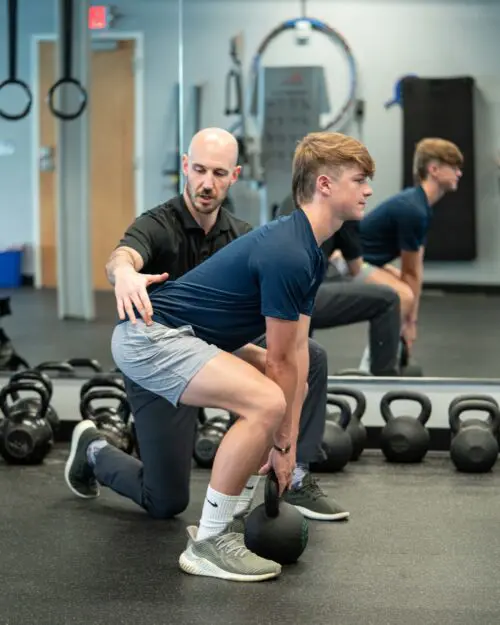
A physical therapist in the wild! 3 of my personal upper body warmups

Incorporating overhead pressing exercises into my weight training routine is something I really enjoy, but I often find them a bit challenging.

My overhead mobility isn’t as good as I’d like it to be, and a significant reason for that is my stiff chest. I have a mild case of pectus excavatum, commonly known as bowl chest. This condition causes the sternum-the bone at the center of the chest-to remain depressed, creating difficulties during overhead movements.

While this condition varies in severity, it often leads to difficulties during overhead movements due to the restricted ability of the sternum to rise when pressing or reaching overhead. In an ideal scenario, the sternum should lift as you inhale and lower as you exhale. However, for individuals with pectus excavatum or a generally stiff chest, this natural movement is hindered, making overhead exercises more challenging.

It’s not just those with pectus excavatum who face these challenges. Many people develop tight chest walls from modern lifestyle habits such as prolonged sitting, slouching, carrying heavy backpacks, or simply spending too much time hunched over a desk. These habits can cause stiffness in the chest, limiting overhead mobility and increasing the risk of injury during exercises like the overhead press.

Physical therapy offers a comprehensive approach to improving overhead mobility, particularly for those dealing with stiff chests. Traditional stretching methods might not be effective in addressing the underlying issues that restrict movement. Instead, targeted exercises and warm-up drills can be instrumental in loosening the chest, enhancing mobility, and ensuring that the body is well-prepared for the demands of weight training.

Three Effective Warm-Up Drills for Improved Overhead Mobility

To address these challenges, incorporating specific warm-up drills into your routine is crucial. Here are three exercises that can help improve overhead mobility, especially for those struggling with a stiff chest:

1. Crab on Elbows: This exercise is designed to open up the chest and promote better sternum mobility. By supporting yourself on your elbows in a crab-like position, you can stretch the chest and prepare it for the demands of overhead pressing.

2. Hooklying Overhead Reach: In this exercise, you lie on your back with your knees bent and reach overhead. The goal is to enhance the connection between your breathing and your chest movement, encouraging the sternum to rise and fall with each breath. This drill not only improves mobility but also reinforces proper breathing techniques that are essential during overhead movements.

3. Yoga Pushup*: Combining the elements of a traditional pushup with yoga-inspired movements, the yoga pushup is excellent for improving overall shoulder and chest mobility. It helps in engaging the entire upper body while emphasizing the importance of controlled breathing and proper form.

The Importance of a Tailored Warm-Up Routine

A tailored warm-up routine that addresses specific areas of stiffness or weakness can significantly improve your performance and reduce the risk of injury. In physical therapy, we emphasize the importance of being intentional about your warm-ups. By incorporating exercises like the crab on elbows, hooklying overhead reach, and yoga pushup, you can specifically target areas that need improvement, ensuring that your body is fully prepared for the workout ahead.

Moreover, these exercises are not just about getting ready for the workout; they are about making long-term improvements in mobility and strength. Over time, consistent practice of these drills can lead to better overhead mobility, reduced discomfort, and enhanced performance in your weight training routine.

For anyone facing challenges with overhead pressing due to a stiff chest or conditions like pectus excavatum, physical therapy offers a range of solutions that can make a significant difference. By incorporating targeted warm-up drills into your routine, you can improve your overhead mobility, reduce the risk of injury, and enjoy the full benefits of your weight training regimen. Remember, being intentional about your warm-up is not just a preparation—it’s a critical part of your journey toward better physical health and performance.
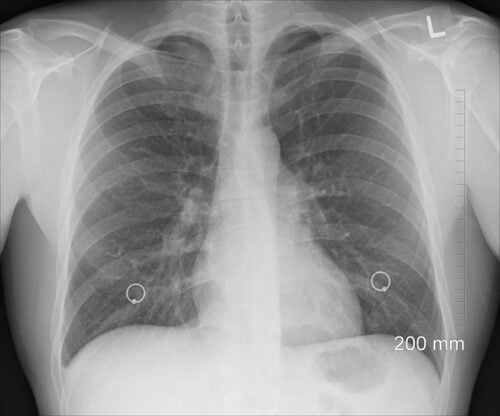

X-Rays and MRIs don’t tell sports physical therapists the whole story

Medical images like X-Rays and MRIs are awesome and a helpful part of the sports physical therapy process. It’s like peering into the secret life of our bones and tissues, but sometimes what we see can be a bit startling.

Picture this: You’ve just got your X-Ray or MRI results. There’s a moment of truth, where you feel like your body’s betrayed you. Maybe you’re staring at an image that seems to scream ‘surgery!’ or ‘pain for life!’

But hold on – it’s not all doom and gloom.

X-Rays provide physical therapists with more general information, especially with bones. They show us the spacing between vertebrae in your back or if there’s a sneaky fracture hiding in there. But when it comes to the softer stuff – muscles, tendons, ligaments – they’re a bit out of their depth.

This is where the MRI comes in, providing more detailed information about our intervertebral discs and soft tissues. It’s high-resolution and insightful, but sometimes all this detail doesn’t help us.

Research has shown that many of us are walking around with meniscal tears in our knees or disc issues in our backs, completely unaware because we feel fine. Then there are times when we’re in pain, get scanned, and the images come back with a shrug – nothing significant.

When it  comes to back pain, about 90% of it is ‘non-specific’. Translation: even with all our tech, we can’t pinpoint the exact cause in most cases. So, do these images really matter?

Well, yes and no.

They’re super valuable when they align with what you’re feeling – when the story your body is telling matches the tale spun by the images. But if you’re holding an X-Ray or MRI report that’s making you second-guess your body’s capabilities, take a step back. It’s just one piece of a much larger puzzle.

Even if an image shows something that looks bad, it doesn’t mean you’re destined for surgery, or a life of pain or inactivity. Our bodies are incredible at adapting and healing. As physical therapists and sports performance coaches, we’re detectives in a way. We look for the root cause of the damage and focus on fixing it, not just the symptoms.

If you’ve got an X-Ray or MRI that’s got you worried, it is important to understand why these issues popped up in the first place and discover what you can do about them.

It’s not just about getting out of pain; it’s about getting back to living your life and doing the things you love, regardless of what the images say. So, keep moving, keep exploring, and remember, your body’s story is much more than a snapshot on a screen.

What breaking my nose taught me about physical therapy and performance training

My nose healed up, so I assumed I was fine (this was clearly before I became a sports physical therapist)…

It was the late 90s, and I had broken my nose a few weeks prior. My doctor cleared me to return to wrestling practice as long as I could avoid contact to the face.

Surprisingly, my middle school teammates respected that, and I was able to fully return to the mat. What was also a surprise was that I struggled to rebuild my conditioning as I continued to struggle to breathe through my nose. Turns out I had a deviated septum because of the fracture and ultimately had to get surgery to fix it.

I quickly realized that feeling better and hitting peak performance is about more than heavy training and conventional approaches to sports physical therapy.

Survival is your body’s number 1 priority, and it will pull out all the stops to maintain that sweet ability to breathe– even if it means putting more stress on other areas.

Nasal breathing is the VIP pass to effective respiration. It’s the body’s go-to strategy when you’re relaxing and even during those moderate sweat sessions. Breathing through your nose isn’t just about getting air in and out – it’s a full-service operation. It filters, humidifies, and regulates the temperature of the air you’re breathing. And here’s the kicker – it lets you extract more oxygen because it takes longer than mouth breathing.

But wait, there’s more. Breathing through the nose isn’t just a respiratory hack; it’s a triple threat. It’s like the Swiss Army knife of wellness, regulating stress, blood pressure, and even boosting the immune system.

Now, how do you get in on this nasal breathing action? Easy. Start with a 5-minute daily ritual of relaxed breathing. Inhale and exhale through the nose, throw in 5-second pauses after each exhale, and ensure that the exhale is twice as long as the inhale. It’s like a mini-vacation for your respiratory system.

Quick side note: if you’ve got anything messing with your ability to breathe – asthma, allergies, or a deviated septum – don’t be a hero. Talk to your doctor or physical therapist about it. These issues can throw a wrench in your nasal breathing game and mess with all your best efforts.

Why I don’t coach belly breathing anymore

If you have worked with me as a physical therapy patient in McLean or Bethesda, you know I love talking about breathing.

This is usually well received, but sometimes people look at me like I have two heads.

I get it because I used to think the same thing. “I’m here in physical therapy because my shoulder hurts, and now you are giving me breathing exercises.”

I bring a breathing component into many drills that I prescribe because our body adjusts to the position where it feels most comfortable. That position is the one it can best breathe in.

Sometimes, these adjustments impact the body’s ability to move, resulting in joint pain.

As physical therapists, we can help you correct these problems with drills that assist you in breathing more effectively where you are restricted.

Let’s start by focusing on where the breath comes from.

The lungs are located inside the rib cage. Our rib cage is designed to expand in 360 degrees when we breathe in and compress in 360 degrees when we breathe out. Think of it like an accordion.

When an area of our rib cage is restricted, our breathing is also.

Sometimes, our entire rib cage is stiff, causing people to compensate with an exaggerated belly breath.

While the belly is meant to move with the rib cage, it should not move in place of it. Don’t forget the lungs are in the rib cage, not the stomach!

Pay attention to my breathing cues in this 90/90 hip lift video, beginning at the 50 second mark. I begin with a silent inhale through the nose and a long sigh through the mouse before pausing for 5 seconds. This ensures that my chest and stomach rise as I inhale and reverse as I exhale.

Try including this breathing strategy in your stretches or mobility work, and nasal breath when at rest. Here is an article on the importance of doing so!

New Bethesda location coming soon!

CHP-Bethesda is getting bigger and better!

I am so excited to finally tell you about our new physical therapy and sports performance facility in Bethesda. We are moving 2 miles down the road to 5272 River Road.

You may wonder why we moved so soon after opening our McLean facility.

Our new 3100-square-foot, state-of-the-art facility will allow us to have a sports performance center and physical therapy clinic. This will help us to continue our mission of helping active people like you conquer injury while providing opportunities to train in a setting like none other.

This amazing new facility is being built and is expected to open in mid-November.

Stay tuned for updates on our grand opening and all of the new services we will be providing at the new and improved CHP Bethesda!

P.S – If you need help with something now, we have openings available!

Maximizing your child’s chance of earning a college scholarship

ONE person has the final decision in determining if your athlete will receive a scholarship to play college sports. The coach.

Coaches are most concerned with keeping their jobs or earning job opportunities at more prominent programs.

If your athlete can help a college coach with either, a scholarship may be coming their way!

On the other hand, coaches hate inconsistency. When talented players cannot play consistently, a coach can’t trust that they can win consistently, and inconsistent winning equals a lack of job security.

What is the number 1 reason an athlete is unable to play? You guessed it, injury.

I remember speaking to a college football coach in Texas who told me that he would rather have a good player that is consistently healthy than a great player who is always in physical therapy and injury prone. He went on to say that he likes players who overcame an injury and stayed healthy afterward. To the coach, this indicated a strong work ethic, a resilient mindset, and commitment to the physical therapy and performance training process. 

A comprehensive strength training program is best for athletes to stay healthy or overcome a lengthy injury history. Now that summer is here, this is the perfect time for your athlete to get started!

But finding the best strength training solution can be challenging. You should look for three things in your athlete’s strength training program.

  1. Qualified and Experienced Coaches: Look for coaches with a track record of working in your athletes’ sport or discipline. They should demonstrate a strong understanding of exercise science and sport-specific training.
  2. Individualized Program Design: A quality strength training program is tailored to the specific needs and goals of the athlete. Look for programs that start with an individualized assessment to identify strengths, weaknesses, and areas of improvement. The program should be designed to address your athlete’s unique characteristics.
  3. Goal Alignment: Your athlete’s strength training program should align with their goals and sport. Look for programs that incorporate exercises, training methods, or progressions relevant to your athlete’s sport. 

Are you interested in finding the best summer training program for your athlete? 

If so, contact us to participate in our rising-star training assessment.

This assessment will show you and your athlete the secret to helping them avoid injury and take their performance to the next level. 

×