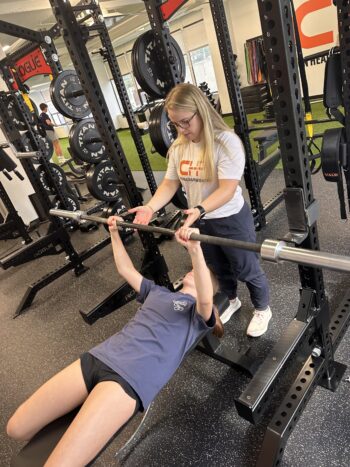
The back and shoulders are two of the areas where people commonly experience pain when lifting weights.
For many active adults and athletes, that discomfort can make certain exercises frustrating. Over time, they may start avoiding movements like overhead presses, bench presses, or squats altogether.
But experiencing pain during an exercise doesn’t necessarily mean you have to stop doing it.
Sometimes, a few simple modifications can make a big difference. The goal is to find ways to continue building strength while reducing unnecessary irritation and gradually improving your body’s ability to tolerate different movements.
At Cohen Health & Performance, we often help patients dealing with shoulder pain and back pain find ways to stay active without constantly aggravating their symptoms.
Here are three common gym exercises that can be modified to make training more comfortable.
1. Overhead Press: An Alternative for Shoulder Pain
Overhead pressing is a great way to develop upper-body strength. However, pressing a weight completely overhead requires a significant amount of shoulder mobility.
If you don’t have the range of motion needed for that movement, forcing your arms into an overhead position may cause discomfort.
One simple modification is to slightly recline the bench when performing a seated dumbbell shoulder press.
This changes the angle of the movement and reduces how much shoulder flexion is required while still allowing you to train your vertical pressing strength.
For people experiencing shoulder discomfort, this can be a useful alternative to traditional overhead pressing.
If you’re looking into shoulder rehab in Bethesda or shoulder rehab in McLean, it’s important to understand that modifying an exercise is only one part of the process. Identifying why the shoulder hurts and addressing any underlying limitations should also be part of your rehabilitation plan.
2. Bench Press: Try Dumbbells Instead of a Barbell
The bench press is another exercise that commonly causes shoulder discomfort, particularly around the front of the shoulder.
For people who enjoy lifting heavy, giving up the bench press can be frustrating. Fortunately, there are ways to modify the movement without completely removing it from your routine.
One option is to use dumbbells instead of a barbell.
Unlike a barbell, dumbbells allow each arm to move more naturally during the pressing motion. This gives your shoulders more freedom to find a position that feels comfortable.
Another option is to reduce the range of motion by placing a pad on your chest. This prevents the weight from traveling as far down and can help reduce stress on the front of the shoulder.
These adjustments can help you continue training your chest and upper body while working around shoulder discomfort.
3. Barbell Back Squat: Consider a Safety Squat Bar
Squats are one of the most effective exercises for developing lower-body strength.
However, some people experience back pain when performing traditional barbell back squats.
When the bar rests behind your head and across your upper back, your body needs to adjust its position to balance the load. For some individuals, this can increase discomfort in the lower back.
A safety squat bar offers another option.
Its design positions the load differently, making it easier for many people to maintain a more upright torso and engage their core throughout the movement.
We often find that patients tolerate safety squat bar squats better than traditional back squats. It also allows them to continue loading their lower-body muscles without relying on the same positioning required by a conventional barbell.
If your gym doesn’t have a safety squat bar, there are other squat variations that may be more appropriate depending on your symptoms and training goals.
Exercise Modifications Should Match Your Body and Your Goals
One of the biggest mistakes people make when dealing with shoulder or back pain is assuming they have to stop performing the exercises they enjoy.
In reality, there are often different ways to train the same muscle groups and develop strength without repeatedly irritating an area.
However, the right modification depends on the individual.
Someone experiencing shoulder pain may have different mobility limitations, strength deficits, or movement restrictions than someone else with similar symptoms. The same applies to back pain.
That’s why an individualized evaluation matters.
At Cohen Health & Performance, our physical therapists look beyond the painful area to understand what’s contributing to your symptoms. We consider your injury history, movement patterns, training demands, and personal goals to develop a rehabilitation plan that makes sense for you.
Looking for Shoulder Rehab in Bethesda or McLean?
If shoulder pain is interfering with your workouts, finding the right approach to shoulder rehab in Bethesda or shoulder rehab in McLean can help you work toward returning to the activities you enjoy.
Whether you’re dealing with discomfort during overhead pressing, bench pressing, or other upper-body exercises, our team can help identify what’s contributing to your symptoms and determine which movements are appropriate for your recovery.
Need Help With Back Pain in Bethesda or McLean?
Back pain doesn’t necessarily mean you have to give up squatting or lower-body training.
With the right assessment and exercise modifications, you may be able to continue building strength while gradually improving your ability to tolerate different movements.
At Cohen Health & Performance, we provide individualized care for people experiencing back pain in Bethesda and back pain in McLean. Our goal is to help you understand what’s causing your symptoms, build strength, and return to training with confidence.
If shoulder or back pain has been limiting your workouts, contact our team to learn how we can help you build a training program around your body and your goals.
