Runners: Here is a quick workout for you

I get it. Running is a lot easier than going to the gym. Just throw on your running shoes, walk out the front door, and you are good to go! Meanwhile, the gym requires you to leave the house, get in the car, drive there, and fight for equipment and space with others. Not to mention that the traffic in McLean and Bethesda is no joke!

By now, you probably know that cross-training is essential to improving running performance and avoiding physical therapy. But many runners find it hard to make time for anything besides running. It is easy to fall into the trap that we have seen many runners fall victim to. This is the mindset that the only thing that counts towards training is the miles they log. But this is not true!

Cross-training is essential for runners because it helps prevent injury, build/maintain strength, and improve your run times and muscular endurance! Lifting weights and moving your body in varied ways from your typical movement patterns (running is repetitive!) builds resilience to injury. A typical cross-training program for a runner should include strength training of not only your lower body, but upper body and core as well. Lower body strength is important for power production and single leg control during your run. Core and upper body strength will help you maintain efficient running posture and overall muscular conditioning. Cross-training doesn’t have to be long and daunting.  2 sessions per week of 30 minutes of strength training is a great place to start! Below is an easy full-body template and example workout to try at the gym or home!

Step 1: 5-10 minutes warm-up 

  • Get your muscles warm
  • This can include jogging, biking, or dynamic stretches

Step 2: Full Body Circuit 

  • Choose 1-2 exercises for your lower body, and 1-2 exercises for your upper body
  • Include compound movements! This includes exercises that use your lower body, upper body, and core to work together
  • Perform each exercise for 8-10 repetitions, and repeat the circuit for 3-4 total rounds

Step 3: Core and Plyometric Finish 

  • Choose 2-3 core exercises and 1-2 plyometric exercises
  • Perform each exercise for 20-30 seconds, and repeat the circuit for 3-4 rounds

Example: 
1. Jog on the treadmill at 5-6 MPH for 5 minutes

2. Perform 3 rounds of the following circuit:
A. Reverse Lunge x10 reps on each leg
B. Dumbbell Bench Press x10 reps
C. Goblet Squat x10 reps
D. Shoulder press x10 reps
*Choose a weight that is challenging for you, but you can complete all 3 circuits

3. Perform 3 rounds of the following circuit:
A. Sprinter Step Up x 30 seconds
B. Side plank x 30 seconds on each side
C. Russian twists x 30 seconds

If you are a serious runner that is looking to step up your performance or avoid injury, contact us for a customized cross-training program designed by our resident triathlete, Dr. Kelly Henry!

Runners rejoice: how dry needling can help you

It must be your lucky day because we have another guest post from the Clinic Director of our McLean location, Dr. Kelly Henry!

Do you have tight muscles or knots that won’t go away? Maybe you have even gone to physical therapy elsewhere but made minimal progress!

If you are anything like me, you have tried massage, foam rolling, stretching, and whatever else you can think of, but they keep returning.

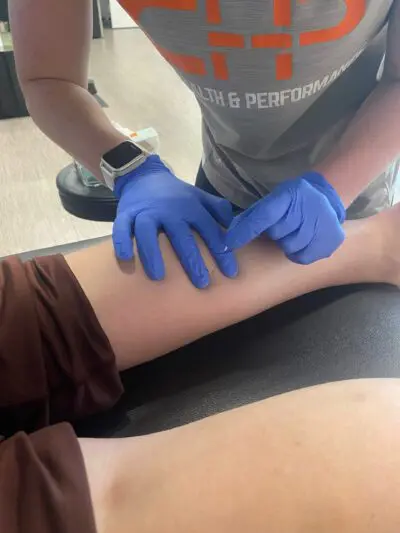
Dry needling could be the solution you are looking for. Running is a very linear and repetitive sport, which increases the risk of developing muscle tightness and symptoms related to overuse. Many runners have experienced relief of chronic quad, calf, hamstring or hip flexor tightness from dry needling.

I recently helped a runner during a physical therapy session at our McLean facility that was experiencing consistent calf pain. It was most intense in the middle of his runs and forced him to reduce his overall mileage. He did everything that he could to fix it. He spent a lot of time warming up before runs, cooling down after runs, and he stretched constantly. But nothing helped.

His first physical therapy session included dry needling for his calf muscles, range of motion drills, and a few adjustments to his running technique, and the chronic calf pain went away!

Dry needling works by targeting a muscle limiting range of motion or causing pain. Your physical therapist will identify which muscle is causing the problem, identify “trigger points” in the muscle, and create a “twitch response” with the needle. A twitch response is a quick contraction that helps the muscle relax. People often feel better just a few moments after treatment! Here are some of the things that my runners have noticed after dry needling:

  • Less tightness during and after runs
  • Improvement in muscle soreness
  • Faster recovery from nagging injuries
  • Improved range of motion and muscle activation during cross training

Dry needling is best used with other forms of physical therapy and rehabilitation, including exercise and neuromuscular conditioning.

If you are a runner that is struggling with chronic injuries or tightness or is looking to optimize your recovery, contact us for a dry needling session in our McLean facility today.

Speaking of serious runners…we have 2 slots still available for a FREE Resilient Runner Injury screen at our McLean facility. If you want to run injury-free for years to come, don’t miss this!

This screen involves the use of our exciting, new Forcedeck technology. Learn more about that here!

Contact us for more information and to sign up.

Nails on a chalkboard to me

“It Will Hurt Your Knees if They Go Past Your Toes”—Debunking the Myth

Recently, while working out at the gym, I overheard two young men discussing their barbell squats. One of them mentioned that he had just finished physical therapy, and I hope the following advice didn’t come from his therapist…

After completing a set, one of the lifters (let’s call him Lifter 1) was chatting with his friend (Lifter 2). Lifter 2 advised him not to let his knees go past his toes during squats, claiming it would be bad for them.

This belief is widespread in fitness circles, the personal training industry, and was even common in physical therapy. However, it’s simply not true.

Your knees naturally go over your toes when you walk or run. In fact, proper squat technique requires your knees to move well past your toes.

Attempting to prevent this by pushing your hips back and arching your lower back only shifts more stress onto your lower back, increasing the risk of back pain.

But you might wonder: does allowing your knees to move past your toes increase stress on them?

The answer is no! In fact, research shows that training your knees to comfortably move past your toes helps build healthier knees and reduces the strain on your back.

Check out the squat tutorial below to retrain your squat technique and get your knees accustomed to moving over your toes as they naturally should!

Remember, there’s no such thing as a “bad” or “good” exercise. The suitability of an exercise depends on various factors, including your fitness goals, injury history (consult your physical therapist), unique body traits, and movement capabilities. Keep this in mind whenever you hear generalized or “one size fits all” advice about exercise.

Runners, Stop Making This Mistake in Your Training

According to the research, the chances of having a knee injury increase significantly after running for 1000 hours.

Most serious runners pass the 1000-hour mark within 1 year and end up in performance physical therapy clinics like CHP!

Does this mean that “bad knees” are inevitable once you choose to run? No, but it does mean that you must learn how to take care of them.

Running consists of thousands of strides repeated over and over. As a result, any problems with your running technique will add up, potentially contributing to injury.

Even if you are not a serious runner, you are likely approaching the 1000-hour running mark.

Does this mean that you are a ticking time bomb, ready to explode? Probably not if you are strength training and working on improving your running technique.

Strength Training

Implementing strength training into a consistent exercise routine has been shown to make you a more efficient runner. This means that you use less energy to run a given amount of time and as a result, are less fatigued. Less fatigue=less risk of injury.  For this reason, becoming a more efficient runner is an essential part of the sports physical therapy process.

Research also shows that regular strength training improves a runner’s speed and VO2 max. VO2 max is a measure of the amount of oxygen that you can use during exercise. When you can use more oxygen as you run, you will run farther, faster!

Just remember, every runner is unique. Even if you have a running partner with the same routine, you both have unique characteristics and needs to address in a strength training program. Your strength training program must be unique to you. Cookie cutter programs don’t cut it!

Running Technique

Think of the last time that you went out for a run. Were you thinking about every stride you took? Were you aware of your foot strike? I highly doubt it!

Running is an automatic pattern that does not require conscious thought to perform. Most people listen to music or podcasts. We couldn’t do that if we needed to focus on how to run.

Unfortunately, this also means that you may be repeating the same bad pattern over and over without realizing your mistake, until it is too late. One of the most common mistakes occurs with a runners foot strike position. Runners often contact the ground in front of the body which puts more stress on the body.

Foot strike position is dependent on your body dimensions (such as limb length).

We can’t change your anatomy, but we can change the position, aka the posture, of our bodies. This is often the first step of the physical therapy process for a runner!

A “stacked” posture will change your foot strike so that it occurs directly underneath the body. This results in a more efficient stride and less stress to the body. To learn about the stack, check out a previous article that I wrote on Learn to Stack Like a Snowman.

Attempt the drill below to feel what it is like to have a stacked posture while running.

  • Grab a partner and ask him/her/they to stand behind you (you are also standing)
  • Have your partner press down on your shoulders with a moderate amount of force and do not let them squish you
  • As you resist them you should feel your abs engage and feel as if you are standing tall
  • Next, attempt to shift your weight onto 1 leg and pick up your opposite foot while resisting the force of your partner
  • Try the other leg

For a video on this drill, click here.

After performing this drill, you should have a better sense of your optimal running posture. Try to replicate this feeling the next time you go on a run!

Runners: don’t miss this part of your training!

Looking to Boost Your Running Performance Without Increasing Volume?

If you’re searching for ways to enhance your running performance without endlessly increasing your mileage, you’re not alone—many of our physical therapy clients in Bethesda have the same goal!

It’s a common misconception that the only path to becoming a better runner is by running farther and faster. While this might ultimately be the aim, strength training is a crucial element in improving overall fitness and race performance.

Incorporating strength training into your regular exercise routine has been proven to enhance running economy (efficiency!) and prevent injuries. These two factors are vital for long-term running success and are consistently emphasized in physical therapy.

More specifically, strength training reduces the risk of injury and boosts muscular endurance. Research shows that regular strength training improves a runner’s speed and VO2 max—the maximum amount of oxygen your body can utilize during exercise.

However, to reap these benefits, it’s important that a runner’s strength training program is properly designed and tailored to their individual goals and characteristics.

Fortunately, most runners share similar objectives: to run faster, run farther, and avoid injury. Strength training programs for runners should therefore focus on exercises that enhance running-specific qualities.

But with so many exercise options available, where do you begin? Starting on your own can be overwhelming.

That’s why we’re offering a FREE workshop designed to teach you the strength training program that will elevate your performance to the next level.

All ages and skill levels are welcome!

What Sprinters Teach Distance Runners

Our physical therapists in Bethesda commonly teach sprinting drills to both distance runners and field sport athletes.

Although distance running and field sports are very different activities, sprinting drills help to correct running form within both groups of people and make a positive impact throughout the physical therapy process.

For runners, sprint training teaches the body to move fast. The greater the speed is that a runner is capable of running, the easier it is to run fast for extended periods of time.

For example, if someone wishes to run a marathon in 4 hours or less, this person needs to average 9:09 minutes per mile. Prior to incorporating sprint training into their routine, this person may have been capable of running 14 mph at maximum speed. After sprint training, this person is now capable of running 15 mph at maximum speed. Due to having a faster maximum speed, running a 9:09 minute mile is now less taxing on the body, therefore requiring less energy to sustain this pace.

For distance runners and field sport athletes, sprinting improves running technique by forcing an individual to pick their hips and knees up in front of their body to larger degree. This helps to change the common habit of kicking legs far behind the body, resulting in further compensations that increase the risk for hamstring injuries among many others.

Check out the video below to learn more about how we coach running technique here at Cohen Health in Performance Bethesda!


×