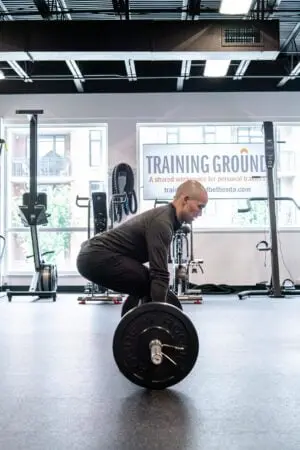
Training with back pain may only require a simple modification

Back pain is a prevalent and debilitating condition affecting a significant portion of the global population. Studies indicate that more than 70% of individuals will experience back pain at some point. The diverse ways back pain can manifest make it a complex challenge for patients and physical therapists. However, physical therapy is an effective way to alleviate and manage this common ailment without surgery.

Practitioners often encounter many symptoms and triggers when treating patients with back pain through physical therapy. One remarkable aspect of this approach is that patients, particularly physically active ones, are keenly attuned to the movements that provoke their pain. Two common movements that often exacerbate back pain are deadlifts and squats, both of which are integral to various exercise routines.

Deadlifts, which involve bending at the hips to lift objects from the ground, are notorious for triggering back pain in many individuals. This movement positions the spine horizontally relative to the ground, subjecting it to significant shearing forces. Shearing force is the mechanical stress that results from one vertebra wanting to move forward or backward relative to the one above or below it. For people with back pain, deadlifts can intensify the discomfort due to the stress placed on the spine during this movement.

Squatting is another common exercise that can exacerbate back pain, especially when performed with resistance, such as lifting weights. Unlike deadlifts, squats require a vertical orientation of the spine, leading to increased vertical compression against gravity. This added pressure can be a source of pain for many individuals suffering from back issues.

If you experience back pain, it’s essential to consider the specific movements that trigger your discomfort. Is your pain more pronounced when lifting objects from the floor or when engaging in squatting exercises with added resistance? This distinction can help guide your approach to managing and alleviating your back pain.

If deadlifting worsens your back pain, temporarily replace this exercise with squatting variations in your training program. While this isn’t a permanent solution, it can help you find relief from pain while addressing the underlying causes of your discomfort. Physical therapy can be instrumental in guiding you through these modifications and ensuring you perform the exercises correctly and safely.

Conversely, if your pain intensifies during squatting exercises with resistance, consider switching to single-leg squat variations as an alternative to traditional double-leg squats. Again, this approach is not meant to be a permanent solution but can provide temporary relief while targeting the root cause of your pain.

Consider contacting a qualified physical therapist for comprehensive support in addressing the root causes of your back pain. These professionals have the knowledge and expertise to develop personalized treatment plans tailored to your specific condition and needs. With the guidance of a physical therapist, you can work towards a long-term solution to your back pain, improving your overall quality of life and well-being.

Back pain is a common and multifaceted issue that affects many individuals. Physical therapy offers valuable solutions for managing and alleviating back pain by addressing the specific movements that trigger discomfort. Whether it’s deadlifts or squats, modifying your exercise routine with the guidance of a physical therapist can help you find relief while tackling the root causes of your pain. Don’t hesitate to seek professional assistance in your journey towards a pain-free and healthier back. Contact us for help with your back pain today!

My shoulder pops. Why is that?

Do you ever feel your shoulder popping and wonder why? This is a common issue that can stem from various causes. The shoulder is a complex joint, boasting the largest and most versatile range of motion in the body. It consists of bones, ligaments, cartilage, and tendons that facilitate movement in many directions, but this complexity also makes it prone to instability when movement quality is compromised. As a result, the shoulder is one of the most frequently injured joints, often leading to shoulder pain.

Before jumping to conclusions, consider these questions:

1) Is the popping sensation painful?
2) Have you recently injured your shoulder, leading to pain?
3) Does your shoulder feel stable?
4) Is the popping accompanied by weakness?

Clicking and popping can occur for various reasons. If it’s painless, it may just be harmless joint noise known as crepitus, which is the release of pressure within the joint—similar to when you crack your knuckles. However, if the popping is painful, it could indicate irritation.

Overuse of the shoulder through repetitive motions can lead to irritation and inflammation of the tissues within the joint. Common examples include bursitis and tendinitis, which are frequently seen as sports injuries. These conditions often arise from movement compensations combined with repetitive activities, causing swelling in the bursa sac and rotator cuff tendons. The bursa are fluid-filled sacs that cushion joints, while the tendons are cords that connect muscles to bones. Over time, rotator cuff tendons can wear down, much like the sole of a shoe, eventually leading to tears if untreated. This can result in increased pain, limitations in exercise or training, and even difficulties with daily activities like sleeping or using the arm.

Popping accompanied by pain can also be due to degenerative arthritis, a condition caused by years of wear and tear. In arthritis, the cartilage that protects bones wears down, becoming rough and leading to increased friction in the joint. This friction can cause injury as the joint surfaces rub together like sandpaper, leading to joint inflammation and shoulder pain. Left untreated, arthritis can limit your ability to exercise and perform daily activities.

Shoulder pain and impingement can occur when the space between the top of the shoulder blade (acromion) and the top of the upper arm bone (head of the humerus) narrows due to movement compensations. This narrowing causes swelling and inflammation, further reducing space and leading to the pinching of the rotator cuff tendons and bursa. If not treated, this condition can limit exercise and interfere with daily activities.

Shoulder instability happens when the head of the upper arm bone (humerus) cannot stay centered in the shoulder socket (glenoid) during movement. This instability places extra strain on various structures within the shoulder, potentially irritating the cartilage (labrum) and causing pain and weakness. Left unchecked, this can increase the risk of developing arthritis.

Despite all these potential issues, the key point is not just understanding these conditions but figuring out why the popping, tendinitis, bursitis, arthritis, impingement, or instability started in the first place.

Small rotator cuff tears, labral tears, arthritis, and joint damage are common in the shoulder, but there is still plenty you can do (without surgery) to alleviate pain and return to the activities you enjoy.

The crucial question to ask yourself is, “What movement compensations am I making that are irritating my shoulder?” By addressing these compensations with the help of a skilled sports physical therapist, you can continue to exercise and maintain an active lifestyle.

Why Is Your Mobility Limited?

Do you feel limited in your hips when attempting a squat like the gentleman above? Or perhaps your shoulders feel stiff when you try to raise your arms overhead? Maybe it’s your ankle mobility that’s holding you back?

No matter where your mobility issues arise, it’s actually your body—more specifically, your brain—that’s intentionally causing this. You might feel tightness in a muscle, tendon, or joint, but this is simply your body’s way of creating more rigidity to better handle the physical demands you place on it regularly.

I often reflect on the many players I’ve worked with in the National Football League. A significant number of them had restricted ankle mobility, particularly in dorsiflexion (the ability to pull the top of the foot upward). These athletes were constantly sprinting, pushing, cutting, and accelerating, which required them to stay on the balls of their feet. Their heels rarely touched the ground, leading their calves and Achilles tendons to operate in a consistently shortened position. The brain smartly adapted to this by creating stiffness in the calves, which enhanced the elastic, spring-like properties of the muscle. This adaptation allowed them to use less energy and push off more quickly since they were already close to the starting position.

While this adaptation was beneficial for performance, it often led to imbalances when left unchecked, putting them at risk for various injuries. Their bodies essentially “forgot” how to move in a more controlled, less extreme manner. This “all or nothing” movement pattern works well for the high-intensity demands of sports but can become problematic when relied upon off the field.

This concept applies to all of us. Our brains will adapt and limit mobility in different areas if we continuously train our bodies in only one way.

Don’t get me wrong—our bodies need to know how to generate power for sports or training. However, we also need to ensure that we’re not overly reliant on these patterns and that we can move in various ways.

That’s why I often encourage athletes and patients to include exercises in their training that don’t require excessive strain. You shouldn’t need to grit your teeth or tense every muscle in your body to accomplish a task. If you do, it indicates a lack of movement efficiency.

Stretching alone won’t resolve this issue because we cannot overpower the nervous system. Instead, the best approach is to address the root cause of mobility restrictions by incorporating the strategies mentioned above.

×