Surgeon Says “You’re Cleared.” What That Really Means

At Cohen Health and Performance, we see this all the time.

A patient walks in excited because their orthopedic surgeon just told them, “You’re cleared.”

For the athlete or for a parent of a young athlete that sounds like great news. It feels like full steam ahead, time to get back to the field, the court, or the gym.

But being cleared by your surgeon doesn’t necessarily mean your body is ready for the demands of your sport.

That’s where our team at Cohen Health and Performance, providers of expert physical therapy in Bethesda, comes in.

What Your Surgeon Means by “Cleared”

When your surgeon clears you, it’s a medical milestone. It means:

  • The surgery was successful.
  • Imaging and MRI results look good.
  • Your range of motion has returned.
  • You’ve regained a basic level of strength.

In other words, your surgeon’s focus is on whether the surgical site has healed and whether you’re safe to start progressing again. Their job is to make sure the repair looks good, moves well, and passes basic checks.

But that doesn’t mean your body is fully prepared for the demands of your sport.

Why “Cleared” Doesn’t Always Mean “Ready”

Let’s take a closer look at what happens in those follow-up visits.

Your surgeon might test your strength by asking you to hold your arm or leg in a fixed position while they apply pressure. If you can resist them without pain or weakness, that box gets checked.

The problem? That’s not how sports work.

Sports are dynamic. You’re not holding a static position. You’re cutting, sprinting, jumping, landing, throwing, or reacting at high speed. Your body must not only produce force but also control and absorb it repeatedly and efficiently.

That’s where the real risk lies after surgery. An athlete may appear strong in basic tests, but when it’s time to decelerate from a sprint or land from a jump, their body might not yet have the capacity to handle those forces safely.

Without that preparation, the risk of reinjury or injury elsewhere in the body skyrockets.

How Physical Therapy Bridges the Gap

This is exactly where advanced sports physical therapy in Bethesda plays a critical role.

At CHP, our job isn’t just to make sure your range of motion and strength look good on paper. It’s to determine if your body can handle the high-speed, high-load, fatigue-driven conditions of your sport.

We use a combination of clinical expertise and advanced sports technology, including VALD Force Plates, A-frames, and dynamometers to objectively measure how your body performs.

Some of the key things we assess include:

  • Force production: How much power can you generate through your repaired side?
  • Deceleration control: Can you safely slow your body down after a sprint or jump?
  • Symmetry: Are you unconsciously favoring one side more than the other?
  • Fatigue performance: Do you maintain good control and power when you’re tired?

These metrics tell us whether your body is actually ready for competition—not just whether your surgery has healed.

Every Sport Has Different Demands

One of the most important things we teach our patients is that every sport has its own movement and performance prerequisites.

A swimmer’s shoulder rehab will look completely different from a soccer player recovering from an ACL surgery.

A tennis player’s shoulder must tolerate explosive, high-velocity end-range movements.

A football player must absorb and redirect massive amounts of force.

That’s why at CHP, no two return-to-sport plans look the same. We build individualized programs that mirror the specific stresses and skills of your sport, helping you return not just healthy, but stronger, faster, and more resilient than before.

Fatigue: The Hidden Factor Behind Re-injury

Another key area we focus on is how your body performs when tired.

It’s easy to look great when you’re fresh but most injuries don’t happen during warm-ups. They happen when fatigue sets in late in the game, when your muscles and nervous system are under stress.

That’s why we test your ability to maintain strength, stability, and control under fatigue.

If your repaired side starts to fail once you’re tired, your risk of reinjury increases dramatically.

By building up work capacity and fatigue tolerance, we help you finish strong, no matter the score or the quarter.

The CHP Difference

At Cohen Health and Performance, our approach to physical therapy in Bethesda is centered on one goal: helping athletes safely and confidently return to the activities they love.

We combine one-on-one care, advanced testing technology, and individualized programming to make sure every athlete we work with is truly ready, not just medically cleared.

If you’ve been cleared by your surgeon but want to be confident that your body is ready for the next step, we’d love to help.

Contact us at Cohen Health and Performance today to learn more about our individualized physical therapy programs in Bethesda and McLean designed to help athletes move, feel, and perform at their best.

Why Foam Rolling Isn’t Fixing Your IT Band Pain (And What Actually Will)

If you’re an athletes or runner who’s been dealing with persistent pain on the outside of your thigh or knee, there’s a good chance someone has told you to grab a foam roller and go to town on your IT band.

And if you’ve tried it, you probably noticed that it didn’t do much.

At Cohen Health and Performance, where we specialize in physical therapy for runners, we see this all the time—runners struggling with IT band syndrome who are stretching and rolling with little to no relief. The truth is, there’s a much more effective approach to solving this common issue.

Understanding the IT Band: It’s Not a Muscle

The iliotibial (IT) band is a thick, fibrous piece of connective tissue—known as fascia—that runs from your hip down to the outside of your knee. Unlike muscle tissue, fascia doesn’t stretch or adapt the way muscles do. In fact, in cadaver dissections during our physical therapy training, we saw just how tough and dense this tissue is.

That means your foam roller isn’t “loosening” the IT band. You’re not breaking up tissue adhesions. And you’re definitely not lengthening it. So what can you do?

Focus on the Muscles That Influence the IT Band

The key to managing and eliminating IT band pain lies in addressing the muscles that attach to it:

  • Tensor Fasciae Latae (TFL)
  • Gluteus Maximus
  • Gluteus Medius

These muscles influence the tension and position of the IT band. If they’re tight, weak, or imbalanced, they can pull on the IT band in ways that cause irritation—especially during repetitive activities like running.

Why Hip Mobility Matters

One of the first things we assess in our physical therapy for runners sessions is hip mobility. If your hip joints don’t move well, the muscles surrounding them can’t work through their full range of motion. This can lead to stiffness, compensation, and excessive tension placed on the IT band.

Improving hip mobility creates a healthier foundation for movement and reduces the mechanical stress on the IT band during running.

Strength Balance Is Critical

Another common issue? Muscle imbalances.

For example, if the TFL (front/side of the hip) is more active than the glutes (back of the hip), it can pull the IT band forward and create friction or irritation. A strong, well-functioning gluteal complex helps counterbalance this tension and stabilize the pelvis—especially important with each stride during running.

At Cohen Health and Performance, our team of physical therapists uses targeted strength work to restore that balance and reduce IT band stress.

Pelvis Positioning

How your pelvis and rib cage stack during movement matters more than most runners realize. Many runners adopt an anterior pelvic tilt (hips tipped forward), which changes how muscles like the glutes and TFL function. This posture can amplify IT band tension and make even “normal” movement patterns painful.

Addressing postural habits is an important part of our assessment and treatment process.

Movement Patterns and Running Technique

Finally, we always look at how our patients move—whether it’s squatting, lunging, or running. Movement strategies that rely too heavily on compensation patterns (e.g., overusing the quads or collapsing through the hips) can place unnecessary strain on the IT band.

If you’ve never had your movement or running gait analyzed by a physical therapist, this is a great first step.

Physical Therapy for Runners: Get to the Root of IT Band Pain

The bottom line: foam rolling your IT band might provide short-term relief, but it doesn’t fix the root cause. If you’re dealing with ongoing lateral thigh or knee pain, the answer lies in a comprehensive assessment of your mobility, strength, posture, and movement patterns.

At Cohen Health and Performance, we specialize in physical therapy for runners. We’ll help you:

  • Identify the true source of your IT band pain
  • Build a personalized program to restore function and eliminate discomfort
  • Keep you running stronger, longer, and pain-free

Ready to Get Rid of IT Band Pain for Good?

Visit us at our Bethesda or McLean locations
Click here to schedule a 1-on-1 evaluation with one of our Doctors of Physical Therapy

Don’t let IT band pain sideline your training. Let’s get you back to what you love—stronger and smarter than ever.

CHP Spotlight Interview with Dr. Rajeev Pandarinath

Many of us will eventually need joint replacement surgery. Why is it better to start with physical therapy and delay this surgery whenever possible?

ACL tears are one of the most common knee injuries among weekend warriors and high school athletes. How does Dr. Pandarinath change his approach in one situation versus the other? Does a high school athlete require a unique approach for the post-operative, sports physical therapy process?

Why do some rotator cuff tears require immediate surgery?

I recently interviewed Dr. Rajeev Pandarinath to tackle these questions and more in the latest edition of the CHP Spotlight Interview series. Dr. Pandarinath is an orthopedic surgeon specializing in arthroscopic procedures of the shoulder, knee, and hip. 

The mission of the CHP Spotlight Interview Series is to share information with you from local experts in the fields of sports medicine, physical therapy, personal training, and sports performance. Now, more than ever, a seemingly infinite amount of information is available, and finding credible information is challenging. But we have good news. We are here to help you find the best information about physical therapy, personal training, and sports medicine from experts in Bethesda, Chevy Chase, DC, McLean, and Northern Virginia.

If you or someone you love has had a shoulder, hip, or knee injury, don’t miss this interview! 

To learn more about Dr. Pandarinath, click here and check out our interview below!

What All Rotational Athletes Must Be Capable Of (Part 2)

The best ability is availability.

Rotational athletes come to physical therapy for help for with a variety of different overuse injuries (for more information, check out part 1 here). These injuries are the result of an excessive amount of stress placed onto one area which exceeds the body’s ability to tolerate.

Excessive stress accumulates in a particular area (often the lower back) as it is forced to pick up the slack from another area of the body that is not doing its part. Injury rehabilitation often involves discovering what these areas are.

Many times, it is the hips.

The hips are large joints with powerful muscles (ex. The glutes) surrounding them. This area should be generating the power to make things easier elsewhere.

The med ball hip toss teaches the body to generate rotational power at the hips and ultimately propel the ball through the arms. Once you have mastered this drill, step things up and give the perpendicular med ball throw a shot!

Do you feel your body is getting beat up during golf, tennis, or baseball? Come discover the root cause of your discomfort and specific strategies to address it. Visit our website to schedule a FREE phone consultation with a member of our team! Link in bio.

Ergonomics Are Overrated (Maybe)

Blasphemy! Every physical therapy professor from Bethesda to New Zealand just made me public enemy number one.

I am exaggerating, of course, however it sounds outrageous for a sports physical therapist or anyone working in the injury rehabilitation field to state that ergonomics could be overrated.

This is not to say that they are not important. An individual’s workplace setup, for example, is an important factor to consider when addressing ailments such a chronic neck or back pain.

However, if you look on social media or watch an episode of shark tank, you are likely to find several different devices claiming to fix your posture and solve your pain. Many then purchase these products and become discouraged when their ailments are not cured.

Claiming that a single ergonomic correction will solve all your issues is to ignore the myriad of different factors that contribute to pain or injury. Furthermore, it ignores the fact that there are other, more influential factors.

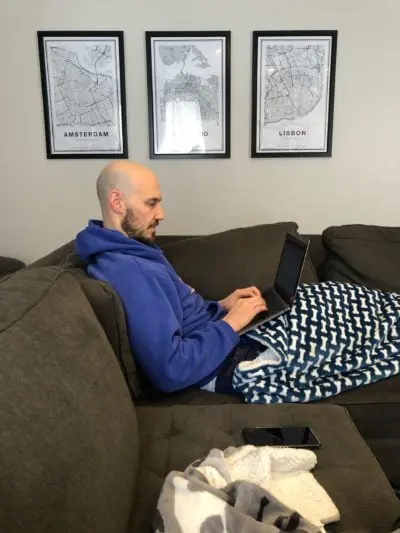
Look at the picture above. An ergonomic specialist would give me a failing grade. I am slouching and looking down at my computer with my legs stretched straight out. Even worse I’m resting my computer on my poor pup, Chip (he is under the blanket)!


However, I’m feeling pretty good today. I slept well last night and went on a long walk this morning after exercising. These factors outweigh the impact of an hour of computer work.

Improving large components of health such as sleep, nutrition, exercise, and stress enhance the resilience of our bodies.

Resilience is an awesome thing. It creates room for error and means that we can still feel great despite having an imperfect desk set up.

Overall, it is worth repeating that you should still try to improve ergonomics whenever possible, however do not expect it to solve much when the larger components of health are being ignored.

For more information on these larger components of health, check out the articles below!

Does Your Metabolism Actually Slow As You Age?

Benefits of Walking for Physical and Mental Health

Exercise Stacking

Is Shoulder Clicking Bad?

“My shoulder clicks when I press or reach overhead. Is that a problem?”  “Is it bad to feel things moving and popping in my shoulder whenever I perform this movement?”

Questions like these are common in the sports physical therapy and injury rehabilitation setting. The answer is always context dependent because clicking can occur for several different reasons.

The shoulder is a complex joint with the most range of motion in the body.  It is comprised of bone, ligaments, cartilage, and tendons that allow for greater ease of movement in many different directions, however, it runs the risk of becoming unstable when movement quality is poor.

This can result in movement limitations or clicking/popping within the shoulder.

Check out an article that a member of our physical therapy team wrote back in 2018 if you are interested in learning more about the different sources of shoulder clicking/popping.

Regardless of the specific source of the clicking/popping, it is most important to improve the root causes of these issues: movement quality and mobility.

If you are interested in improving the movement quality and mobility of your shoulders, come join me for our virtual and pre-recorded mini-shoulder mobility workshop. We are offering this course for FREE to you, our CHP fam! Simply enter promo code CHPFAM at checkout.

In this workshop, you will learn:

  1. The source of your shoulder mobility limitations and/or discomfort
  2. How to assess the movement quality of your shoulders
  3. Exercises that you can start doing RIGHT NOW to improve your shoulder function, reduce discomfort, and decrease the risk for future injury

This workshop is a MUST attend for athletes, weekend warriors, and everyone in between that want to:

  1. Train without being held back from pain
  2. Decrease future injury risk
  3. Perform at their highest level for years to come!

Sign up today HERE and don’t forget to enter promo code CHPFAM at checkout to get this class for FREE!

×