Why a physical therapist doesn’t recommend stretching

“My shoulder feels tight.” “My hip flexors are tight; I need to stretch them.”

These are common complaints we hear in physical therapy.

While these descriptions aren’t wrong—after all, no one can argue with how you feel—they can sometimes lead to misconceptions about how to address the problem.

The sensation of “tightness” often arises as the body’s way of protecting areas that are vulnerable to injury. When a part of the body is unstable, the nervous system responds by creating stiffness in the surrounding muscles to safeguard it. For example, the hamstrings, which attach to the pelvis, might feel tight in someone with low back pain. This tightness occurs as the muscles stiffen to provide added stability to the pelvis.

In this case, simply stretching the hamstrings won’t solve the problem. The individual needs to learn how to stabilize their back, perhaps by mastering the stack (find out how to do that here) and strengthening the trunk muscles accordingly. Once the underlying issue is addressed, the hamstrings can finally relax.

This is just one example of why a muscle might feel tight, but it’s important to understand that tightness can stem from various causes—and the solution is rarely just to stretch!

If you’re dealing with tight, uncomfortable muscles, it’s time to uncover the root cause. Contact us today to schedule an evaluation and discover how you can finally resolve those tight muscles!

What I wish about training as a high school athlete

This week we have a special guest post from Dr. Samuel Kinney. Dr. Kinney is a performance physical therapist in our McLean location. In addition to being an amazing physical therapist and strength coach, Sam was a successful collegiate soccer player. Learn more about Dr. Sam here.

“Lifting weights will stunt your growth.” “Squatting heavy is the key to training.”

The advice that I received as a high school athlete was all over the place and as a physical therapist, I now roll my eyes.

I wanted to impress my high school coaches and be the best athlete that I could be, but weight training confused me, and I didn’t know where to start.

Weight training in high school often felt like a competition among my teammates.

I placed a large emphasis placed on how much weight was on the bar. This was a result of encouragement from my team and my internal motivation to lift the most weight I could.

There wasn’t much thought put into our weight training program besides that. I eventually had a back injury while attempting to power clean more weight than I was ready for.

Fortunately, I went to physical therapy, which sparked my interest in the sports physical therapy profession. Unfortunately, I had to take time off from the gym and lost a lot of the progress that I had worked so hard for. While back injuries are impossible to prevent, had I known what I know now, I could have greatly reduced my risk of having one.

Training for your sport off the court or field is an essential part of developing strength, speed, and overall athleticism. A more scientific approach to training helps you excel at your sport and keeps you in the game by reducing your risk of injury. But knowing where to start and what to do in the weight room is one of the greatest challenges for a young athlete.

If the weight being lifted is causing you to struggle to maintain form and you are unsure that you can control the weight, it is too much. The advice that I would give to my high school self would be to forget about how much weight is on the bar and instead focus on how well I can control the weight through the full range of motion of the lift. It is more important to progressively increase the weight on the bar over time rather than in one weight training session.

If you are a high school athlete or the parent of one, Dr. Sam Kinney is currently offering free performance assessments as part of our rising-star training program.

This assessment will show you and your athlete the secret to helping them avoid injury and take their performance to the next level.

Contact us for more information and to sign up.


Need for speed: how young athletes get faster

As my old high school football coach used to say… Speed kills.

Even in physical sports like football, faster players usually have an advantage over bigger competition.

Speed training can be (and should be!) incorporated into an athlete’s workout routine and is an important part of the return to sport process in physical therapy. Whether your athlete is working to be the fastest on the field, track, or court, there are three key essentials to consider when trying to increase speed:

  1. Learn and practice the basics 

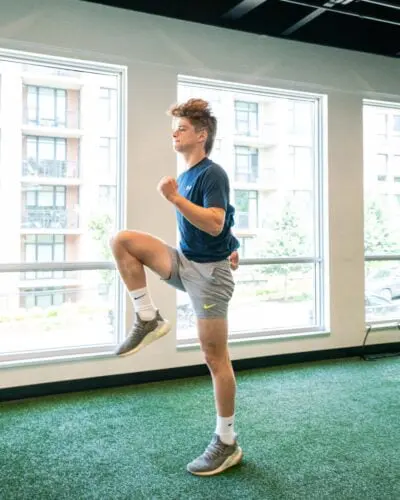
Just like any other sport, there is a technique to sprinting. You can do a few basic drills to practice sprint mechanics and emphasize proper foot strike, forward knee drive, and core activation for a fast and efficient stride. Marching, skipping, and high-knee run drills encourage this technique:


  1. Strength training! Quads, hamstrings, calves, core

Running fast requires more than moving limbs quickly to be successful. Strength is essential to running to create power, endurance and prevent injury. While athletes use virtually all their muscles to run at top speeds, some main movers for sprinting include the hip flexors, quads, hamstrings, calves, and core. Compound lifts and single leg strength exercises targeting these muscle groups are a great way to make an athlete’s stride stronger:


  1. Practice accelerations and sprinting 

Speed training can be broken down into parts, starting with the initial acceleration. There are a few drills to help decrease the time it takes you to get from the start to full speed:


An athlete can progress into repeated sprint efforts. Some common sprint workouts include:

  • Flying 10s: Build speed for 20-30 yards, sprint for 10 yards, slow down for 20-30 yards
  • 10×10: Practice accelerating for 10 yards, then slowing down as fast as you can. Repeat 10 times.

Are you an athlete or the parent of a high school athlete working to be a step faster than the competition?

Here is your solution.

We are in the midst of summer, but it’s not too late to participate in our summer rising-start training program. In this program, your athlete will receive a personal performance assessment and a custom-designed speed program that our team will coach them through.

If you dream of leaving your competition in the dust, contact us to learn more and sign up!

Maybe I Do Hate Stretching…

Zac, why do you hate stretching?

I received this question during a physical therapy session recently, which admittedly made me chuckle. I don’t hate stretching, but we overrate its importance (physical therapists included).

Like most people, when you think of stretching, you think of static stretching. This type of stretching involves holding a stretch for an extended period.

Come to gyms like the one I train at, and you will see most people doing this form of stretching before they exercise.

Research has shown that static stretching performed before physical activity may negatively affect performance and does nothing to reduce injury risk. It temporarily decreases muscle strength and power and reduces muscle stiffness, essential for joint control and protection.

But stretching feels good. I agree, so I recommend that you perform your favorite stretches when you are done with your workout.

So, what should I do to warm up before exercise?

Dynamic stretching and drills specific to the activity you are about to perform.

This type of warmup involves moving your body through its full range of motion, mimicking the movements of the activity you are about to perform. This helps increase heart rate and body temperature and improves coordination, balance, and neuromuscular control.

Below are 2 drills I often use on my upper body days, followed by 2 more that I commonly use on lower body days with both physical therapy and personal training clients.

Upper Body

  1. Kettlebell Windmill
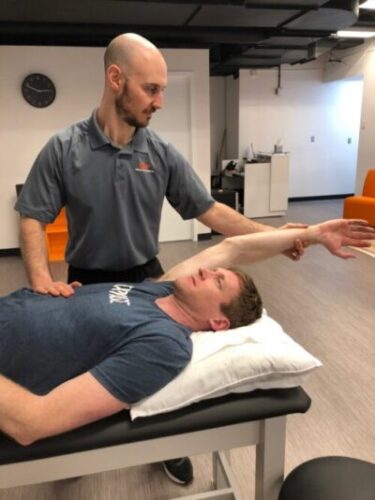
  2. Sidelying Arm Bar

Lower Body

  1. Sissy Squat
  2. Heels Elevated Clean

Interested in receiving a custom-designed warmup routine from our Doctors of Physical Therapy to help you reduce your injury risk while preparing you to perform at your best? Contact us to learn more!

Cryotherapy: Is It Really Worth the Hype?

A few months ago, I attended a conference with a group of physical therapists and personal trainers. Over a meal, we found ourselves discussing the day’s events. One of the highlights of the conference was a series of product pitches from various companies targeting healthcare providers like us. Among them was a cryotherapy company, and their representative happened to recognize our group.

He approached our table and confidently delivered his pitch:

“Cryotherapy can help your patients reduce pain, accelerate muscle recovery, decrease inflammation, and improve overall wellness.”

Sound familiar? If you’ve ever heard a similar claim and wondered if cryotherapy really lives up to the buzz, you’re not alone. At our physical therapy clinics in Bethesda and McLean, we receive many inquiries about the effectiveness of cryotherapy.

Let’s break it down.

What Exactly is Cryotherapy?

Cryotherapy involves exposing the body to extremely low temperatures for a brief period, usually just a few minutes. While there are several forms of cryotherapy, the most well-known is whole-body cryotherapy. This process involves standing in a chamber filled with liquid nitrogen vapor, where temperatures can drop as low as -200°F to -300°F (yes, you read that right).

The Ongoing Debate

The benefits of cryotherapy remain a topic of debate within the medical, physical therapy, and fitness communities. While some studies have shown promising results, others have found little to no benefit.

Proponents of cryotherapy suggest that it can help manage various conditions, including chronic pain, arthritis, inflammation, and even depression. The theory is that exposure to extreme cold triggers the release of endorphins—your body’s natural painkillers—while also reducing inflammation in targeted areas. In some cases, studies have indicated that cryotherapy may help alleviate pain and inflammation in people with conditions like rheumatoid arthritis. However, much more research is needed to validate these claims.

There are also suggestions that cryotherapy aids in **muscle recovery** after exercise. The idea is that cold temperatures cause blood vessels to constrict, reducing blood flow to the affected muscles. As the body warms up post-session, blood flow returns and promotes healing. While some studies support this, others have shown little to no significant effect.

So, What’s the Verdict?

Cryotherapy is still relatively new, and as with many emerging treatments, the evidence is limited and mixed. Early research shows potential, but more comprehensive studies are necessary to reach firm conclusions.

It’s also important to remember the risks. Exposing the body to such extreme cold comes with hazards, including potential skin damage and frostbite.

If you’re thinking about giving cryotherapy a try, it’s crucial to consult your physician first to ensure it’s a safe option for you.

CHP Spotlight Interview with Sports Medicine Physician, Dr. Richard Edgar

Why do so many field sport athletes and runners suffer lower body soft tissue injuries, like hamstring strains? 

As with all sports, injuries are part of the game and it is impossible to avoid them altogether. But being aware of risk factors can reduce the risk and is an essential component of the physical therapy process. There has been research studying the influence of strength imbalances of opposing muscles. One of the most common comparisons is with the hamstrings and quadriceps, called the hamstring to quadriceps strength ratio.

Research in physical therapy and sports medicine journals suggest that the hamstrings should be at least 60% as strong as the quads, especially among athletes.

Don’t miss my latest interview with Dr. Richard Edgar where we discussed topics like this and so much more! Dr. Edgar is a Primary Care Sports Medicine physician at the Anderson Orthopaedic Clinic. He specializes in non-operative treatment of musculoskeletal injuries and has an extensive sports background himself. 

The mission of the CHP Spotlight Interview Series is to share information with you from the greatest experts in the fields of sports medicine, sports physical therapy, personal training, and performance. Now, more than ever, there is a seemingly infinite amount of information available and finding the most credible information is a challenge. The good news is that we are here to help you find the best information related to physical therapy, personal training, and sports medicine from experts surrounding us in Bethesda, Chevy Chase, DC, McLean and Northern Virginia.

If you or someone you love has had a sports related injury, don’t miss this interview!

To learn more about Dr. Edgar, click here and check out our interview below!

×