The Most Overlooked Reason Runners Keep Getting Injured

Repetitive soft tissue injuries are one of the most frustrating issues runners face. Calf strains, hamstring pulls, hip flexor pain, and lingering tendon problems often seem to appear out of nowhere, especially in runners who are otherwise consistent and motivated in their training.

One of the most overlooked causes of these injuries has nothing to do with mileage alone. Instead, it comes down to how close your body is operating to its maximum capacity during your runs.

Why Running Pace Matters More Than You Think

Imagine a car that can technically reach highway speed, but doing so requires maximum effort. Pushing it that hard, day after day, eventually causes things to break. Not because the distance is too long, but because the system is constantly operating near its limit.

The same principle applies to running.

If you are running close to your maximum sustainable speed just to hit your target training pace, your body is under significantly more strain. That strain is absorbed primarily by your soft tissues such as your calves, hamstrings, hip flexors, Achilles tendon, and connective tissue. Over time, this accumulated stress often leads to overuse injuries.

Two runners may complete the same 5-mile run at the same pace, but if one runner is operating at 80% of their maximum effort while the other is closer to 60%, the internal load on their bodies is very different.

This difference matters.

Why Faster Runners Often Stay Healthier

Elite and highly trained runners are fast, but more importantly, their speed ceiling is high. Because of this, moderate and long-distance paces require less relative effort. Their muscles and tendons are conditioned to tolerate higher forces, which makes everyday training less stressful on their bodies.

For recreational runners, this is where many training programs fall short.

A common assumption is that preparing for longer races simply means running more miles. While mileage is important, it is only one part of the equation. One of the most underutilized tools in injury prevention is strategic speed training.

How Speed Training Reduces Injury Risk

Speed training isn’t just about racing faster, it’s about raising the maximum speed your body can safely handle.

Incorporating interval-style workouts helps:

  • Improve force tolerance in muscles and tendons
  • Reduce strain during slower, longer runs
  • Improve running efficiency and resilience

A simple and effective example includes:

  • 400-meter intervals on a track or measured flat surface
  • Running at a high effort (roughly 80–90%)
  • Taking longer rest periods to ensure quality movement and speed

The goal is not exhaustion. The goal is adaptation, teaching your body to handle higher forces so that everyday running feels easier and places less stress on vulnerable tissues.

Even runners training for half marathons or marathons benefit from this approach, particularly during the off-season or early build-up phases. As race day approaches, speed work often becomes less frequent while mileage increases, but having already raised your speed ceiling can dramatically reduce injury risk.

How Physical Therapy for Runners Helps

This is where physical therapy for runners becomes especially valuable.

At Cohen Health & Performance, we work with runners to:

  • Identify strength, mobility, and load-management limitations
  • Assess running mechanics and tissue tolerance
  • Design training strategies that reduce injury risk
  • Integrate speed work safely and progressively
  • Treat recurring soft tissue injuries at the root cause

Rather than simply addressing pain after it appears, our approach focuses on helping runners train smarter so injuries are less likely to occur in the first place.

Serving Runners in McLean and Bethesda

We provide specialized physical therapy for runners at our clinics in McLean, VA and Bethesda, MD, working with runners of all levels, from recreational athletes to competitive endurance runners.

If you’ve been dealing with recurring calf strains, hamstring tightness, hip flexor pain, or feel like your body breaks down whenever you increase training intensity, it may be time to take a closer look at how you’re training, not just how far you’re running.

Our team helps runners stay healthy, improve performance, and continue progressing toward their goals without constantly being set back by injury.

If you’re looking for expert physical therapy for runners in McLean or Bethesda, we’re here to help.

Fitness watches: what stats should you care about?

Dr. Kelly Henry here. I work with lots of runners in McLean as physical therapy and performance training clients. We all know a runner who is obsessed with their watch, and with all the technology these days, your fitness watch can tell you just about anything.

This is informative and overwhelming at the same time.

So many statistics are provided, but how many of them are relevant? And if they are relevant, what do they mean? After doing a deep dive into my own watch (a Garmin Venu Square), and some market research on other running watches’ statistics, here is what you should care about:

Resting heart rate 

What this means: How fast your heart beats when you are not doing any activity.

Why you should care: A normal heart rate ranges from 50-100 beats per minute, but more importantly, your watch is learning what is normal for you. Fitness watches usually do a good job of tracking this. Knowing your resting heart rate is a good indicator for helping you determine what your heart rate should be when you’re exercising. A raised heart rate can indicate a number of things, but regarding your training, it can indicate overtraining and a lack of recovery.

Heart rate zones 

What this means: Most fitness trackers divide your heart rate into Zones 1-5. These are determined based on your resting heart rate and a hypothetical maximum heart rate derived from a standard calculation.

Why you should care: You can use your heart rate zones to guide the intensity of your training. Most of your workouts should be performed in Zones 2-4. If you are performing cardiovascular exercise, exercising in Zones 1-3 will provide more of an aerobic benefit (lower intensity, longer duration), whereas Zones 4-5 should focus more on anaerobic systems and power development (fast runs, sprints, or interval training). If you aim to address certain improvements (speed vs. endurance), using heart rate zones can be a great objective way to determine how to adjust your perceived effort. Keep in mind heart rate can be impacted by other factors, including heat and time of training.

Cadence 

What this means: Simply put, cadence is how many steps you are taking in one minute. Aka, how fast your feet are moving.

Why you should care: Measuring cadence helps to make you aware of your stride length and energy expenditure while running. A longer stride often results in a lower cadence and vice versa. Research has shown that patients with knee pain after running often benefit from a shortened stride by increasing stride length. An ideal cadence for most people is 170-180bpm (beats per minute).

Distance 

What this means: How far you ran/walked/moved.

Why you should care: Tracking distance ensures that you are progressing your exercise appropriately and is one of the main things runners care about. While some people prefer time-based exercise, distance may be easier to track if you are working on maintaining a consistent pace. Tracking distance over time is important to ensure there is adequate training volume and can prevent over or under-training. Generally, you should aim for a ratio between 0.80-1.20 when comparing month-to-month averages. This means that the weekly average of this month’s distance is not less than 80% or more than 120% of the weekly average of last month’s distance. Your watch should calculate your weekly mileage for you! Use this mileage in the following formula:

(Week 1 distance + Week 2 distance + Week 3 distance + Week 4 distance) / 4 = Average Workload)
Then divide this number by the average workload from the previous month. This is more accurate for more experienced runners, while less experienced runners or those who run shorter distances may be able to increase their distance more liberally.

Heart Rate Variability (HRV)

What this means: The variation in time between heartbeats. Although our heartbeat is often described as a metronome, it is not. There are small differences in the intervals between each of your heartbeats, which are impacted by your sympathetic nervous system. HRV depends on multiple readings, including core body temperature, circadian rhythm, metabolism, and sleep cycle, to make the best estimate.

Why you should care: In a broad scope, increased HRV can be correlated with better aerobic fitness (if there is no underlying pathology). While it’s difficult to properly measure HRV strictly from a wearable, it can indicate training adaptations and improvements in cardiovascular health. HRV is good supplemental data but shouldn’t be the basis for any training changes since the sensitivity of this measurement is limited, and the most accurate HRV reading will come from a controlled clinical setting. Multiple comorbidities can impact HRV, including chronic pain, inflammation, insomnia, concussions, depression and anxiety, and other stress.

These 5 statistics only scratch the surface of what your fitness watch can do for you. If you are a runner searching for an advantage over your competition, schedule a consultation by replying to this email. In this consultation, she will help you determine how to use technology to your advantage and other ways to improve your performance.

Runners rejoice: how dry needling can help you

It must be your lucky day because we have another guest post from the Clinic Director of our McLean location, Dr. Kelly Henry!

Do you have tight muscles or knots that won’t go away? Maybe you have even gone to physical therapy elsewhere but made minimal progress!

If you are anything like me, you have tried massage, foam rolling, stretching, and whatever else you can think of, but they keep returning.

Dry needling could be the solution you are looking for. Running is a very linear and repetitive sport, which increases the risk of developing muscle tightness and symptoms related to overuse. Many runners have experienced relief of chronic quad, calf, hamstring or hip flexor tightness from dry needling.

I recently helped a runner during a physical therapy session at our McLean facility that was experiencing consistent calf pain. It was most intense in the middle of his runs and forced him to reduce his overall mileage. He did everything that he could to fix it. He spent a lot of time warming up before runs, cooling down after runs, and he stretched constantly. But nothing helped.

His first physical therapy session included dry needling for his calf muscles, range of motion drills, and a few adjustments to his running technique, and the chronic calf pain went away!

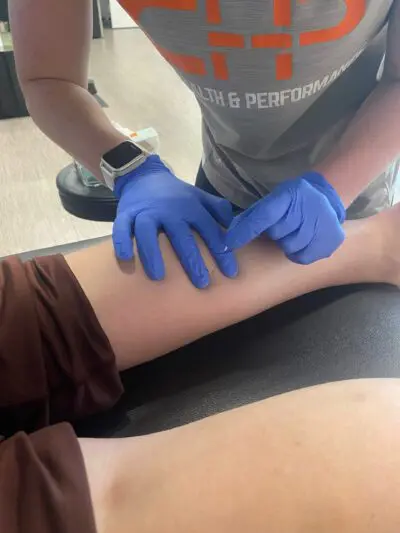
Dry needling works by targeting a muscle limiting range of motion or causing pain. Your physical therapist will identify which muscle is causing the problem, identify “trigger points” in the muscle, and create a “twitch response” with the needle. A twitch response is a quick contraction that helps the muscle relax. People often feel better just a few moments after treatment! Here are some of the things that my runners have noticed after dry needling:

  • Less tightness during and after runs
  • Improvement in muscle soreness
  • Faster recovery from nagging injuries
  • Improved range of motion and muscle activation during cross training

Dry needling is best used with other forms of physical therapy and rehabilitation, including exercise and neuromuscular conditioning.

If you are a runner that is struggling with chronic injuries or tightness or is looking to optimize your recovery, contact us for a dry needling session in our McLean facility today.

Speaking of serious runners…we have 2 slots still available for a FREE Resilient Runner Injury screen at our McLean facility. If you want to run injury-free for years to come, don’t miss this!

This screen involves the use of our exciting, new Forcedeck technology. Learn more about that here!

Contact us for more information and to sign up.

×