What I learned by going to the ER

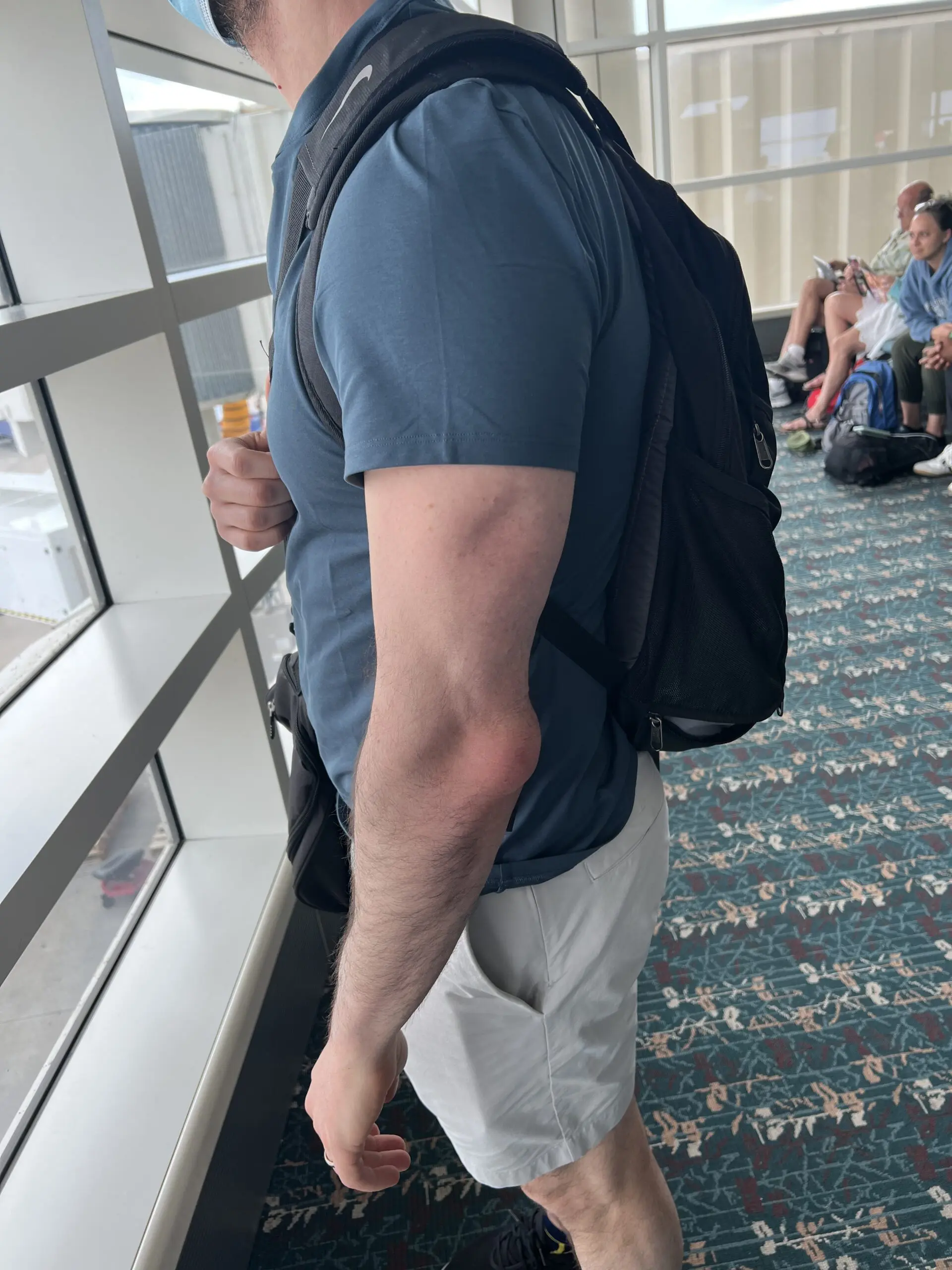
I woke up for the final day of a conference I had traveled to in Orlando. My wife, Deb, joined me for the trip, and the first thing I heard from her was, “What happened to your elbow?!”

I had a golf ball-sized bump on the back of my elbow, consistent with Olecranon Bursitis. I remember one of my professors in physical therapy school calling it “Popeye elbow.” This typically occurs because of a trauma or infection, and there hadn’t been any trauma, so it must have gotten infected, which needs to be treated immediately.

We flew back home that afternoon and went right to the emergency room. After waiting a few hours, they confirmed the infection, prescribed antibiotics, drained my elbow, and recommended that I consistently maintain compression on the area.

But I wasn’t confident in the recommendations….

The PA that treated me had a lot on her plate. She was running from room to room, and I could sense she was providing general recommendations because this wasn’t her area of expertise.

So, I later texted some of my colleagues here in McLean and Bethesda within the physical therapy/medical field, and they confirmed my suspicions.

The antibiotic I was prescribed was not the best option for my type of infection, and these areas of swelling should never be wrapped in compression garments.

This is not the fault of the people of the ER. I greatly respect their expertise, the stressful environments they work in, and the fantastic work they do to help so many people. This just wasn’t their area of expertise.

In fact, they did the most critical part of their job. They kept me safe until I could see a specialist.

Elbow conditions such as mine were his area of expertise. His recommendations were specific and clear, and most importantly, he took his time so that I could ask any questions I had.

What a refreshing experience. My doctor was present, and I didn’t feel like his hand was on the doorknob the entire time as he tried to leave quickly.

It is impossible to provide excellent care when we are rushing. As physical therapists, we learn so much just by being present. One of the first things I tell our doctoral students is that our patients will give us all the clues if we slow down, listen, and ask great questions.

Are your healthcare providers doing that? Can you ask all the questions that you have?

What about when you aren’t in their clinic? It’s normal to forget to ask something during an appointment. Will they answer your question promptly when you aren’t in their office?

If you need help, contact me to connect you with the right healthcare provider. I’ve made it a mission to connect with the healthcare community around the DMV because that will help us better serve you.

As healthcare consumers, we can see whomever we want. Look for an expert that provides you with the type of care that you expect to receive!

Why I’ve Been Training Like a Bodybuilder

If there is one thing that natural bodybuilders (aka those that don’t take steroids) know, it is how to build muscle.

One of my friends is a personal trainer and natural bodybuilder, and can compete with those that aren’t “natural” by being super bright, with a deep understanding of the science of hypertrophy (fancy word for building muscle).

Muscle helps protect against injury, and as physical therapists, we need to understand how to help our patients build more when necessary.

What better way to learn than to test yourself? All physical therapists should try it on themselves first, right? My friend and I have been designing my training routine for the past year, and my back feels great.

As many of you know, my history of low back pain, beginning as a collegiate athlete, led me to become a physical therapist. In the past, strenuous weight training programs would irritate it. But I have been training harder than ever over the past year and feeling great.

People often experience back pain as they use their backs to support or lift weights. If I was using my back during an exercise, I wasn’t placing enough stress on my muscles to stimulate growth.

It is easy to cheat as exercises become more challenging. Maintaining quality technique when tired is a great way to remain resilient to injury. Check out this video for more on this.

Besides reducing injury risk and building strength, adding muscle is helpful for other reasons, including:

  1. Increased metabolism: More muscle equals a higher metabolic rate. This doesn’t just mean your body will burn more calories at rest. A higher metabolic rate provides more sustainable energy to the body throughout the day.
  2. Decreased fall risk: Increased muscle mass helps to reduce fall risk in the elderly population, and it is best to start this process early.
  3. Reduced risk of chronic disease: Increasing muscle mass has been shown to help reduce the risk of chronic diseases such as diabetes and heart disease. Muscle tissue helps to regulate blood sugar levels, blood pressure, and cholesterol.

Ready to join me and enter a bodybuilding competition?! Just kidding. That is not necessary, but there is a lot we can learn from unexpected places!

3 exercises I don’t do anymore

A few weeks ago, I was catching up with a former physical therapy colleague from our time working with professional athletes.

We laughed about how we used to work out every day at 5:30 am before the athletes got to the facility. We took turns designing the training programs that we used to torture ourselves with so early in the morning.

After our conversation, I thought that looking at our old training programs would be interesting. I noticed three popular exercises that I don’t do anymore both personally and professionally with my patients as a sports physical therapist in Bethesda and McLean.

  1. Planks: Other exercises do a better job of strengthening the core and working the abs. Planks are typically performed with straight legs, which helps support the body with the legs, not the abs. It is also an easy exercise to cheat by allowing the belly to sag slightly toward the ground. As this occurs, the body is supported by the hip flexor musculature and the lower back instead of the abs. Try performing a bear variation instead!
  2. Barbell Back Squats: This exercise can be done effectively but requires many qualities to perform correctly. Minor limitations in shoulder range of motion, thoracic spine extension, hip mobility, and ankle flexibility result in much strain to the lower back and other areas. I’ve found that I can strengthen my lower body very effectively with exercises that have a lower risk. Goblet, Zercher, or SafetySquats are usually better options unless you are a powerlifter or a collegiate athlete.
  3. Upright Rows: The upright row fails the risk vs. reward equation. You can create the benefits of this exercise with other, lower-risk exercises. The upright row forces the shoulder into combined flexion and internal rotation as it lifts a weight. Doing so is stressful to the shoulder and isn’t worth the risk. Dumbbell pressing variations like this are a better option.

What is the goal of this exercise? That is the question I ask myself as I design training and physical therapy programs for my patients/clients. Typically, the goal is to increase strength, build muscle, or prevent injury. If a different exercise is more effective at reaching those goals or can deliver the same result with less risk, that is the better option.

Maybe I Do Hate Stretching…

Zac, why do you hate stretching?

I received this question during a physical therapy session recently, which admittedly made me chuckle. I don’t hate stretching, but we overrate its importance (physical therapists included).

Like most people, when you think of stretching, you think of static stretching. This type of stretching involves holding a stretch for an extended period.

Come to gyms like the one I train at, and you will see most people doing this form of stretching before they exercise.

Research has shown that static stretching performed before physical activity may negatively affect performance and does nothing to reduce injury risk. It temporarily decreases muscle strength and power and reduces muscle stiffness, essential for joint control and protection.

But stretching feels good. I agree, so I recommend that you perform your favorite stretches when you are done with your workout.

So, what should I do to warm up before exercise?

Dynamic stretching and drills specific to the activity you are about to perform.

This type of warmup involves moving your body through its full range of motion, mimicking the movements of the activity you are about to perform. This helps increase heart rate and body temperature and improves coordination, balance, and neuromuscular control.

Below are 2 drills I often use on my upper body days, followed by 2 more that I commonly use on lower body days with both physical therapy and personal training clients.

Upper Body

  1. Kettlebell Windmill
  2. Sidelying Arm Bar

Lower Body

  1. Sissy Squat
  2. Heels Elevated Clean

Interested in receiving a custom-designed warmup routine from our Doctors of Physical Therapy to help you reduce your injury risk while preparing you to perform at your best? Contact us to learn more!

Most People Forget This Part of Their Recovery

Recovery is a buzzword nowadays, and entire industries (outside of just sports physical therapy) have sprouted up to help athletes and weekend warriors improve their recovery from sports, challenging workouts, and injury. Foam rolling, compression garments, Theraguns, supplements, and cryotherapy (see a previous article I wrote here) are just some of what you may find.


Professional athletes like Tom Brady have gotten in on the action as well. He created his company, TB12, which focuses on “facilitating muscle recovery, injury prevention, and improved performance for anyone with an active lifestyle.”


Like many other approaches to recovery and health improvement, Tom emphasizes the importance of nutrition and sleep. People have argued about the finer details of how he approaches nutrition, but I’ll leave that to the internet to discuss.  


One major factor is commonly forgotten despite all this information about optimizing recovery and performance.


Our environment.


The environment is critical to our overall well-being and can significantly impact our body’s ability to heal itself. Our bodies are very complex and constantly respond to their surroundings. Research has shown that environmental factors such as temperature, noise, and light affect our mood, stress levels, and immune systems.


Physical therapy and dealing with an injury is a stressful and anxiety-inducing experience, and a calming environment can help to reduce these negative emotions. Studies have shown that exposure to nature, such as greenery and natural light, helps to reduce stress levels and improve overall well-being. Exposure to sunlight and fresh air has also been shown to boost the immune system and help the body heal faster.


Tips for Creating a Healing Environment


Choose the proper lighting.


Natural light is the best option, so try working or relaxing in an area near a window. If natural light is not possible, consider investing in full-spectrum lighting to mimic natural light.


Incorporate nature.


Consider incorporating plants, flowers, and other natural elements into your office or areas you relax.


Rest in organized places.

This is especially true when recovering from an injury. So much is out of our control as we wait for the body to heal, and research suggests that a clean and organized space reduces anxiety and promotes a sense of control. Keep your recovery area free of clutter!


Looking for ways to speed up your recovery from training or injury? Contact us to learn more!

What is blood flow restriction training? Should I try it?

Think of the last time that you injured your arm or leg or needed physical therapy. If you haven’t had an extremity injury, or needed sports physical therapy, congratulations, and I guess you must use your imagination.

You saw your doctor for help, and they told you to rest your injured limb for at least 4 weeks. You have no choice but to relax and allow your injured limb to get small and weak.

This is where blood flow restriction (BFR) training is a helpful part of the physical therapy process. A cuff or strap is placed tightly around a limb to reduce blood flow but not entirely block it. Exercise is then performed in this state.

This allows you to exercise at a lower intensity but enjoy many benefits of high-intensity training, such as muscle growth and improved strength.

While BFR can’t replace regular training, it is an excellent option for people that want to speed up their return from injury or are searching for ways to exercise without beating up their joints.

But restricting blood flow sounds sketchy. Is it safe?

Yes. Research has shown that BFR is safe when used with patients with no contraindications to it. As with all things, it can be unsafe when misused or placed in the wrong hands.

At Cohen Health and Performance, we use BFR both in McLean and Bethesda to limit weakness and muscle atrophy after surgery. Our patients recovering from knee surgery, such as an ACL reconstruction, have seen great results. When more strength is preserved, people have a faster recovery.

But the benefits extend far beyond people recovering from surgery. People struggling with chronic and overuse injuries can use BFR to maintain their strength without interrupting recovery. This helps people to return to the entirety of their active lifestyles much quicker.

Interested in using BFR to speed up your recovery from an injury or help you with your training? Contact us!

×