We Are Expanding!!

We are expanding!

CHP-McLean is opening this summer in McLean, Virginia! We are so excited for the opportunity to further spread our mission of helping injured athletes and active adults to overcome the injuries that limit their active lifestyles.

Our 2700 square foot, state of the art space will be used to deliver the high-level sports physical therapy and performance training that you have come to expect from us in Bethesda.

However, that is not all! We will also be offering small group training to high school athletes. If you are a high school athlete or the parent of one, this is a can’t miss opportunity to get stronger, faster, and take your performance to the next level.

CHP-McLean is being built out now and is expected to open in late July 2022. Follow the @cohenhealthandperformance instagram page for continued updates on our buildout and grand opening!

We hope to see you there!

1 Trick to Perfect Running Foot Strike Position

If you ever experience back pain when running, are a runner that has been to physical therapy, or are curious about foot strike position, this article is for you!

One of my favorite workshops to conduct is the CHP Running Technique and Performance lab. I have a blast throughout the workshop, but the Q&A portion is my favorite. I have gotten the opportunity to answer many different questions which have forced me to expand my knowledge and has helped me to create a better workshop over time.

While the questions that I receive consistently differ, one topic remains consistent. Someone inevitably asks about foot strike position and my answer often surprises them.

There is no correct foot strike position.

Among other things, foot strike position is dependent on an individual’s body dimensions (limb length as an example) and the position of the body above.

While we cannot change your anatomy, we can change the position, aka the posture, of our bodies.

A “stacked” posture will facilitate a foot strike that occurs directly underneath the body. This foot strike position results in a more efficient stride and minimal stress to the body. To learn about the stack, check out a previous article that I wrote on Learn to Stack Like a Snowman.

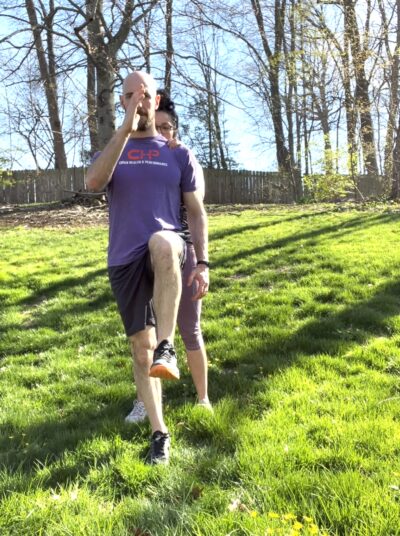
Attempt the drill below to feel what it is like to have a stacked posture while running.

  • Grab a partner and ask him/her/they to stand behind you (you are also standing)
  • Have your partner press down on your shoulders with a moderate amount of force and do not let them squish you
  • As you resist them you should feel your abs engage and feel as if you are standing tall
  • Next, attempt to shift your weight onto 1 leg and pick up your opposite foot while resisting the force of your partner
  • Try the other leg

For a video on this drill, click here.

After performing this drill, you should have a better sense of your optimal running posture. Try to replicate this feeling the next time you go on a run!

Why Powerlifters Don’t Move Laterally

As most physical therapists will tell you, powerlifters typically do not demonstrate great multidirectional movement skills. Why would they?

Training for any sport is all about specificity.

The goal of a powerlifter is to squat, deadlift or bench press more weight. Their training reflects this and as a result, they become better at those lifts. Any movement qualities that do not contribute to helping perform in these lifts are likely to suffer because they are not useful to the sport.

In fact, any unnecessary movement may be detrimental to their sport because it takes energy away from what is most important.

One way to prevent unnecessary movements from occurring is to reduce the capability of doing so in the first place!

Elite level powerlifters often do not even possess the prerequisite movement capabilities to efficiently move laterally.  That wouldn’t be helpful to their performance!

The highest level of performance in any sport often requires physiological adaptations that set the body up for the greatest level of success in that specific activity. Many times, this means that unrelated movement capabilities will diminish.

While this is helpful for short term performance, when taken too far, a reduction in movement options can increase the risk for injury. A lack of movement capabilities results in a limited number of ways the body can minimize physical stress.

How do we know that the body has lost too many movement options? Overuse injuries begin to accumulate, and signs of discomfort start to present themselves.

The best solution for any athlete looking to improve their performance in particular sport is to visit a professional that can assess their capabilities and personal risk profile. Our team of Doctors of Physical Therapy at Cohen Health and Performance specializes in just that.

Contact us today to learn more!

Where You May Be Cheating Your Pushups (Video Included)

Let’s stop cheating our pushups and making the injury rehabilitation process more challenging! 

There is a simple way to make our pushups easier. Allow for your shoulder blades to pinch together and limit the motion’s range of motion . Less distance required for the push up=less effort. 

However, is this better for you?

Allowing your shoulder blades to pinch together excessively when performing a pushup places more strain onto the shoulder joint and may lead you to a physical therapy clinic like ours. Because the shoulder blades are pinched together, they are no longer able to move effectively and contribute to the exercise. More strain is placed onto the shoulder joint as it is forced to pick up the slack. 

Correcting this common compensation may prevent you from “repping out” the same number of pushups however you will get more out of the exercise. In addition, your shoulders will be healthier in long run!

The video below helps to illustrate this difference.

Video 1: The shoulder blades immediately come together.

Video 2: Begins by reaching away from the floor thus helping the shoulder blades to start in a more protracted (spread apart) position. From there they move slowly together as the body descends to the floor and spread apart again on the way back to the starting position.

What Is That Hip Pinch?

Have you ever experienced an annoying “pinchy” sensation in the front of your hip? Many patients are referred to physical therapy for other regions of the body (back pain being the most common) and mention this uncomfortable sensation in passing.

Typically this occurs with movements like deep squatting. This “pinch” occurs as the ball of the hip (the femoral head) glides forward excessively and presses against the soft tissues located in the front of the joint.

This forward movement is normal however it is important be mindful of where the socket of the joint (acetabulum) is positioned as well.

Often times, pinching occurs in the front of the hip due to a poorly positioned hip socket.

The good news is that we can reposition the hip socket so that your hip does not pinch as easily!

There are many great drills that help with this however the Shifted Single Leg 90/90 Hip Lift is a great one to start with (this is also a great movement to get the hips/pelvis moving before running). In this video, the left hip socket is being oriented into a position that will result in less pinching.

  1. Start by lying on your back with hips/knees bent at 90 degrees and feet on a wall
  2. Slowly pull your heels down towards the ground as you reach your knees towards the ceiling. Your tailbone will slowly lift off of the ground and you should begin feeling your hamstrings working.
  3. Without moving your feet, shift 1 hip/knee down as the other hip/knee shifts up. As you shift one hip/knee down, ensure that you are pulling towards the ground with that heel. You should feel that specific hamstring cooking at this point!
  4. Pick the opposite foot up off the wall while maintaining the hip shift
  5. Hold this position while taking a relaxed breath in through the nose, followed by a long exhale out through the mouth before pausing for 5 seconds. Perform this for 5 cycles.

As with all exercises, they should be specifically tailored to your particular needs and unique physical qualities. Schedule a FREE phone consultation with a member of our physical therapy team on our website to determine how to most effectively implement an exercise like this into your program!

How a physical therapist trains with back pain

Back pain is one of the most common issues encountered in sports physical therapy and injury rehabilitation, especially among runners. Those with sensitive lower backs often need to carefully manage the total amount of activity they perform over time.

It’s particularly important to pay attention to exercises that involve significant axial loading, which refers to weight bearing directly down onto the spine.

Exercises with high axial loading, such as barbell squats, typically involve supporting the weight on the shoulders.

For individuals with back pain, it’s crucial to keep the volume of axial loading reasonable. However, reducing the number of exercises that can be performed may limit progress for those who want to achieve their fitness goals.

The trap bar squat is an excellent exercise that targets the legs and, when executed correctly, keeps the back feeling great.

Here’s how to do it:

1. Set up a trap bar with a box placed in the center.
2. Stand on the box and position yourself inside the trap bar.
3. Exhale to engage your core by bringing the ribs down and activating your abs.
4. Inhale as you squat down by pushing your knees forward to reach the bar—this is not a deadlift!
5. If needed, reset your abs, take the slack out of the bar, and stand tall as you exhale.
6. Repeat.

Contact us to learn more about improving your gym performance while maintaining a healthy lower back!


×