What Is Limiting Your Pull Ups?

Pull ups are an incredible exercise. The ability to perform a strict pull up with quality technique is a great measure of upper body strength and relative strength per body weight. This is also an exercise that many struggle with. This can be due to a lack of strength, increased body mass or lack of shoulder mobility. How do you know what is your limiting factor?

It is often assumed that strength or an increase in body mass is the issue. If this is the case then the solution is relatively simple. Focus on strengthening your pull ups! This can be done a number of different ways and with a number of different strategies, however, it doesn’t need to be overly complicated. If body mass is the issue, then strengthening will also help. However, decreasing the weight that you are pulling also makes things easier.

The most overlooked component to pull ups is shoulder mobility. Many active people that participate in weight lifting, CrossFit and various other fitness approaches lack full overhead shoulder flexion.
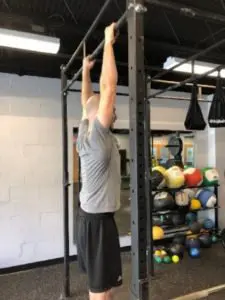
180 degrees (full overhead) of shoulder flexion is required for a strict pullup as the body begins hanging directly below the bar with the arms straight. The wrists, elbows, shoulders, trunk and legs should all be in one line. The body is then pulled up until the chin is above the bar.
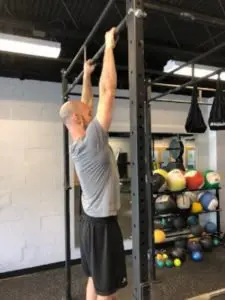
When 180 degrees of shoulder flexion is not present, the shoulders often begin behind the body and a larger arc of motion is required to pull up. This requires much more muscular effort and causes the body to tire more quickly. Many active people train multiple days per week and therefore, possess the strength and low body mass required to perform a strict pullup.

Thus, the limiting factor is often shoulder mobility. To test your mobility, attempt the back to wall shoulder flexion test. Simply stand with your lower back very lightly touching a wall and attempt to raise your arms overhead. Can you touch your hands to the wall without arching your lower back away from the wall? If not, some overhead mobility work may be warranted.

Why Would You Celebrate Your Anniversary At Disney?

This past weekend my wife, Debbie and I went on quick vacation to Disney World. We chose to escape the fast-paced environment of DC, turn back the clocks, and celebrate our anniversary like little kids.

Debbie and I are typically able to remain consistent with exercise and healthy eating however it is a challenge to avoid the stressors that life in a metropolitan area can bring. A constantly high level of stress may interrupt sleep, contribute to fatigue and decrease the ability of the body to positively adapt from exercise.

A strategic break is a wonderful way to battle this challenge. Strategic breaks are necessary in the lives of any hard working, driven individual. People often feel guilty for taking a break from the grind however research has proven that great ideas com during “off” time and/or immediately after. For example, Bill Gates is famous for constantly taking weeks off without cell phone or internet access to simply disconnect.

After my strategic break, I am feeling rejuvenated and ready to give everything I have to our patients to help them get the best results possible. This most recent vacation had the added benefit of allowing us to take a break from the serious and laugh at ourselves which I find hugely valuable.

Adjusting your exercise routine and approach to nutrition is important however when was the last time you evaluated your life balance?

Do You Need To Warmup?

This is probably a good idea; however, this does not mean that you need to stretch, roll around on the ground and perform “activation” drills for 15 minutes prior to being ready for exercise.

There is no perfect warmup for everyone. The best warmup depends on what your activity level had been that day and the specific activity that you are preparing for (among many other things). If you are getting ready to run, perform activities that practice things necessary to run effectively. If you are going to lift weights, practice movements similar to the lifts you are going to perform (ie. If you are going to squat, then squat in your warmup!).

Furthermore, if you have been sitting at a desk for the majority of the day, you may need a more comprehensive warmup. On the other hand, if you have an active job requiring you to move in a variety of different ways then your warmup can be the activity itself.

Animals don’t require extensive warmups prior to sprinting. They have been walking, standing and moving all day prior to ramping things up when nature necessitates it. If you have been active the majority of your day prior to training, be like a cheetah!

A small warmup is often necessary however be purposeful about it rather than mindlessly performing the same thing each workout.

For help creating a customized workout for you, feel free to contact us via e-mail info@cohenhealth.com or phone (240) 686-5609

Foam Rolling: Should You Do It?

Foam rolling is a very common recovery tool among athletes and exercise enthusiasts. Simply pop your head inside a gym here in Bethesda and you will likely see several people lying on the ground, rolling on these objects. Many people now own foam rollers for home use. We are often asked about them as they are also commonly used in sports physical therapy.

How do you know if you should foam roll? If you are already using this tool, should you continue?

Like most things, it depends. More specifically, it depends on why you are using the foam roller. Foam rollers do not “break up” tissue as is often believed. Our body is not that fragile. Could you imagine what your body would do lifting weights if tissues could be drastically changed by a round piece of foam?

However, if you are using the foam roller because it feels good and the routine of “rolling out” helps to get you in the right mindset for training (if used prior to exercise) or recovery, keep it up. The sensory input of the roller moving up/down the body’s tissues can feel good, similar to a massage and often helps people relax.

A foam roller is not going to do any harm. Whether or not you should use one depends on the reasons why you are doing so.

If you have any further questions about this or something else in the field of physical therapy/strength and conditioning please feel free to contact Dr. Cohen or Dr. Immermann.

E-mail: info@cohenhealth.com
Phone: (240) 686-5609

What Is Good Posture?

“I know, my posture is terrible.”

Sometimes our patients/clients will come to us concerned about their posture.

People are classically taught to “sit up straight,” or stand with their chest out and shoulder blades pulled down and back. This is often seen as the counter to slouching which is commonly looked down upon.

I rarely think of posture as good or bad.

Most people think of posture as a static (non-moving) position. However, our posture, much like movement, is always changing. The body constantly adapts to more efficient and comfortable positions based on demand.

Think of your most recent workday. Your resting posture was likely much different at the end of your workday when compared to when you first sat down in the morning. In the morning you may have been much more upright and aware with your coffee kicking in. However, you later began to slouch and melt into your chair as the afternoon lull approached.

Your posture likely appeared very different in both of these situations and an assessment of your posture would therefore also appear different depending on the time of day it was done.

“Does this mean that posture doesn’t matter?”

No, that is not the case. What it does mean is that there are other things that warrant more attention. Practicing high movement quality every day, taking walks outside to break up continuous bouts of desk work and getting a full night’s sleep will have a greater impact on your health then constantly worrying about your resting posture.

Check out additional blogs from Cohen Health and Performance for more information on how to incorporate healthy lifestyle habits into your routine.

Why Your Back Pain Won’t Go Away

Have you tried everything and still have low back pain? Is your daily pain limiting your workout of the day?
Here are some reasons your back pain won’t go away…

1) A Poor Night’s Sleep
Sleep is the best recovery tool that we have. From an evolutionary perspective, we better have a great reason for leaving ourselves unconscious and vulnerable for a number of hours! Research indicates that quality of sleep plays a crucial role in improving outcomes in chronic pain patients.

Make sure that you have a high-quality mattress. A poor-quality mattress can leave your back feeling worse due to a lack of support. For this reason, a high quality, firmer mattress is often best. Be sure to test out multiple mattresses to determine which one is best and most comfortable for you. This is also not the time to get cheap! Think of this as an investment as we use it for at least 8 hours every day. One-third of your life is spent in bed!

Furthermore, no more sleeping on your stomach. Sleeping on your stomach increases the compression on your lower back. Initially it can be extremely challenging to sleep on your side or back when you are not accustomed to it. However, it will become significantly easier with a little bit of repetition.

2) Addiction to Technology
According to recent research, the average person spends about nine hours per day using electronic devices. This will increase tension in a number of areas including the lower back.

Try setting limits on your technology use or maybe even give yourself a technology curfew at the end of the day. This will help reduce your technology use and can even help improve your quality of sleep by reducing blue light exposure before bed.

3) Stress
The body is very resilient, however, it can still only handle so much stress. Stress can be both physical and emotional. The body is limited in the amount of physical stress that it can handle when it is pre-occupied with emotional/psychological stress. Research indicates that people struggling with anxiety and depression are more likely to experience a number of orthopedic pains including lower back pain. This can often lead to a downward spiral of emotional/psychological stress contributing to lower back pain and lower back pain leading to more stress.

If you feel that you could reduce your stress, try meditating or deep relaxation techniques. Not sure how to go about that? There are many great apps that you can use on your phone to help guide you. You can even do something as simple as setting aside time to sit and relax and reflect on your day.

4) Not Getting a Comprehensive Treatment Plan
If you are receiving treatment for back pain and symptoms are not getting any better, you have to consider the possibility that your treatment plan may not be comprehensive enough. Back pain is very complex and is influenced by a number of factors, including many that were not described in this article. A comprehensive evaluation is essential to determine the root causes of pain and assess the numerous factors that contribute to this issue.

Effective treatment targets the root issue and doesn’t just chase symptoms. This is essential to provide fast and long-lasting results. Do not trust your back to just anyone!

If you continue to have symptoms, remember that we specialize in helping athletic people just like you get out of pain and back to doing those activities that you love.

Call to learn more or to schedule an appointment. If you aren’t sure if we are the right place for you, please sign up for a free consultation to determine if we are the right people to help you!

×