Two Common Reasons You Have Neck Pain (And How to Fix It)

Neck pain is a common complaint of people seeing a physical therapist in Chevy Chase or Bethesda. Although a variety of different factors can cause it, two of the most common explanations of neck pain and discomfort are rib cage stiffness or overtraining.

One effective treatment of neck pain can be to reduce any rib cage stiffness that may be causing a lack of mobility below the neck. The muscles of the upper back and shoulders attach directly to the neck and can cause tension when unable to expand freely. To have pain-free neck mobility, the rib cage must be able to expand 360 degrees.

One simple method to improve rib cage stiffness is with a breathing exercise such as Rockback Breathing off an elevated surface (see below).

Rockback Breathing on a Bench

Another common cause of neck pain in our patients is overtraining. When patients disregard the warning signs and continue to push themselves, there is an increased stress response throughout the body. This causes the accessory respiratory muscles to work harder, thus developing neck stiffness and discomfort.

If overtraining is the issue, it can help take a couple of days to give your body time to rest and recharge. Similarly, it can be invaluable to work directly with a professional to ensure overtraining doesn’t become a long-term issue. Although it’s enticing to continue to train harder, you can usually achieve better results by giving your body more opportunity to recover.

When your neck pain has persisted for longer than a few weeks, it’s time to meet with a professional who can help identify more subtle reasons for the discomfort. If you’re in the Bethesda or Chevy Chase area, our physical therapists can help you get back to living your life pain-free!
Why Your Big Toe Matters

Our poor big toes. They are one of the unsung heroes of our lower extremity and are integral for walking, running, and optimal function during standing activities. We commonly focus portions of treatment within an athletic physical therapy session to big toe function.

The big toe helps with shock absorption and propulsion while often bearing over 50% of our body weight. It provides an essential role in sustaining the arch of the foot, thus setting the stage for optimal function of the rest of the foot.

For these reasons, people that suffer big toe amputations typically experience balance deficiencies and struggle with a variety of upright activities.

The great toe needs approximately 60 degrees of extension for walking, specifically during the terminal phase of gait (push off) when the weight is on the front of the foot and the heel is off the ground.

Even more motion is needed for running and athletic activities like sprinting. We commonly find that our athletic patients have limited great toe mobility which forces the body to compensate, and increases the risk for overuse injuries elsewhere.

A good target for a committed runner or athlete is 90 degrees of great toe extension, which you can test on yourself!

Begin seated with your foot flat and relaxed on the ground. While keeping the balls of your feet on the ground, use your hand to lift your big toe up towards the ceiling. Can it reach 90 degrees and get perpendicular to the ground?

If not, our Director of Education, Dr. Alex Immermann has a fantastic drill to help you! Check it out below!

Big Toe Extension PAILs/RAILs

If this drill created any pain or discomfort, please contact us.

How to Know if an Exercise is Good or Bad

Athletic physical therapy often consists of answering questions about particular exercises.

What is your opinion on deadlifts? How do you feel about pushups? Is running bad for your knees?

My answers typically start by highlighting the context involved with any particular exercise.

Exercises are often labeled as good or bad, however most exercises are appropriate in a particular context, while being inappropriate in another.

For example, the deadlift is a great exercise when the goal is to build muscle and strength of the “pulling” musculature (glutes, hamstrings, upper back). However, this same exercise can be problematic for an individual with a history lower back pain, and cannot properly control his/her spine as the hips bend.

If a deadlift is inappropriate for a particular person, he/she can work on the qualities necessary to safely perform the movement, should that be a priority. Check out the video below as a reference for how Dr. Cody teaches the ability to brace the abs during a deadlift.

Bracing During a Deadlift

It is much simpler simply label the deadlift as “bad for your back” or “the best exercise for xyz”, however as with most things, the answer is not black and white.

Unfortunately, this way of thinking also applies to entire methods or schools of thought. Well-known strength coach Eric Cressey (and sadly the strength coach of the New York Yankees) wrote a great article about his process for assessing particular methodologies.

What do you think of XYZ method?

Keep an eye out for any professionals in the field of health, medicine, or fitness that label things as good or bad. Things are rarely that simple as a myriad of different factors exist within the presentation of every individual. If you experience a professional that claims he/she has the only guaranteed solution, and everyone else is wrong, run!

Why “Shoulders Down and Back” Is Not Helpful

“Shoulders down and back” is a cue that is commonly used to correct one’s posture. However, as performance physical therapists we find this cue to be detrimental to how the shoulder complex is meant to function. In fact, correcting this belief has been one of the most helpful suggestions during our virtual physical therapy sessions and throughout the injury rehabilitation process.

Pulling the shoulder blades down and back opposes necessary shoulder blade during reaching activities. The shoulder blades are meant to elevate and abduct (move apart) as the arm is moved away from the body.

The motion of the shoulder blades moving away from the spine is called protraction. Protraction is required to properly perform pushups or reach in any direction.

This is of particular importance for active people that wish to lift weights or play a sport. Attempting to keep the shoulders “down and back” as the arms need to move away from the body will negatively impact the mechanics of the shoulder and possibly result in injury.

“Shoulders down and back” may work for drills such as deadlifts, rows, and farmers carries, however it is useful to forget this cue for other activities, such as posture correction!

Fact or Fiction: I need to be using a foam roller

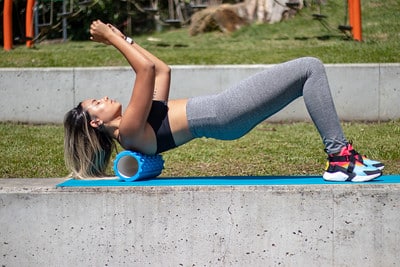
A common belief in the world of athletic physical therapy in Chevy Chase or Bethesda is that athletes and active people must consistently foam roll for recovery. This belief is further perpetuated in the world of performance training. Simply pop your head inside any gym here and you will see what I mean!

Like most things, foam rollers have a time and place.  “Rolling out” often feels good and the routine of doing so prior to training helps many people get into the proper mindset for training. Furthermore, the sensation of foam rolling may help the body relax when you are not exercising.

Foam rollers are a great tool for these reasons, however some people claim that these tools “break up” knots in muscles and “smooth” out the tissues of the body. This is simply not the case.

The human body is very resilient. If it were fragile enough to be structurally altered by a foam roller then we would be in a lot of trouble! Could you imagine what would happen to your body when lifting weights if it could be drastically changed by a round piece of foam?

The good news is that a foam roller is not going to do any harm, however whether or not you should use one depends on what you are looking to get out of it.

**Credit for image “Foam rolling on back” by PTPioneer is licensed under CC BY 2.0.www.ptpioneer.com


My Favorite Piece of Health Technology in 2020

Trackable health data has produced entire industries, the most prominent of which are wearable health tracking technology. This technology can also be used to enhance the results of athletic physical therapy and performance training.

Wearable health trackers commonly measure things such as heart rate, step count, sleep quality, and physical activity. This data is useful when it is utilized to make better health decisions and develop healthier habits.

However, it is easy to become obsessed and overwhelmed with the constant influx of data. When I got my first piece of wearable technology I became so obsessed with the data that it actually caused me stress. Always remember that this data is information meant to improve your health. The data is for you to interpret and adapt to your lifestyle!

With that being said, my favorite piece of health technology in 2020 is the Oura Ring.

The Oura Ring is a wearable health tracker that detects health information through the finger and has proven to be more accurate than most commonly used health trackers. For more information about Oura Ring, check out their website https://ouraring.com/

However, its accuracy is not the reason that Oura Ring is my favorite piece of technology in 2020.

This year Oura conducted research to determine if the data collected could be used to predict when someone is infected with COVID-19. Although more research is needed, the results are promising and the answer appears to be yes. For more information on this topic, check out the article below.

https://www.ucsf.edu/news/2020/12/419271/wearable-sensor-may-signal-youre-developing-covid-19-even-if-your-symptoms-are

Do you have any questions about health and fitness technology? If so, please respond to this email and ask away!

P.S. We have no affiliation with Oura and do not receive anything by endorsing them!

×