Shoulder pain is frustrating.
It can make lifting uncomfortable, limit your workouts, and even affect simple daily activities.
Recently, I found myself dealing with a shoulder issue of my own.
It wasn’t severe enough to stop me from training, but it was nagging enough that I knew I needed to figure out what was going on before it became a bigger problem.
So I did what we encourage our patients to do every day.
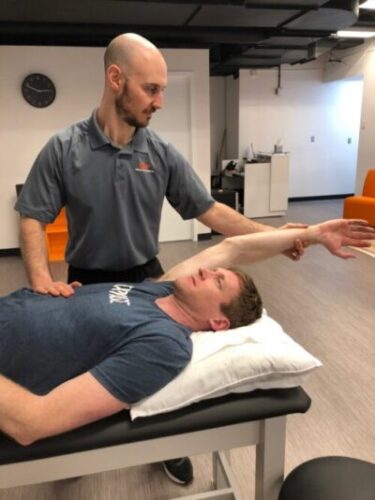
I had another physical therapist evaluate it.
As physical therapists, we’re trained to assess movement and diagnose injuries. But it’s surprisingly difficult to evaluate yourself objectively. Having someone else take a step back, perform the right tests, and look at the full picture makes a huge difference.
In my case, we identified that one of my rotator cuff muscles, the supraspinatus, was irritated.
That diagnosis changed everything.
The Best Exercise Depends on What’s Actually Causing Your Pain
If you’ve ever searched for shoulder pain exercises online, you’ve probably found hundreds of videos and programs promising quick relief.
Some are well intentioned.
Some are based on good research.
The problem is that none of them know why your shoulder hurts.
Two people can both have shoulder pain but need completely different treatment plans.
One person may have irritation in a rotator cuff tendon.
Another may have limited shoulder mobility.
Someone else may have weakness that’s affecting how their shoulder moves.
The symptoms can feel similar, but the underlying problem is very different.
That’s why trying random exercises often leads to frustration.
Before choosing the right treatment, you need the right diagnosis.
Your History Matters
The shoulder doesn’t exist in isolation.
When we evaluate someone, we don’t just look at the painful area.
We want to understand how the symptoms developed.
Previous injuries.
Training volume.
Exercise selection.
Work demands.
Movement habits.
All of those factors help explain why pain developed in the first place.
For me, years of football, my current training routine, and the specific demands I place on my shoulder all influenced the plan we created.
That’s why rehabilitation should never be copied from someone else.
It should be built around you.
Teaching the Shoulder to Work Together Again
Pain doesn’t just affect one muscle.
It can change how the entire shoulder functions.
One of the first goals in my rehabilitation was improving how my rotator cuff muscles worked together to stabilize the shoulder.
We started with simple weight-bearing exercises that encouraged the shoulder muscles to coordinate and create a stable base before progressing to more demanding movements.
As the shoulder became more tolerant of load, we gradually introduced exercises that specifically challenged the irritated tissue.
The progression mattered just as much as the exercise itself.
Loading an irritated muscle too early can increase symptoms.
Waiting too long can delay recovery.
Finding the right balance is one of the most important parts of rehabilitation.
There Isn’t One Perfect Shoulder Exercise
People often ask what the best exercise is for shoulder pain.
The answer depends on the person.
The same exercise that helps one individual could make someone else’s symptoms worse.
That’s why rehabilitation isn’t about collecting exercises.
It’s about understanding when to use them, how much load to apply, and how to progress them over time.
Those decisions should always be based on a thorough evaluation.
Sports Physical Therapy in Bethesda and McLean
Whether you’re dealing with shoulder pain from lifting, throwing, tennis, pickleball, CrossFit, or another activity, getting the right diagnosis is the first step toward recovery.
At Cohen Health & Performance, we take the time to understand not just where your shoulder hurts, but why it’s hurting. Our one-on-one approach combines movement analysis, strength testing, and individualized rehabilitation to create a plan that’s built around your goals.
If you’re looking for sports physical therapy in Bethesda or sports physical therapy in McLean, our team is here to help. We work with active adults and athletes to identify the root cause of pain, improve movement, and get you back to training and competing with confidence.
The sooner you understand what’s driving your symptoms, the sooner you can stop guessing and start making meaningful progress.
