1 Trick to Perfect Running Foot Strike Position

If you ever experience back pain when running, are a runner that has been to physical therapy, or are curious about foot strike position, this article is for you!

One of my favorite workshops to conduct is the CHP Running Technique and Performance lab. I have a blast throughout the workshop, but the Q&A portion is my favorite. I have gotten the opportunity to answer many different questions which have forced me to expand my knowledge and has helped me to create a better workshop over time.

While the questions that I receive consistently differ, one topic remains consistent. Someone inevitably asks about foot strike position and my answer often surprises them.

There is no correct foot strike position.

Among other things, foot strike position is dependent on an individual’s body dimensions (limb length as an example) and the position of the body above.

While we cannot change your anatomy, we can change the position, aka the posture, of our bodies.

A “stacked” posture will facilitate a foot strike that occurs directly underneath the body. This foot strike position results in a more efficient stride and minimal stress to the body. To learn about the stack, check out a previous article that I wrote on Learn to Stack Like a Snowman.

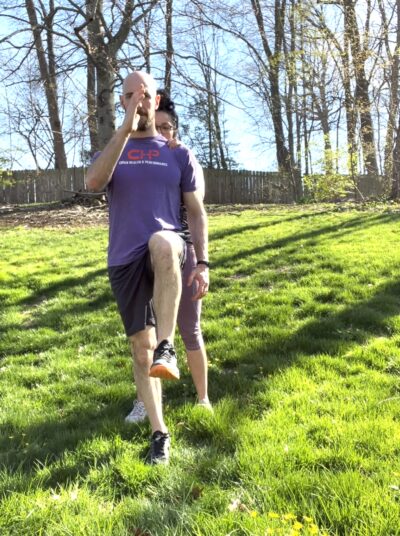
Attempt the drill below to feel what it is like to have a stacked posture while running.

  • Grab a partner and ask him/her/they to stand behind you (you are also standing)
  • Have your partner press down on your shoulders with a moderate amount of force and do not let them squish you
  • As you resist them you should feel your abs engage and feel as if you are standing tall
  • Next, attempt to shift your weight onto 1 leg and pick up your opposite foot while resisting the force of your partner
  • Try the other leg

For a video on this drill, click here.

After performing this drill, you should have a better sense of your optimal running posture. Try to replicate this feeling the next time you go on a run!
Learn to Stack Like a Snowman

Learn to stack like a snowman….

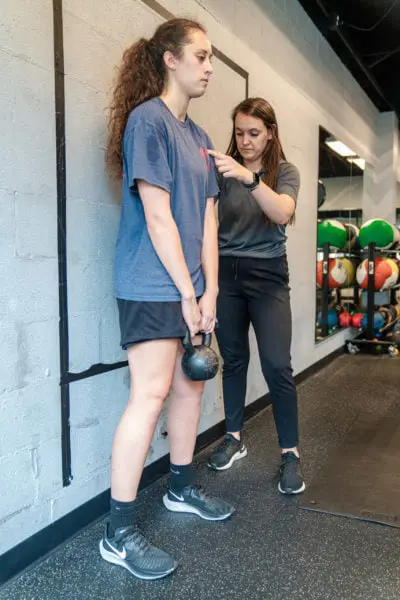
The “stack” is one of the prerequisite positions to master in physical therapy or performance training. This position is essential for movements like squats, split squats, hip hinging and pretty much anything one might perform in the gym.

Think of the stack like a snowman. The 3 balls of a snowman represent the head (top ball), rib cage (middle ball), and pelvis (bottom ball). The goal of the stack is to center each of the 3 balls over one another.

The weight bearing surfaces of all 3 balls are larger when they are centered over one another. This means that the weight of the snowman is spread over a larger area (ie. less stress in each individual spot).

Now imagine that one ball starts to roll forward or backward. The ball above and below must roll with it to avoid falling to the ground and keep the snowman standing upright. This adjustment changes the weight bearing dynamics for each ball and more weight is now directed onto a smaller amount of space. This produces more stress onto these new weight bearing areas and may cause these areas to break down faster (think discs in our lower back).

This same dynamic happens in our body. As one of our balls (head, rib cage, or pelvis) rotates away from center, the other balls must accommodate. This places more stress onto the body as a whole and often results in discomfort.

Achieve the stack by practicing the following steps.

  1. Imagine that you are wearing pants with back pockets. Without bending your knees further, roll your back pockets underneath your body (you should feel your abs turn on)
  2. Without hunching over take a relaxed breath in, followed by a long and relaxed breath out. Feel your anterior ribs move down, back and in. Ensure that you can gently maintain this position while inhaling and exhaling
  3. Imagine that someone is standing behind you pressing hard down onto your shoulders. 

The stack can be a challenging position to master and integrate into your training routine. However it is often the secret to avoiding back pain with common activities in the gym. 

Contact us to learn other adjustments to common exercises that may become your hidden secret to overcoming pain and optimizing your performance.

What Is That Hip Pinch?

Have you ever experienced an annoying “pinchy” sensation in the front of your hip? Many patients are referred to physical therapy for other regions of the body (back pain being the most common) and mention this uncomfortable sensation in passing.

Typically this occurs with movements like deep squatting. This “pinch” occurs as the ball of the hip (the femoral head) glides forward excessively and presses against the soft tissues located in the front of the joint.

This forward movement is normal however it is important be mindful of where the socket of the joint (acetabulum) is positioned as well.

Often times, pinching occurs in the front of the hip due to a poorly positioned hip socket.

The good news is that we can reposition the hip socket so that your hip does not pinch as easily!

There are many great drills that help with this however the Shifted Single Leg 90/90 Hip Lift is a great one to start with (this is also a great movement to get the hips/pelvis moving before running). In this video, the left hip socket is being oriented into a position that will result in less pinching.

  1. Start by lying on your back with hips/knees bent at 90 degrees and feet on a wall
  2. Slowly pull your heels down towards the ground as you reach your knees towards the ceiling. Your tailbone will slowly lift off of the ground and you should begin feeling your hamstrings working.
  3. Without moving your feet, shift 1 hip/knee down as the other hip/knee shifts up. As you shift one hip/knee down, ensure that you are pulling towards the ground with that heel. You should feel that specific hamstring cooking at this point!
  4. Pick the opposite foot up off the wall while maintaining the hip shift
  5. Hold this position while taking a relaxed breath in through the nose, followed by a long exhale out through the mouth before pausing for 5 seconds. Perform this for 5 cycles.

As with all exercises, they should be specifically tailored to your particular needs and unique physical qualities. Schedule a FREE phone consultation with a member of our physical therapy team on our website to determine how to most effectively implement an exercise like this into your program!

How a physical therapist trains with back pain

Back pain is one of the most common issues encountered in sports physical therapy and injury rehabilitation, especially among runners. Those with sensitive lower backs often need to carefully manage the total amount of activity they perform over time.

It’s particularly important to pay attention to exercises that involve significant axial loading, which refers to weight bearing directly down onto the spine.

Exercises with high axial loading, such as barbell squats, typically involve supporting the weight on the shoulders.

For individuals with back pain, it’s crucial to keep the volume of axial loading reasonable. However, reducing the number of exercises that can be performed may limit progress for those who want to achieve their fitness goals.

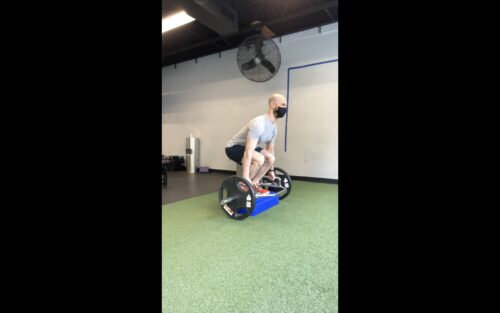
The trap bar squat is an excellent exercise that targets the legs and, when executed correctly, keeps the back feeling great.

Here’s how to do it:

1. Set up a trap bar with a box placed in the center.
2. Stand on the box and position yourself inside the trap bar.
3. Exhale to engage your core by bringing the ribs down and activating your abs.
4. Inhale as you squat down by pushing your knees forward to reach the bar—this is not a deadlift!
5. If needed, reset your abs, take the slack out of the bar, and stand tall as you exhale.
6. Repeat.

Contact us to learn more about improving your gym performance while maintaining a healthy lower back!


What Touching Your Toes Really Says

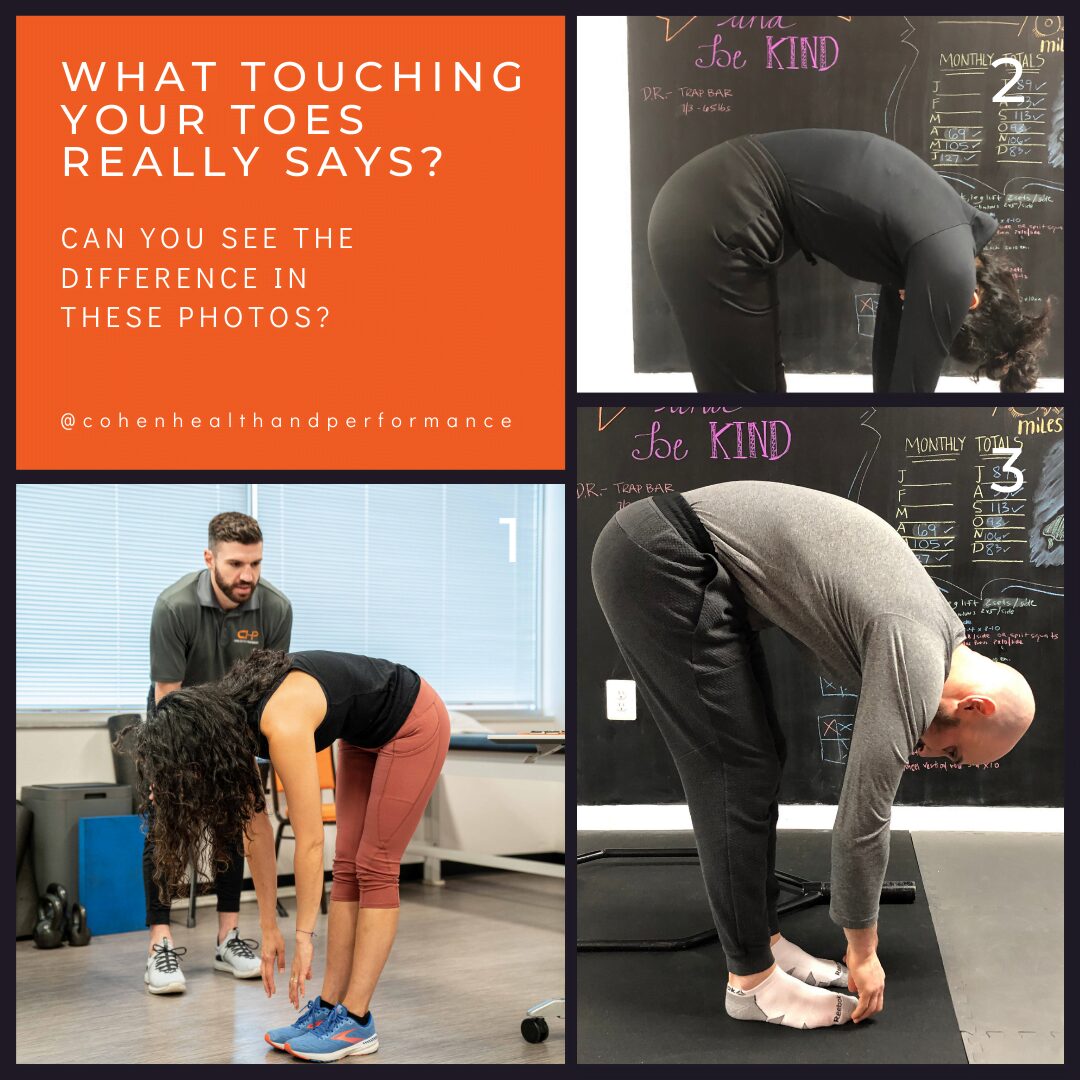
Can you see the difference in these photos? The toe touch is a simple test that is often performed in injury rehabilitation and sports physical therapy settings.

However, important parts of this test are commonly missed. Simply touching your toes doesn’t tell the whole story. If you can touch your toes, great, however there are different ways that you can get there.

Have you stretched your hamstrings to such a degree that they allow you to nearly palm the floor? 

If you are a gymnast that may be a great thing. However field sport athletes (ex. Lacrosse, football, basketball, baseball) and weight lifters need a level of hamstring stiffness for explosive movement. 

Is your lower back straight or does it flex into more of a C curve to allow you to more easily touch your toes? Is your lower back bending in certain areas but not in others?

Your lower back consists of multiple bones (vertebrae) that are stacked on top of each other. Our backs are built this way to allow for movement of one segment on the next. However many times these small movements do not occur and the lower back moves as one unit. The result is a lower back that looks straight in places despite being bent over. Over time, a lack of lower back  movement can increase the risk for injury.

The toe touch is a great test and can be made even better when directed by a professional with a trained eye.

Contact us for more information about how a customized movement assessment may help you optimize your training and avoid injury!

Fact or Fiction: Do our bodies actually fall out of alignment?

We are excited to begin a series of posts discussing common myths in the realm of athletic physical therapy. Today’s myth commonly applies to back pain physical therapy as well.

Many of our patients have been told that their body may be “out of alignment”, or that their joints need to be “re-aligned.” Unfortunately, this is not the greatest advice.

Human beings are never in a static position. Even at rest, the simple act of breathing creates movement. By definition, being in alignment means that our bodies are in a straight line, or that all parts of our body are consistently in the appropriate relative positions to one another.

We cannot consistently be in alignment because we are always moving. If our body was constantly aligned, we would be unable to move anywhere.

Your body can feel as if it is out of alignment when you overuse or rely upon specific movement strategies or body positions. This can happen for a myriad of reasons and results in feelings of stiffness and discomfort that often temporarily feel better with an adjustment.

An adjustment can be helpful if the causes of stiffness or discomfort are also addressed. The root causes of stiffness or discomfort are typically addressed by focusing on movement limitations that are present.

Any relief provided by an adjustment will be temporary when the root cause of the discomfort or stiffness is left unaddressed. Check out the article below for some activities that may help!

3 Home Exercises to Help Your Back Pain

We hope that this provided some insight into a common rehab myth. Stay tuned for more to come!

×