5 Mistakes Athletes Make Returning to Sport After a Shoulder Injury

Navigating the path through physical therapy and back to training after a shoulder injury is like threading a needle. It’s tricky and demanding, and if not done right, it can lead to setbacks. At Cohen Health and Performance, our experiences in McLean and Bethesda have given us invaluable insights into what works and what doesn’t. Here are five common errors that can derail your recovery journey in physical therapy.

  1. Jumping the Gun: Increasing Workload Too Quickly

This is the big one. When athletes feel no pain or get the green light from their doctor, they often rush back to their previous training levels. But this excitement can quickly turn into a setback.

It’s crucial to educate early to prevent this. Feeling better doesn’t mean you are back to your pre-injury levels. 

Progressive loading is critical. Develop a detailed plan that helps you slowly and progressively increase activity. This gives your shoulder a chance to acclimate to more stress and loading over time. Include physical therapy exercises to care for your rotator cuff and improve the movement capabilities of your scapula-thoracic joint and rib cage. 

  1. Start with 1 arm exercises

Everyone has a dominant arm, but rushing into bilateral exercises like bench presses and pull-ups requires addressing unilateral strength imbalances. After an injury, your body may be experiencing something called protective inhibition when the nervous system prevents you from fully activating the muscles of the injured arm. In addition, you may be experiencing weakness and atrophy from not using your injured arm for a period.  

At Cohen Health and Performance, we use tools to measure force output and look for upper extremity strength to be symmetrical before moving to bilateral exercises. Ensuring that your strength is balanced can save a lot of headaches and prevent re-injury.

  1. Treating the Symptom, Not the Cause

It’s easy to focus on the source of the pain, but it’s vital to look at the bigger picture. Ask yourself: What caused this shoulder injury? 

There are numerous factors to look at here, but we’ll discuss a couple common issues.

Let’s start by looking assessing an athlete’s overall workload. Many are consumed by games, practices, and workouts without sufficient recovery built in. 

In addition, their bodies may not be able to handle all the stress that they are asking of them. Many of our physical therapy patients do not have the movement capabilities and loading tolerance necessary to withstand the rigors of their sports schedules. 

  1. Lack of Individualized, Objective Return-to-Sport Programs

A one-size-fits-all approach needs to be revised. Every athlete is an individual with unique traits, strengths, and weaknesses. A personalized, detailed roadmap to recovery is needed. 

Your athlete’s personalized program must start with their goals. Next, they must undergo a thorough assessment to determine their current situation.

The athlete’s goals are the destination, and the assessment is the starting point. The program is the roadmap to get them from the start to their destination. 

  1. Lack of Communication 

Open communication with all parties involved (parents, coaches, physical therapists, trainers, and physicians) is essential for a triumphant return to sport. Everyone needs to be on the same page, which ultimately helps the athlete return to sport faster and safer.

At Cohen Health and Performance, we request to be in touch with an athlete’s coaches, parents, and other healthcare team members. 

If you avoid these common mistakes, you’ll be back in the game stronger and more resilient than before your injury.

Are you seeking ways to overcome your shoulder injury and return to the field immediately? Contact us to get back out there ASAP!

 

CHP Spotlight Interview: Dr. Garry Ho

In the ever-evolving sphere of health and fitness, the quest to sidestep the scalpel in favor of less invasive approaches has directed us towards physical therapy and regenerative medicine.

I recently sat down with Dr. Garry Ho, a sports medicine specialist at OrthoVirginia. Dr. Ho doesn’t just see patients; he sees potential athletes in everyone, regardless of age. This perspective is refreshing, as recreational athletes search for the high quality of care, typically only reserved for the professionals.  Dr. Ho’s collaboration with our physical therapy team at Cohen Health and Performance underscores a synergy that is pushing boundaries and redefining injury recovery, physical therapy, and fitness.

Why is it, you might ask, that burgeoning athletes—still green behind the ears—are succumbing to afflictions once reserved for adults? Dr. Ho sheds light on this conundrum, attributing it to a modern paradox: the pursuit of fitness through sport versus the foundational necessity of being fit to engage in sport. It’s a chicken-or-the-egg scenario that has far-reaching implications for our approach to physical therapy and training.

Physical therapy, in this narrative, is not just a reactive measure but a proactive toolkit. It’s about recalibrating our bodies, ensuring they are primed and ready for the demands we place on them, whether that’s chasing a soccer ball, sprinting down a track, or even just keeping up with our kids. The magic of physical therapy lies in its ability to tailor rehabilitation and conditioning to the individual.

In the vast expanse of information that is the internet, finding credible, actionable advice on physical therapy—or any health-related topic—can feel like searching for a needle in a haystack.

The mission of the CHP Spotlight Interview Series is to share information with you from local experts in the fields of sports medicine, physical therapy, personal training, and sports performance. Now, more than ever, a seemingly infinite amount of information is available, and finding credible information is challenging. But we have good news. We are here to help you find the best information about physical therapy, personal training, and sports medicine from experts in Bethesda, Chevy Chase, DC, McLean, and Northern Virginia.

To learn more about Dr. Ho, click here and check out our interview!

A physical therapist’s role in performance training

Physical therapy plays an integral role in the world of sports, particularly for young athletes navigating the challenges of high school sports.

After opening our new facility in Bethesda, my return to treating patients has once again shown me the critical role that physical therapy and physical therapists play in the health, recovery, and performance enhancement of these young individuals.

Our afternoons are bustling with the energy of high school athletes, many of whom bring a fervor and intensity to their training that, while commendable, often needs a more informed approach to be sustainable and beneficial in the long term.

The Role of Physical Therapists in Youth Sports

Physical therapists specialize in understanding the complex dynamics of the human body, especially how it heals, adapts, and improves with proper training and rehab. In the context of high school athletics, a physical therapist’s role transcends mere rehabilitation; it encompasses prevention, education, and performance optimization. We see a common thread among young athletes: a passion for their sport that sometimes leads to overzealous training habits.

Overtraining: The Pitfall of Youthful Exuberance

The notion of overtraining is not new, yet it remains a prevalent issue among high school athletes. The invincibility felt by the youth can often lead to pushing their limits, participating in multiple teams, and juggling a demanding academic schedule. This relentless pursuit of excellence, while admirable, can lead to compromised techniques and an elevated risk of injuries. Herein lies the importance of physical therapy – guiding these athletes towards more mindful, strategic approaches to training that emphasize recovery, technique, and balanced physical development.

The Overlooked Aspects of Performance Training

In the age of social media, the allure of “exciting” training routines is undeniable. Yet, it is the foundational aspects of youth sports performance training – such as mobility, stability, and foundational movement skills – that often go overlooked. The basics don’t get a lot of likes on Instagram!

Physical therapists are adept at identifying these gaps and implementing training regimens that address these vital components. Exercises like Forward Bounds and Forward Hops are examples of specific drills that we use to teach essential skills, highlighting the need for a nuanced approach to training that balances the exciting with the essential.

The Need for Individualized Training Programs

Another critical area where physical therapists make a significant impact is in the development of individualized training programs. High school athletes, particularly those recovering from injuries, require tailored programs that consider their unique needs, strengths, and weaknesses. Generic training programs often do not address these nuances, potentially hampering an athlete’s recovery and performance enhancement. A physical therapist’s expertise in creating customized training plans is invaluable, ensuring each athlete’s journey towards optimal performance is both efficient and safe.

Encouraging a Holistic Approach

For athletes motivated to excel, the guidance of a physical therapist can be transformative. It is not merely about correcting mistakes but fostering a holistic approach to training that integrates physical wellness, injury prevention, and performance optimization. Our training programs embody this philosophy, offering young athletes a comprehensive foundation upon which to build their sporting endeavors. To learn more about our training programs, click here!


Physical therapy and physical therapists occupy a central role in the health and performance of high school athletes. Through their expertise in rehabilitation, injury prevention, and performance training, they guide young athletes towards more sustainable, effective training practices. The lessons learned extend beyond the gym or field, instilling a mindset that prioritizes overall health, well-rounded development, and the long-term enjoyment of sports. As we continue to support these young athletes at our Bethesda and McLean facility, the value of physical therapy remains abundantly clear – it is not just about rehabilitation but about fostering a generation of athletes who are as healthy as they are talented.


How physical therapy created a better athlete

Let me share a story about one of my earliest sports physical therapy patients.

He was a natural athlete, excelling in basketball, baseball, and tennis, always standing out as the star of his teams.

But as he turned 16, something began to change. It was as if the world around him was speeding up, and for the first time, he found himself struggling to keep pace. His once unmatched speed during practice sprints started to lag; the basketball court, once his domain, saw him struggling to hold his ground against tougher opponents. Even his prized spot in the baseball lineup was contested and eventually claimed by a teammate. This was a turning point in his young career, a moment of realization that his natural talents alone were no longer enough to keep him ahead of the competition.

He was determined to reclaim his position.

On a perfect spring day, with the temperature at a crisp 65 degrees, he stood at the plate. The pitcher wound up, released the ball, and WHACK! He sent a rocket into left field and dashed down the first base line—only to suddenly clutch his right thigh and collapse to the ground.

This injury is what brought him to me for physical therapy, seeking help to recover and return to the field.

Our time together in physical therapy was marked by determination, learning, and growth. Over weeks of intense, personalized therapy sessions, we focused not just on recovery but on holistic improvement. His comeback was nothing short of extraordinary. He not only regained his spots on his teams but returned stronger, faster, and with a deeper appreciation for the fundamentals of athletic training.

Below is a video of one specific technique we used to help him boost his speed!

Our sessions were more than just about rehabilitation, physical therapy, and performance training; they were an educational journey. We delved into the importance of strength training, mobility exercises, and proper movement techniques—core principles that, in hindsight, might have prevented his injury. This experience led us to wonder: What if this foundational training had been part of his routine before the injury? Could the right preparation have helped him maintain his edge without the setback of injury?

While we can’t know the answers for sure (though I have my suspicions), I’m confident that with a stronger foundation of strength, mobility, and movement skills, he could have played even better.

This young athlete’s story is far from unique. It highlights a common theme in youth sports—a narrative of natural talent, unexpected challenges, and the journey to recovery and improvement. It’s a reminder of the critical importance of foundational training in the development of young athletes. To address this need, we’ve launched a program focused on educating young sports enthusiasts about the essentials of athletic training.

It’s a unique chance for young athletes to learn about strength, mobility, and movement skills that are key to excelling in sports and avoiding injuries.

To provide a personalized and engaging experience, we’re limiting the number of participants. So don’t delay—contact us to secure a spot. This is an investment in your child’s athletic future, one that could help them avoid injuries and achieve lasting success.

Physical Therapy FAQs: I’m Sore. Can I Still Train?

Today we have a special guest post from Dr. Kelly Henry. Dr. Henry is the clinic director and a sports physical therapist in our McLean facility. Enjoy!


“I’m sore – I shouldn’t train, right?”

As sports physical therapists and performance coaches, we frequently encounter this question, especially when people begin a new exercise regimen or return to activity after a break. Delayed Onset Muscle Soreness (DOMS) often accompanies these transitions, typically appearing 24-48 hours after activity.

Muscles ache, movement becomes uncomfortable, and tightness sets in. Despite the discomfort, DOMS is usually not a cause for concern. It’s simply a side effect of the muscle breakdown and the repair process that facilitates adaptation to exercise.

You obviously shouldn’t be training if you are sore right? Wrong! Training through DOMS offers several benefits:

  • Improved adaptation: Exercising in a fatigued state prompts muscles to adapt, leading to enhanced strength and endurance over time.
  • Temporary symptom relief: Exercise often temporarily alleviates DOMS symptoms as muscles warm up and blood flow increases, aiding in the repair process.
  • Enhanced recovery: Regular training can make muscles more resilient, reducing the frequency and duration of soreness and allowing for better adaptation to increased workloads.

However, rest days remain crucial. How sore is too sore? Here are some guidelines:

  • Does soreness diminish after your typical warm-up?
    • If yes, proceed with your planned workout.
    • If no, consider Active Recovery (low-intensity aerobic activity) or reducing training intensity.
  • If soreness persists after 10 minutes of Active Recovery, take a rest day.

If soreness is severe or persistent, or if you struggle to exercise without experiencing significant discomfort, it may be wise to seek additional assessment. Your sports physical therapist can evaluate your level of soreness to determine its root cause, adjust your exercise program to minimize discomfort, and ensure it aligns with your goals and capabilities.

Sports physical therapists can never assume

In our roles as sports physical therapists in McLean and Bethesda, we must be sure that athletes are fully ready to return to sport before finishing the physical therapy process. Otherwise, there is a high likelihood of re-injury.

Instead of relying on mere optimism and hope, we do everything possible to objectively ensure athletes are safely returning to the field. That’s why we leverage cutting-edge technology that provides precise insights into the capabilities of the physical therapy patients that we work with.

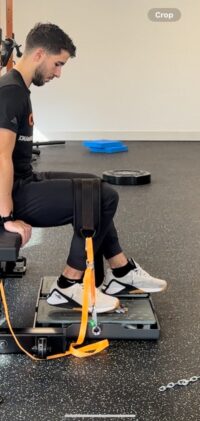
One of the muscles that we measure using this technology is the soleus muscle., a powerhouse in the lower leg that’s often overlooked during the sports physical therapy process. You might know it as one of the two calf muscles, and it’s a game-changer for athletes who sprint, run, or jump. Why? Because it’s the muscle that propels you forward, generating force through your foot and ankle.

When you’re active, your soleus muscle can handle up to six times your body weight! That’s a lot of stress, and it’s why injuries like muscle strains, ankle sprains, Achilles tendinopathy, or even post-ACL reconstruction issues often involve the soleus.

Studies show that athletes should generate 1.5 to 2 times their body weight per leg in an isometric test. It’s not just about recovery; it’s about understanding your body’s capabilities and pushing the limits safely.

Below is a picture of Dr. Sam Kinney using our force deck technology to measure the force generation capabilities of his soleus muscle. The sensors within the plate underneath his foot is measuring exactly how much force he is expressing through it.

By integrating these sophisticated testing methods, we can paint a complete picture of calf and soleus strength. This insight allows us to spot weaknesses, tailor rehab strategies, and reduce the risk of future injuries. Ultimately, it’s about enhancing athletic performance in a way that’s both smart and effective.

Whether you’re an elite athlete or someone passionate about staying fit, understanding, and strengthening your soleus muscle is essential to unlocking your full potential.

If you are interested in learning more about how our sports technology can reduce your injury risk or help you recover from a current injury, contact us today!

×