How to know your athlete’s sports performance program is any good

Lately, I’ve noticed a nice change.

High school athletes better understand the importance of sports training during their off-season(s), most notably during the summer.

What a relief! In the past, I spent countless hours teaching my physical therapy clients about the importance of participating in a well-designed sports training program after they’ve hit puberty. 

But now there is a new challenge. 

Choosing the right performance program!

Young athletes have many different options, including different programs, coaches, companies, etc. So, how do you know which option is best?

Start by understanding the design of the sports performance program and who is directing it. 

The Coach

When selecting a coach for your athlete, it’s crucial to prioritize experience, qualifications, and expertise. A coach should possess a deep understanding of athletes across various skill levels and abilities. This breadth of experience ensures that they can tailor their approach to meet the unique needs of each individual under their guidance. Moreover, qualifications play a pivotal role in ensuring the efficacy of the training program. Look for coaches who have obtained a college degree in a relevant field such as Kinesiology or exercise science. These degrees provide a solid foundation of knowledge in human movement, physiology, and sports performance.

Furthermore, certifications like the CSCS (Certified Strength and Conditioning Specialist) indicate that the coach has undergone rigorous training and testing in the principles of strength and conditioning. This certification ensures that they are well-equipped to design and implement effective training programs that prioritize safety and performance optimization. Additionally, access to a quality sports physical therapist can be invaluable in preventing injuries and addressing any underlying issues that may impact athletic performance. By prioritizing these qualifications and resources, you can ensure that your athlete receives the highest standard of coaching and support to achieve their goals.

The Program

When considering a training program for your athlete, it’s essential to evaluate its components to ensure comprehensive development and optimal results. Here are key elements that every program should encompass:

Goal Setting: Effective coaching begins with a clear understanding of the athlete’s objectives. Coaches must align training strategies with the athlete’s goals to measure success accurately. Without defined goals, progress evaluation becomes challenging.

Testing: A thorough assessment of the athlete’s current abilities is fundamental. Identifying strengths and weaknesses through objective metrics lays the groundwork for tailored training plans. Quantifiable data provides insights into progress and informs adjustments to optimize performance.

Research-Backed Programming: Cookie-cutter approaches won’t suffice. Each program should be meticulously crafted based on scientific principles and individual assessments. By integrating research-backed methodologies, coaches can design training regimens that address specific needs and sport-related demands effectively.

Facilities and Environment: The training environment significantly impacts motivation and performance. A well-equipped facility with adequate space fosters optimal training conditions. It should promote positivity and motivation, enhancing the athlete’s focus and commitment to improvement.

Re-testing: Continuous evaluation is essential for tracking progress and refining training strategies. Regular re-testing, ideally every 4-6 weeks, allows coaches to gauge advancements and identify areas for adjustment promptly. This iterative approach ensures that athletes stay on the right track towards their goals, with any necessary modifications implemented promptly to maximize results.

By ensuring that these components are integral to the training program, athletes can experience holistic development and tangible progress towards their athletic aspirations.

What options are available in the DMV?

You’re looking at it!

We’ve recently grown the Performance Division of Cohen Health and Performance, starting with Performance University. 

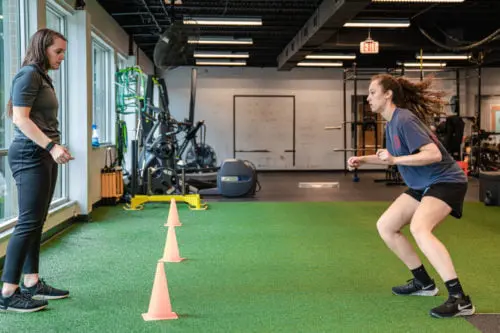
Performance U is a small-group performance training program designed for elite-level high school athletes. It is tailored to your athlete’s needs and designed using recent advances in sports technology. 

If your child dreams of playing collegiate sports or you’ve been searching for the best training option, we’ve got you!

We are accepting new clients for our summer Performance U group, beginning on May 20th! Learn more about Performance U by checking out the video below or clicking here!

Contact us if you are interested in hopping on a phone call with CHP’s Director of Sports Performance, Dr. Ethan Lennox, to learn more or partake in a free trial session!

Why I’ve Been Training Like a Bodybuilder

If there is one thing that natural bodybuilders (aka those that don’t take steroids) know, it is how to build muscle.

One of my friends is a personal trainer and natural bodybuilder, and can compete with those that aren’t “natural” by being super bright, with a deep understanding of the science of hypertrophy (fancy word for building muscle).

Muscle helps protect against injury, and as physical therapists, we need to understand how to help our patients build more when necessary.

What better way to learn than to test yourself? All physical therapists should try it on themselves first, right? My friend and I have been designing my training routine for the past year, and my back feels great.

As many of you know, my history of low back pain, beginning as a collegiate athlete, led me to become a physical therapist. In the past, strenuous weight training programs would irritate it. But I have been training harder than ever over the past year and feeling great.

People often experience back pain as they use their backs to support or lift weights. If I was using my back during an exercise, I wasn’t placing enough stress on my muscles to stimulate growth.

It is easy to cheat as exercises become more challenging. Maintaining quality technique when tired is a great way to remain resilient to injury. Check out this video for more on this.

Besides reducing injury risk and building strength, adding muscle is helpful for other reasons, including:

  1. Increased metabolism: More muscle equals a higher metabolic rate. This doesn’t just mean your body will burn more calories at rest. A higher metabolic rate provides more sustainable energy to the body throughout the day.
  2. Decreased fall risk: Increased muscle mass helps to reduce fall risk in the elderly population, and it is best to start this process early.
  3. Reduced risk of chronic disease: Increasing muscle mass has been shown to help reduce the risk of chronic diseases such as diabetes and heart disease. Muscle tissue helps to regulate blood sugar levels, blood pressure, and cholesterol.

Ready to join me and enter a bodybuilding competition?! Just kidding. That is not necessary, but there is a lot we can learn from unexpected places!

What’s the deal with my ankle popping?

When your knuckles pop, your ankle cracks, or your hip makes that strange noise, do you ever wonder, “Is that bad?” Should you see a sports physical therapist or doctor about it?

Well, there’s no need to worry—it’s probably not a big deal if you’re not experiencing any pain when it happens.

I have this quirky habit every morning as soon as I get out of bed. I keep my right heel on the floor and move my knee over my toes until I feel and hear a pop in the back of my heel. It freaks out my wife, Deb, every time.

The cracking or popping in a joint is similar to the sound of pressure being released from a soda bottle. Over time, pressure builds up within a joint, and for some people, it feels good to release it. That’s the noise you’re feeling and hearing.

However, if you experience pain when the pop occurs or if the area feels unstable, it’s important to reach out to us. We can help determine the root cause of these issues and whether any treatment is necessary.

We’ll assess if your pain is related to arthritis, overuse, or another movement-related issue that we can address through physical therapy, with exercises you can do at home.

Here are a few questions to ask yourself. If you answer “yes” to any of these, it might be time to seek help:

1) Is the popping I feel painful?
2) Has there been a recent injury to this area?
3) Does this area feel unstable?
4) Do I have weakness in this area?

You might not even need to visit the office—a phone call could be enough. Check out our homepage here and click on the “free phone consultation” tab!

Create Your BS Meter

I’m lying on the couch as I got sucked into Instagram and all of their sports physical therapy videos. While scrolling, one exercise video grabbed my attention. This wasn’t because it was good information. It was because it wasn’t and had thousands of likes.
 
There is so much information out there and anyone with a social media account can have a platform. You have access to the best and the worst information. It is overwhelming!
 
You need a BS detector so that you aren’t doing bicep curls while standing on a ball, blowing up a balloon (not far off what I saw the other day).
 
So how do you determine when you should ignore a social media post?
 
Speaking in absolutes. Most times, the best answer that a professional can give you is “it depends.” Rarely is there a correct answer for every situation. For example, stretching or mobility is often promoted as a “fix” for a given injury. Yet, many people have more important problems to solve. For more information, check out our post, Is Mobility Overrated? It is impossible to know of every possible factor that could be contributing to pain or injury. Even the best among us cannot be 100% certain, especially on social media.
 
It is too complicated. An expert can take a complex topic and break it down so that it makes sense to you. Complicated medical jargon is a red flag that the presenter does not understand what they are posting.
 
Promoting personal success stories as evidence. Personal success stories are subjective and ignore the facts and research. Many influencers post personal success stories as evidence for their approach. This ignores all the other factors that may have contributed to the results being promoted (genetics, differences in lifestyle, priority differences, etc.). Quality research requires thousands of trials before it is valid. A case study of 1 or 2 people only applies to those 1 or 2 people!
 
P.S. If someone is promoting a “quick fix”….run!

Runners: How To Vary Your Training to Optimize Your Results!

Implementing variety into training is something that is commonly underutilized and overlooked among recreational runners. This is often the topic of conversation after we perform our running analysis or within a sports physical therapy session.

Varying speed, intensity, and distance can be a useful tool in run training, whether you’re training for a big race or just getting back into it.

Running at different speeds or intensities allows you to vary which muscles and tissues you are repeatedly straining. When you sprint, your technique is going to look very different than when you are going for a long, slow jog.

Including both in your training helps you to disperse the stress of the workout over more tissues, and can help prevent overuse injuries! Some examples of what this variety might look like: 

  1. High Intensity Interval Training (HIIT) runs: “sprint” training! Work to rest intervals should be greater (1:4, 1:5). For example. sprinting for 10 seconds and walking/jogging for 50 seconds. Repeat for 10-15 minutes. Great for a track or grassy field! 
  2. Interval training: longer bouts of faster running, not as intense as a full sprint. Work to rest ratios are going to look more even (2:3, 1:1 or 2:1 ratios). For example, fast running for 1-2 minutes, jogging for 2-3 minutes, repeat for 10-15 minutes. 
  3. Tempo training: usually done as a “long run”. Pick a pace, and try to stick to it throughout the duration of your run. Distances should be specific to what your goals are!
  4. Using Rate of Perceived Exertion (RPE) Scale: If you don’t know what pace time is right for you, start with RPE! You can use a scale of 0-10, with 0 being completely at rest and 10 being a sprint as fast as you can possibly go. Fast bouts of HIIT training should be performed at an RPE of 8-10, whereas interval training should be closer to RPEs of 5-8. An example of an RPE scale can be found here 

In addition to preventing injuries, adding sprints and interval training can help increase muscle mass, cardiovascular endurance, and improve your ability to cover more distance in a shorter amount of time. If you’re finding that you’re constantly dealing with the same injury, consistent soreness in one muscle group, or you just want to shake up your training, a performance physical therapist can help find the right running program for you! 


The first drills that we teach to youth athletes

It is essential to understand the demands placed onto the body when working in a sports physical therapy, injury rehabilitation, and performance training setting.

Sports and weight training require athletes to control the body when moving rapidly.

If an athlete wishes to own the “stack” (stacking of our head, rib cage and pelvis over one another) and protect their lower back they must be capable of doing so when performing high velocity movements.

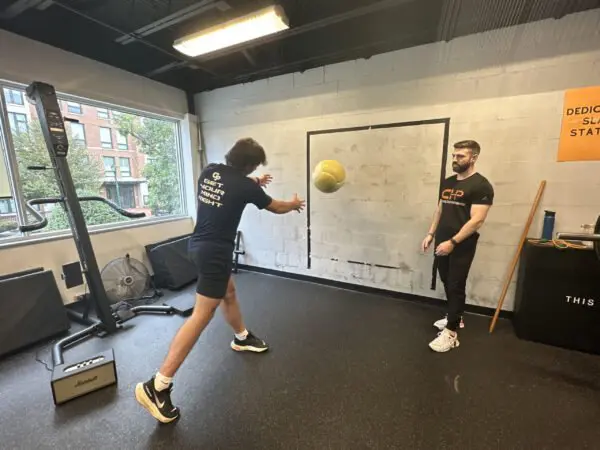
When youth athletes first train, we use medicine ball drills to teach this ability.

The medicine ball chest pass is a great drill to teach this capability. During this the drill, the athlete is generating enough velocity to propel the ball into the wall and back. As this occurs, it can be easy to lose the “stack” requiring the athlete demonstrate a higher of level of body control.

After mastering the chest pass, it is time to bring the arms overhead. More trunk strength and control are required with this movement and the ability to manage intra-abdominal pressure is further challenged. Check out this exercise here.

These are just a couple of the exercises that we incorporate into the training sessions and warmups for our youth athletes.

If you interested in learning more about the summer training options for youth athletes at CHP,  please contact us!

×