3 exercises athletes must master before college

During physical therapy school at Northeastern University, I volunteered as an assistant strength and conditioning coach with varsity athletics.

Summer was the most exciting time as first-year student-athletes came to campus to begin their team’s strength and conditioning program.

Our strength and conditioning and sports physical therapy staff quickly understood which athletes had experience in the weight room and which did not.

The athletes with limited weight room experience seemed lost. They didn’t know how to perform the required exercises and were notably weaker than their teammates.

Their coaches quickly learned about this, putting them at a disadvantage compared to their teammates working in the weight room before attending college.

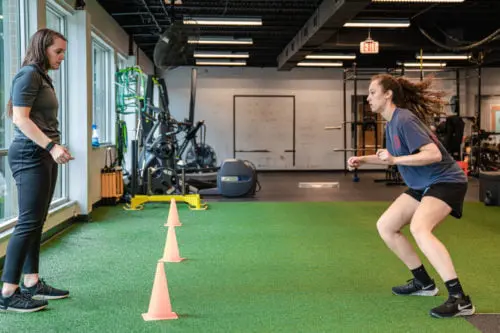
Here are three exercises to help your athlete gain an advantage over their teammates.

Deadlift

Core pushup

Lateral stepdown

Does your athlete dream of playing a sport in college? Are they looking to get ahead of their competition? 

If so, don’t miss this opportunity to join our rising-star summer performance program. In this program, your athlete will be coached through a customized program that will transform them into a stronger, faster, and more explosive athlete. Contact us to learn more!

Bob’s rehab journey from injury to college athletics

Bob was a talented high school lacrosse player with dreams of playing at a Division 1 college. However, despite his ideal size and athletic ability, he wasn’t attracting any interest from college coaches.

The issue wasn’t his talent or drive—it was his injury history. Bob had been plagued by various injuries over the past two seasons, and it was affecting his ability to stay on the field consistently. His history of injuries was the major reason coaches were hesitant to recruit him.

He had already visited multiple doctors and physical therapists but couldn’t seem to stay healthy long enough to make an impact. Frustrated and doubting his chances of ever getting recruited, Bob came to us seeking help.

When we first saw Bob, he was dealing with both ankle and knee injuries that had been bothering him for months. Our sports physical therapy process started with a thorough assessment of his lower body’s range of motion, strength, and movement patterns. We also evaluated his ability to perform the specific movements required in lacrosse.

It quickly became clear that he had significant movement limitations in his ankles and hips, which were causing him to compensate during running and training. These compensations had become ingrained in his movement habits, further reinforcing his limitations and contributing to his recurring injuries.

We worked with Bob to restore proper motion in his ankles and hips, and taught him specific drills to retrain his body to move naturally without compensating.

Once his mobility improved, we shifted our focus to rebuilding his strength, speed, and explosiveness. Our role began to transition from physical therapists to performance trainers. We developed a tailored gym program to help Bob regain his athletic edge and enhance his overall performance.

Three months later, Bob was ready to return to the field for his high school lacrosse season. Although he was nervous about getting back to playing, he was eager to show his coaches the progress he had made.

After his first practice, Bob called me, excited. His coach had pulled him aside to ask what he had been doing during the off-season. Bob had completely outperformed his teammates, returning stronger, faster, and more explosive than ever before.

Fast forward a year, and Bob earned a Division 1 lacrosse scholarship, fulfilling his dream.

If your athlete shares similar aspirations of playing at the collegiate level, reach out to us and join our Performance U Training Program! Let us help your athlete stay healthy, improve performance, and reach their full potential.

CHP Spotlight Interview with Dr. Jamie Grossman

What can you do to prevent common upper and lower body injuries? When is it time for you to see an orthopedic surgeon? Are there surgical procedures that can preserve the lifespan of a joint? 

I sat down with Dr. Jamie Grossman to tackle these questions and more in the latest CHP Spotlight Interview series edition. Dr. Grossman is an orthopedic surgeon with OrthoVirginia specializing in the field of joint preservation. Her areas of interest include sports medicine, joint reconstruction, and hip preservation.

The mission of the CHP Spotlight Interview Series is to share information with you from local experts in the fields of sports medicine, physical therapy, personal training, and sports performance. Now, more than ever, a seemingly infinite amount of information is available, and finding credible information is challenging. But we have good news. We are here to help you find the best information about physical therapy, personal training, and sports medicine from experts in Bethesda, Chevy Chase, DC, McLean, and Northern Virginia.

If you or someone you love has had a shoulder, hip, or knee injury, don’t miss this interview! 

To learn more about Dr. Grossman, click here and check out our interview below!

This is why your back pain isn’t going anywhere

Let me tell you about a past physical therapy patient who saw me in our Bethesda and McLean facilities. We’ll call him John. John is a hard-working guy that had been struggling with back pain for years. It started with pain while weight training and eventually prevented him from standing for more than 20 minutes at one time. His inability to stand was a major problem because his job required him to be on his feet constantly. 


He had been to doctors, physical therapists, and chiropractors. He tried foam rolling, changing his desk setup, and even those strange massage gun-looking things. 


That is when he came to see me for a more “sports approach” to physical therapy.


I began our session by asking him questions about his back; I could sense that he had heard them before. But my following questions grabbed his attention.


He had not received these questions before, and I asked about his sleep habits, use of technology, and stress. These questions created our “aha moment” as we realized the following areas needed to improve if he wanted to conquer his back pain in physical therapy.  


A Poor Night’s Sleep

Sleep is the best recovery tool that we have. Research has shown that sleep quality improves outcomes in chronic pain patients, especially with back pain.


We first made sure that John had a high-quality mattress. A poor-quality bed can leave your back feeling worse due to a lack of support. Most people with back pain tolerate a firmer mattress best. Be sure to test multiple mattresses and determine the best and most comfortable ones. 


John’s final sleeping recommendation was simple—no more sleeping on his stomach. Sleeping on your stomach increases the compression on your lower back. Sleeping on your side or back can be extremely challenging when you are not used to it. But it will become much easier over time.


Addiction to Technology

John was spending way too much time looking at screens.

According to recent research, the average person spends about nine hours per day using electronic devices, which increases tension in several areas, like the lower back.


We started by setting realistic limits on John’s use of technology. We gave him a technology curfew of 9 pm (he couldn’t use his phone after 9 pm). Phones, iPads, and TVs contain blue light, suppressing melatonin production, a hormone essential for quality sleep. 


Reduce Stress

The body is resilient, but it can only handle so much physical and emotional stress. Research indicates that people struggling with anxiety and depression are more likely to experience a few orthopedic pains, including lower back pain.


After discussing this with John, he mentioned that he had enjoyed meditation but didn’t have enough time to keep it up. Because he enjoyed meditating, I suggested he try one of the many great apps with short, 5-minute meditations. 


Suppose meditation doesn’t work for you. No big deal! Search for one thing you enjoy, which reduces your stress, and implement that into your daily routine. Walking outside does that for me. Rain or shine, I ensure I get at least a couple of walks in a day.


As John worked to address these issues, we created a comprehensive physical therapy plan to help his back. Combining all these factors allowed him to recover and return to work and his active lifestyle fully. 


Back pain is a complex issue, influenced by many factors. But that is a good thing because that provides many ways that experts can help. If you have back pain that won’t go away, don’t hesitate to contact us so that we can help you find solutions. 
What is blood flow restriction training? Should I try it?

Think of the last time that you injured your arm or leg or needed physical therapy. If you haven’t had an extremity injury, or needed sports physical therapy, congratulations, and I guess you must use your imagination.

You saw your doctor for help, and they told you to rest your injured limb for at least 4 weeks. You have no choice but to relax and allow your injured limb to get small and weak.

This is where blood flow restriction (BFR) training is a helpful part of the physical therapy process. A cuff or strap is placed tightly around a limb to reduce blood flow but not entirely block it. Exercise is then performed in this state.

This allows you to exercise at a lower intensity but enjoy many benefits of high-intensity training, such as muscle growth and improved strength.

While BFR can’t replace regular training, it is an excellent option for people that want to speed up their return from injury or are searching for ways to exercise without beating up their joints.

But restricting blood flow sounds sketchy. Is it safe?

Yes. Research has shown that BFR is safe when used with patients with no contraindications to it. As with all things, it can be unsafe when misused or placed in the wrong hands.

At Cohen Health and Performance, we use BFR both in McLean and Bethesda to limit weakness and muscle atrophy after surgery. Our patients recovering from knee surgery, such as an ACL reconstruction, have seen great results. When more strength is preserved, people have a faster recovery.

But the benefits extend far beyond people recovering from surgery. People struggling with chronic and overuse injuries can use BFR to maintain their strength without interrupting recovery. This helps people to return to the entirety of their active lifestyles much quicker.

Interested in using BFR to speed up your recovery from an injury or help you with your training? Contact us!

Cryotherapy: Is It Really Worth the Hype?

A few months ago, I attended a conference with a group of physical therapists and personal trainers. Over a meal, we found ourselves discussing the day’s events. One of the highlights of the conference was a series of product pitches from various companies targeting healthcare providers like us. Among them was a cryotherapy company, and their representative happened to recognize our group.

He approached our table and confidently delivered his pitch:

“Cryotherapy can help your patients reduce pain, accelerate muscle recovery, decrease inflammation, and improve overall wellness.”

Sound familiar? If you’ve ever heard a similar claim and wondered if cryotherapy really lives up to the buzz, you’re not alone. At our physical therapy clinics in Bethesda and McLean, we receive many inquiries about the effectiveness of cryotherapy.

Let’s break it down.

What Exactly is Cryotherapy?

Cryotherapy involves exposing the body to extremely low temperatures for a brief period, usually just a few minutes. While there are several forms of cryotherapy, the most well-known is whole-body cryotherapy. This process involves standing in a chamber filled with liquid nitrogen vapor, where temperatures can drop as low as -200°F to -300°F (yes, you read that right).

The Ongoing Debate

The benefits of cryotherapy remain a topic of debate within the medical, physical therapy, and fitness communities. While some studies have shown promising results, others have found little to no benefit.

Proponents of cryotherapy suggest that it can help manage various conditions, including chronic pain, arthritis, inflammation, and even depression. The theory is that exposure to extreme cold triggers the release of endorphins—your body’s natural painkillers—while also reducing inflammation in targeted areas. In some cases, studies have indicated that cryotherapy may help alleviate pain and inflammation in people with conditions like rheumatoid arthritis. However, much more research is needed to validate these claims.

There are also suggestions that cryotherapy aids in **muscle recovery** after exercise. The idea is that cold temperatures cause blood vessels to constrict, reducing blood flow to the affected muscles. As the body warms up post-session, blood flow returns and promotes healing. While some studies support this, others have shown little to no significant effect.

So, What’s the Verdict?

Cryotherapy is still relatively new, and as with many emerging treatments, the evidence is limited and mixed. Early research shows potential, but more comprehensive studies are necessary to reach firm conclusions.

It’s also important to remember the risks. Exposing the body to such extreme cold comes with hazards, including potential skin damage and frostbite.

If you’re thinking about giving cryotherapy a try, it’s crucial to consult your physician first to ensure it’s a safe option for you.

×